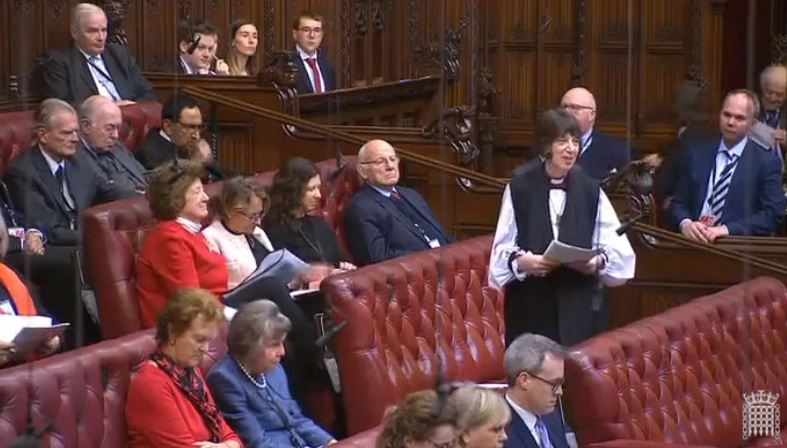
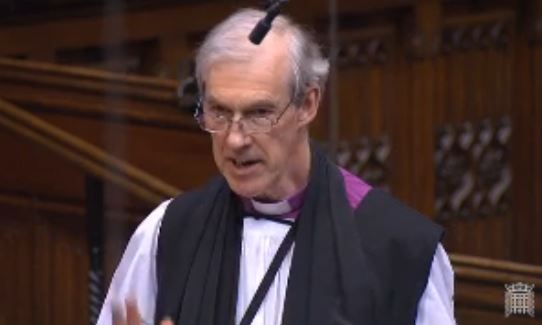
Nationality and Borders Bill: Bishop of Gloucester supports amendment on women’s safety and human trafficking

On 8th February 2022, the House of Lords debated the Nationality and Borders Bill in the fourth day of the Committee stage. The Bishop of Gloucester spoke in favour of amendment 105, tabled by Baroness Lister, which would remove restrictive wording in clause 32 of the bill, especially with regards to victims of trafficking:

“The amendment would remove the narrow restrictive and requirement in Clause 32 that, in order to qualify under the “particular social group” grounds of persecution for recognition as a refugee under the convention, two conditions must be met. The amendment would replace this with an either/or condition.” Hansard
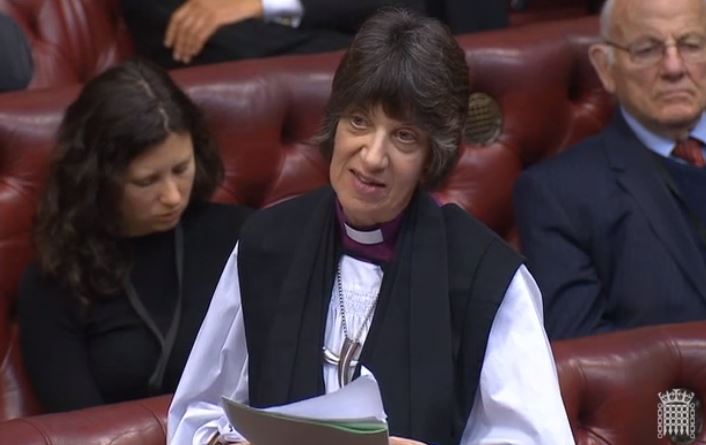
The Lord Bishop of Gloucester: My Lords, I have added my name to Amendment 105 and the intention to oppose Clause 31 standing part of the Bill. I too am grateful to Women for Refugee Women and others for their briefings and support.

In the New Plan for Immigration and the briefings for the Bill, the Government have argued repeatedly that the existing asylum and refugee system is weighted against vulnerable women. The Home Secretary has repeatedly made the point that the large majority of channel crossings are by men aged under 40, for example. Given this, there might be some expectation that the Bill would contain some good news or ambitions on the part of the Government for better reaching and helping the women and girls who make up 50% of the world’s refugees and displaced people. Unfortunately, I do not see any such commitments. As a sting in the tail, in Clauses 31 and 32 we find proposals that seem to significantly disadvantage women further.

Continue reading “Nationality and Borders Bill: Bishop of Gloucester supports amendment on women’s safety and human trafficking”
Votes: Dissolution and Calling of Parliaments Bill

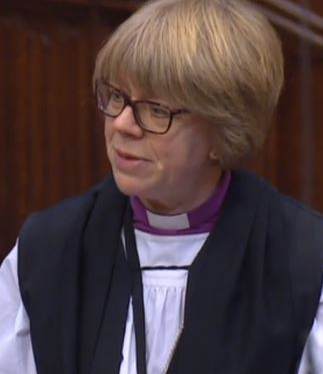
On 9th February 2022, the House of Lords debated the Dissolution and Calling of Parliaments Bill. Votes were held on amendments to the Bill, in which a bishop took part.

Continue reading “Votes: Dissolution and Calling of Parliaments Bill”

Nationality and Borders Bill: Bishop of London tables amendment in support of domestic abuse survivors

During a debate on amendments to the Nationality and Borders Bill on 8th February 2022, The Bishop of London tabled amendment 140, which would provide for safer usage of personal data to protect migrant survivors of domestic abuse:

The Lord Bishop of London: My Lords, Amendment 140 in my name and those of the noble Baroness, Lady Meacher, and the noble Lords, Lord Rosser and Lord Paddick, asks the Committee to consider again the debates that we had during the passage of the Domestic Abuse Bill. Indeed, this amendment was passed in your Lordships’ House last year, only to be rejected by the Commons.

In short, the issue is that immigration enforcement and the sharing of data too often serve as a significant barrier, preventing survivors of domestic abuse coming forward and receiving the help they need. Research from the Latin American Women’s Rights Service, to which I am grateful for its support and briefings, has repeatedly shown that in cases of domestic abuse and other forms of violence against women and girls, victims with insecure immigration status are unlikely to approach the police because they believe that the police will prioritise their lack of legal status instead of protecting them as victims of a serious crime. As many as 50% of domestic abuse victims never report the crimes committed against them.

Continue reading “Nationality and Borders Bill: Bishop of London tables amendment in support of domestic abuse survivors”

Nationality and Borders Bill: Bishop of Durham supports amendments around family reunion

During a debate on amendments to the Nationality and Borders Bill in its fourth day of the Committee stage, on 8th February 2022, the Bishop of Durham spoke in support of amendments targeted towards ensuring family reunion for migrants, particularly refugees and unaccompanied minors:

The Lord Bishop of Durham: My Lords, I specifically support Amendment 117, to which I have added my name, but I support all these amendments around family reunion. I declare my interests in the register around RAMP and Reset as before.

Acknowledging that when people are forcibly displaced they end up in different places, often having lost family members, UNHCR research has shown that families often set out together but become separated along the way. Reconnecting those families, or, where some family members are lost, reconnecting people with other relatives, really matters. In seeking protection, those seeking asylum want to do so alongside the family that they have. This is better for individuals—their well-being and their future prospects—and for the community as a whole. It is therefore also better for social integration.

Continue reading “Nationality and Borders Bill: Bishop of Durham supports amendments around family reunion”

Nationality and Borders Bill: Bishop of Durham speaks in support of amendments on offshoring of asylum seekers

On 8th February 2022, the House of Lords debated the Nationality and Borders Bill in its fourth day of the Committee stage. The Bishop of Durham spoke in support of amendments 100 and 101, tabled by Lord Kirkhope of Harrogate, that would remove the powers in the bill to “offshore” asylum seekers before the consideration of their claims:

The Lord Bishop of Durham: My Lords, in rising to support Amendments 100 and 101, to which I have added my name, I declare my interests in relation to both the RAMP project and Reset, as set out in the register.

When people arrive on our shores seeking protection, we have a responsibility to treat them as we would wish to be treated if we had to flee for our lives. It is right that we have a process to determine who meets the criteria for refugee status, but while we determine this, we are responsible for people’s safety, welfare and care. If we move them to other countries for the processing of their asylum claims, I fear a blind eye will be turned to their treatment. How will we be sure that they are being treated humanely and fairly, and would our Government even give this much concern once they had left our shores? If we look to the experience of Australia and the refugees accommodated in Nauru, as the noble Lord, Lord Kirkhope, has just mentioned, we hear deeply shocking accounts of abuse, inhumane treatment and mental and physical ill-health.

As mentioned in relation to an earlier amendment, I visited Napier barracks last week to see improvements that have been made since the exposure of the disgraceful conditions at the beginning of last year. If what we have seen at Napier is permitted to happen in the UK, what can we expect overseas, where accountability and monitoring will be so much harder? The monitoring of asylum accommodation contractors in the UK is poor, which gives us some idea about the level of monitoring we could expect of offshore processing.

Continue reading “Nationality and Borders Bill: Bishop of Durham speaks in support of amendments on offshoring of asylum seekers”

Nationality and Borders Bill: Bishop of Durham speaks in support of amendments on children’s citizenship

During a debate on the Nationality and Borders Bill on 27th January 2022, the Bishop of Durham voiced his support for amendments to ensure that British Citizenship should not be withheld from a stateless child born in the UK:

The Lord Bishop of Durham: My Lords, I am trying to imagine how it could ever be in the best interests of a child born and raised in this country not to be given the right to be a citizen of this country. In what possible circumstances could we decide that it would be in the best interests of someone born and raised in this country to be decreed, at the age of 13 or 14, a citizen of another state? That is the situation. You could almost forget the 1961 convention, human rights and so on; we are simply talking about the best interests of the child. You can then back it up with all the international stuff on top. I support these amendments.

Continue reading “Nationality and Borders Bill: Bishop of Durham speaks in support of amendments on children’s citizenship”

Nationality and Borders Bill: Bishop of Chelmsford questions increase of powers to remove citizenship

On 27th January 2022, the House of Lords debated the Nationality and Borders Bill in committee. The Bishop of Chelmsford spoke in the debate, raising the issue of increased powers to remove citizenship within the bill, and whether these increases were necessary:

The Lord Bishop of Chelmsford: My Lords, I am grateful to those noble Lords who have already spoken. It is heartening to hear voices from across the Committee raising concerns about the proposed powers in Clause 9. My contribution will be very short.

I can well imagine variants on our current conversation happening time and again, ever since the British Nationality Act 1981, which has already been referred to by the noble Lord, Lord Moylan, brought in deprivation of citizenship. Indeed, a look through Hansard would confirm that.

Since 1981, these deprivation powers have been amended and extended, including in 2003, 2006, 2014 and 2018. Each time, the rationale provided by the Government is the same: that these are relatively minor tweaks made for pragmatic reasons, with the security of the nation in mind, and that these powers will be used only in extreme circumstances, with great caution and restraint on the part of the Government. Yet it seems that these powers are never quite enough.

Continue reading “Nationality and Borders Bill: Bishop of Chelmsford questions increase of powers to remove citizenship”

Nationality and Borders Bill: Bishop of Durham & Bishop of Gloucester support amendment to costs for children’s citizenship applications

On 27th January 2022, the House of Lords debated the Nationality and Borders Bill in the first day of the committee stage. The Bishop of Gloucester, on behalf of the Bishop of Durham, spoke in support of an amendment to regulations around children’s citizenship, and administrative costs associated with citizenship applications:

The Lord Bishop of Gloucester: My Lords, I will speak on Amendment 13 on behalf of my noble friend the right reverend Prelate the Bishop of Durham, who sadly cannot be in the House until later today. He wishes to declare his interests in relation to both RAMP and Reset, as set out in the register. The following words are his, but I will say that I wholeheartedly agree with every one of them.

My interest comes from my ongoing engagement in this House with issues concerning children and ensuring that their best interests are central to legislation. The Government should be doing everything they can to ensure that all children in the UK have the opportunity to thrive. We should be working to remove barriers that they may face in seeking to reach their full potential. The current British citizenship registration fees create a barrier for many children to being and feeling fully part of society.

Continue reading “Nationality and Borders Bill: Bishop of Durham & Bishop of Gloucester support amendment to costs for children’s citizenship applications”

Health and Care Bill: Bishop of Carlisle raises concerns on assisted dying

On 26th January 2022, the House of Lords debated the Health and Care Bill in committee. The Bishop of Carlisle spoke on issues of assisted dying contained in amendments to the bill:

The Lord Bishop of Carlisle: My Lords, I recognise and respect the integrity and passion that underlie Amendment 297. However, I rise to agree wholeheartedly and briefly with those noble Lords and noble and learned Lords who have already expressed their significant reservations about it.

There are two problems in particular with that amendment. The first has to do with the many contentious arguments for and against any legislation permitting assisted dying, some of which have already been mentioned. Tempting though it is to rehearse some more of those, I am conscious not only of the time but of the fact that they have already been presented recently and at length, as we have been reminded by the noble and learned Lord, Lord Mackay, at Second Reading of the Assisted Dying Bill here in your Lordships’ House. The ongoing process of that Bill, however slow it may be, should not be undermined. We have also been assured that this is not primarily what Amendment 297 is all about. I might add that the terminology of that amendment is unhelpfully vague. “Vague” is a word that has already been used more than once in the debate today. For instance, we might ask exactly what is meant by “terminally ill” or “medical assistance”.

Continue reading “Health and Care Bill: Bishop of Carlisle raises concerns on assisted dying”

Health and Care Bill: Bishop of Carlisle supports amendments requiring specialist palliative care services

On 18th January 2022, the House of Lords debated amendments to the Health and Care Bill. The Bishop of Carlisle spoke in the debate, supporting amendments tabled by Baroness Finlay of Llandaff that would require specialist palliative care units to be set up in the UK:

The Lord Bishop of Carlisle: My Lords, it is always a pleasure to follow the noble Lord, Lord Patel. I am pleased to give my wholehearted support to Amendment 47 and to Amendment 52, to which I have added my name, which compellingly requires the commissioning of specialist palliative care services in every part of England. Throughout my life and work I have often had the privilege of being present with families and communities, supporting people of all ages through the final chapter of their life, so I have seen at first hand the enormous difference that high-quality palliative care can make to their experience of dying, death and bereavement.

However, as the noble Baronesses, Lady Brinton and Lady Masham, pointed out, 90% of people might need such care, but as things stand at present only about half of them will receive it. What is more, it is all too often those in our most deprived communities who are dying without the help and dignity they deserve.

To that end, a compelling body of evidence has been provided by Marie Curie, the end-of-life charity, which has been mentioned several times already in this debate. Building on that evidence, this amendment will not only prevent many people with a terminal illness dying in pain but deliver significant cost savings to the NHS by reducing unnecessary hospital admissions.

Continue reading “Health and Care Bill: Bishop of Carlisle supports amendments requiring specialist palliative care services”