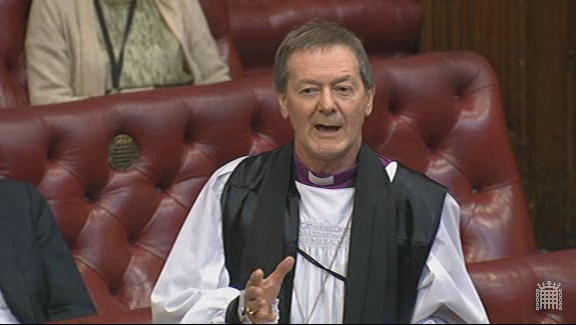
Bishop of Chester welcomes Government amendment to Energy Bill

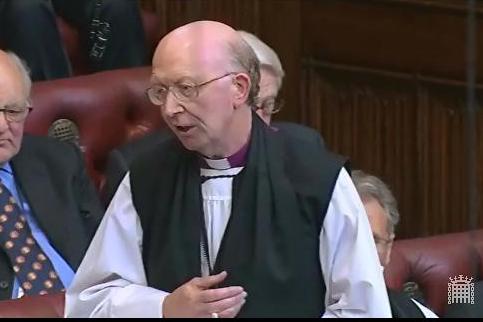
On 19th November 2013, the Bishop of Chester, the Rt Revd Peter Forster, took part in the Report Stage of the Government’s Energy Bill. He spoke in support of a Government amendment regarding the power to modify energy supply licences in domestic supply contracts. The amendment was agreed to.
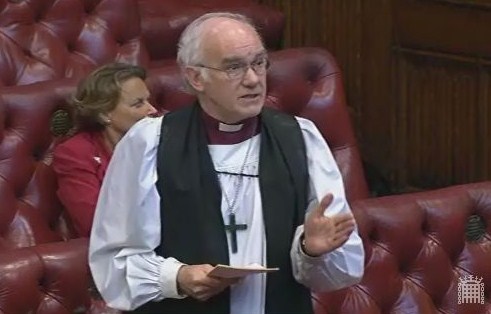
14.03 Bishop of ChesterThe Lord Bishop of Chester: My Lords, I welcome this amendment, which began its life, I think, in an interchange between the noble Baroness and me in Grand Committee. She has pretty much supplied everything that I asked for then, and I am very pleased. The only point that I will make now is that the Government rightly want to make it easy for consumers to switch suppliers. That is a good thing and it is very helpful that this information will be made available one way or another on bills. However, it needs to be made available consistently, in the same form, by different suppliers, so that if you are comparing a bill from one supplier with a bill from another, the information is supplied in the same form on each bill. The noble Baroness did not quite make that point in what she said. I hope that she can assure us that these costs will be disclosed—either voluntarily or by the exercise of the power that she is taking—not only transparently but consistently and comparably by different suppliers. Continue reading “Bishop of Chester welcomes Government amendment to Energy Bill”
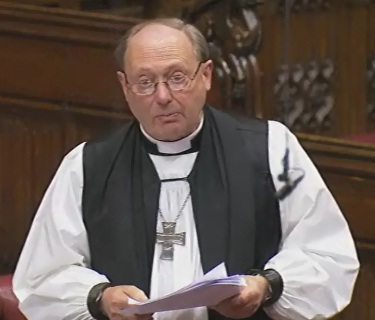
Bishop of Oxford supports amendments to Children and Families Bill

On 11th November 2013, the Bishop of Oxford, the Rt Revd John Pritchard, took part in the Committee Stage of the Government’s Children and Families Bill. He spoke in favour of two amendments – one of the duty of schools to promote the academic, spiritual, cultural, mental and physical development of children and the second on the welfare of children who are asylum seekers. Neither amendment was put to a division of the House.  

Bishop of OxfordThe Lord Bishop of Oxford: My Lords, I also would like to speak briefly in support of Amendment 233, which was so ably and vividly introduced by the noble Baroness, Lady Jones. I have a particular responsibility in the Church of England for education, so I am pleased to be able to bring that authority and support, as it were, on behalf of all the schools that I represent. This is a small but important and crucial piece of work. Continue reading “Bishop of Oxford supports amendments to Children and Families Bill”

Bishop of Derby supports raising age of criminal responsibility

“No one is an individual—that is a modern myth. Each human being is a person who is who they are because of their relationships with others. Crime is when relationships go wrong or are handled destructively. Human beings are formed through relationships” – Bishop of Derby, 8.11.13

On 8th November 2013, the Bishop of Derby, the Rt Revd Alastair Redfern, took part in the debate on the Second Reading of Lord Dholakia’s Age of Criminal Responsibility Bill, which sought to raise the age of criminal responsibility from 10 to 12. The Bishop focused his remarks on the challenges associated with treating children as entirely individual and independent units, and the associated need of providing safe and positive spaces in which children can develop socially – particularly focusing on the need for strong family units. The Bill did not progress any further than its Second Reading. 

DerbyThe Lord Bishop of Derby: My Lords, I, too, thank the noble Lord, Lord Dholakia, for introducing this topic and I heartily endorse all that the noble Earl has said. This is a very complex issue, and we are having this debate in a national context in which public opinion wants justice to be seen to be done. A strong scapegoating mentality exists which indicates that there is also a high level of anxiety in society. The key people to be scapegoated tend to be criminals and immigrants. We have to take that part of the context seriously in having this debate. A second context, as we have heard, is the UN recommendation on the rights of the child, that the age of criminal responsibility should be at least 12. Many countries, as we have heard, go even higher than that. A third context is that there are suggestions, as there is in Ireland, of raising the age to 12, but of allowing some flexibility in dealing with serious crimes. So this is a very complex issue in an anxious society which is nervous about seeming to give positive signals to bad behaviour and social deviancy. Continue reading “Bishop of Derby supports raising age of criminal responsibility”

Vote – Energy Bill

On 4th November 2013, the Bishop of Lichfield, the Rt Revd Jonathan Gledhill, took part in a division during the Report Stage of the Government’s Energy Bill.

House of Lords Division Lobby

Labour Peer Baroness Worthington moved amendment 74, regarding the reduction of carbon emissions.

The Bishop of Lichfield voted ‘not content’. No bishop voted ‘content’.

There were: Contents: 237 | Not Contents: 193 | Result: Government Defeat

(via Parliament.uk)

Bishop of Lichfield urges caution in redefining ‘anti-social behaviour’

“We [must] steer a course between tolerating bad behaviour on the one hand, and on the other hand taking an overly punitive and controlling approach to those whose behaviour can just be annoying. I am not here thinking of street preachers or those who sing hymns very loudly—though a balance has to be struck even in those instances—but chiefly of young people and the more vulnerable among adults.”

On 29th October 2013, the Bishop of Lichfield, the Rt Revd Jonathan Gledhill, spoke in the Second Reading debate of the Government’s Anti-social Behaviour, Crime and Policing Bill. He welcomed measures in the Bill on strengthening firearm regulations, tackling forced marriage and reforms to the College of Policing’s code of ethics. He raised concerns about the newly proposed definition for ‘anti-social behaviour’, suggesting that young people and vulnerable adults could be at risk from a broad definition.


14.03.27 Bishop of LichfieldThe Lord Bishop of Lichfield: My Lords, there is much to welcome in this Bill. The strengthening of the laws on firearms and on forced marriage, for example, are obvious steps forward. The measures for prevention of sexual harm, while raising important issues about the need for caution in restricting the freedoms of unconvicted people, will make possible swifter and more effective action to protect potential victims. The College of Policing has made an encouraging start. I am pleased to welcome the draft code of ethics. It sets a strong, ethical and I would say spiritual basis for law and its enforcement, which is a key concern for us all.

The emphasis on communities—people working together for the common good—has run through the long gestation period of these proposals. The principles of restorative justice and restorative practice, especially in local communities, are built into the efforts of churches in every part of this country to serve their local communities and especially those who are most vulnerable. In my part of the world, 80% of young people typically reoffend in the first two years after their sentence. However, with those who are taken on board by church monitoring and mentoring groups, even with the more difficult cases, the rate of reoffending is less than 20%. Continue reading “Bishop of Lichfield urges caution in redefining ‘anti-social behaviour’”

Care Bill – Vote

On 29th October 2013, three bishops took part in a division during the Third Reading of the Government’s Care Bill. 

House of Lords Division Lobby

Lord Hamilton of Epsom moved amendment 1, in clause 1, page 1, line 10, after “emotional” to insert “and spiritual”.

The Bishops of Lichfield, Norwich and Ripon & Leeds voted ‘content’. No bishop voted ‘not content’.

There were: Contents: 96 | Not Contents: 271 | Result: Government Win

(via Parliament.uk)

Bishop of London presses for reduction in demand for electricity during consideration of Energy Bill

On 28th October 2013, the Bishop of London, the Rt Revd and Rt Hon Richard Chartres, took part in the Report Stage debate of the Government’s Energy Bill. He tabled an amendment to the Bill, which sought to require the Secretary of State to publish a strategy setting out cost-effective policies to achieve a reduction
in demand for electricity, including specific targets for reductions to be made by 2020 and 2030. 
Following the debate on the Amendment, the Bishop did not move it to a vote.  

LondonThe Lord Bishop of London: My Lords, biblical studies teach me that when you have two amendments that look as much alike as my amendment and that of the noble Lord, Lord Grantchester, you must look for an Ur-text. Indeed, there is an Ur-text, as we all know, and the figures in my amendment are simply the latest figures available from the Government. This is intended to be a constructive and supportive amendment, which also reflects the concern mentioned by the noble Lord, Lord Roper, about the sole emphasis on the capacity market not really catching the full subject here.

According to the Secretary of State in his own foreword to the response to the consultation, which was published in May of this year, a 9% reduction in overall demand could save electricity equivalent to the output of four power stations in one year. I do not want to pose as an expert, of which there are many in this House, but I have been trying in my own diocese of London to improve energy efficiency. I have taken a keen personal interest in the various efforts and our churches have actually achieved a 22% saving in energy consumption between 2005 and 2011. Continue reading “Bishop of London presses for reduction in demand for electricity during consideration of Energy Bill”

Vote – Energy Bill

On 28th October 2013, two bishops took part in a division on the Government’s Energy Bill, during its Report Stage.

House of Lords Division Lobby

Crossbench Peer Lord Oxburgh moved amendment 1, which would require the government to set out its decarbonisation strategy in 2014, establishing milestones up to 2030.

The Bishops of Lichfield and London voted ‘content’. No bishop voted ‘not content’.

There were: Contents: 202 | Not Contents: 216 | Result: Government Win

(via Parliament.uk)

Bishop of Guildford supports reform of hereditary titles and honours

On 25th October 2013, the Bishop of Guildford, the Rt Revd Christopher Hill, spoke in support of of Lord Lucas’ Equality (Titles) Bill, during its debate at Second Reading. He also highlighted the Church of England’s progress towards enabling women to become Bishops. The Bill received one day of Committee consideration, but did not receive Royal Assent.

guildfordThe Lord Bishop of Guildford: My Lords, I am grateful for the courtesy of the House in allowing me to slip into the gap, as it were. I shall, I hope, be courteous in return by being very brief in so doing.

Members on this Bench have no direct interest in the content of the Bill, for obvious reasons. Nevertheless, I express support in principle and, indeed, in practice for the Bill before your Lordships’ House and hope to hear that the government Front Bench is also sympathetic. I will not rehearse what has already been said in the House in support of the Bill, which I fully agree with, but am sorely tempted to slip in an amendment to the effect that women bishops could be ordained in the Church of England.

Noble Lords: Hear, hear!

The Lord Bishop of Guildford: That would allow the noble Baroness, Lady Deech, to add bishops to her list.

(via Parliament.uk)

Bishop of Birmingham supports amendment to Banking Reform Bill

“In the wake of the economic debacles following 2008, one of the greatest areas of concern among the public was the apparent lack of change in the financial fortunes of those whom they viewed as being most responsible for the banking crisis.”

On 23rd October 2013, the Bishop of Birmingham, the Rt Revd David Urquhart, spoke during the Committee Stage of the Financial Services (Banking Reform) Bill. He spoke in support of an amendment tabled by Lord Turnbull, to require that banks and other financial institutions abide by a ‘remuneration code’, implemented and enforced by the financial regulator. The amendment, based on a recommendation by the Parliamentary Commission on Banking Standards, was not pressed to a vote during Committee Stage.

01.04.14 Bishop of BirminghamThe Lord Bishop of Birmingham: My Lords, I rise to speak on behalf of the most reverend Primate the Archbishop of Canterbury. He regrets very much that he cannot be in his seat today, but it is seldom that one has the opportunity to offer Christian baptism to a young couple, particularly when their child is a future heir to the throne of this country. None the less, I know that he, like me, would want to echo the support for these amendments, which have been spoken to by the noble Lords, Lord Turnbull and Lord Eatwell. In a sense, I now regret that I am here doing my duty, because I could not have put it better myself.

In the wake of the economic debacles following 2008, one of the greatest areas of concern among the public was the apparent lack of change in the financial fortunes of those whom they viewed as being most responsible for the banking crisis. As we have heard, the salaries of senior bankers seem to remain high and bonus levels have quickly regained their old levels, while for many ordinary people and ordinary businesses across the country, it has been a matter of tightening the belt and looking very seriously at difficult household and commercial budget decisions. The submission of the Church of England’s Mission and Public Affairs Council to the banking commission said of this disparity between what I am going to talk about as two cultures that it,

“has gravely harmed the public perception of banking”. Continue reading “Bishop of Birmingham supports amendment to Banking Reform Bill”