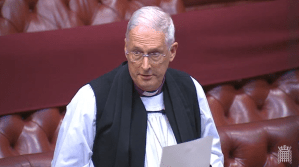
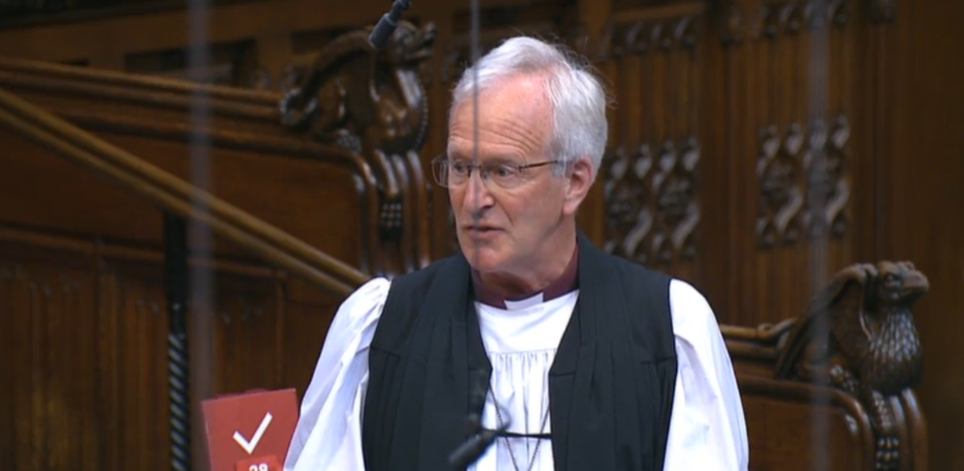
On 25th March 2020 the House of Lords passed the Government’s emergency Coronavirus Bill. It then rose for the Easter recess. The Lord Bishop of Rochester, Rt Revd James Langstaff, praised the spirit of collaboration in which all sides had worked to get the Bill through.
Category: Bills
Legislation before Parliament
Coronavirus Bill: Bishop of Rochester responds on church closures and care for vulnerable
On 24th March 2020 the House of Lords debated the emergency legislation from the Government to deal with the Coronavirus pandemic. The Bishop of Rochester, Rt Revd James Langstaff, spoke in the debate, highlighting issues to do with church closures, funerals, and care of the vulnerable, including the homeless, and those in prison or immigration detention:
The Lord Bishop of Rochester: My Lords, in these days I have been reflecting on the words of the Hebrew psalmist who, at the time of his people’s exile, articulated the question:
“How can we sing the Lord’s song in a strange land?”
In many ways we are entering into a strange land, and indeed in some ways a land of exile: a land in which we are exiled from many of our normal patterns of living, in which people of faith are not able to attend their places of worship and in which many people find themselves having to live life in entirely new ways.
Coronavirus Bill: Andrew Selous supports new clause on postponing General Synod elections
On 23rd March 2020 the House of Commons considered the emergency legislation from Government to respond to the coronavirus pandemic. Part of the Bill provided powers to delay scheduled elections for devolved and regional assemblies and other bodies. A new clause to extend that provision to the General Synod of the Church of England had been tabled by the Second Church Estates Commissioner, Andrew Selous MP, and was accepted by Government. Andrew spoke about it during the Committee stage of the Bill in the Commons:
Andrew Selous (South West Bedfordshire) (Con): I will not detain the House long. I rise to speak to new clause 1, which I understand has been agreed in advance with the Government, and I will move it at the end of this evening’s proceedings.
New clause 1 is very straightforward. It enables the elections to the General Synod of the Church of England to be postponed. Quite recently, we postponed all the elections that we in the House are involved in—the mayoral, local government and police and crime commissioner elections—but the General Synod is the National Assembly of the Church of England, and it is a Church that is episcopally led and synodically governed. The General Synod is a devolved body of this Parliament. It is the first devolved body of the Westminster Parliament and has been since 1919. Synods last five years, just as Westminster Parliaments do. The last one was elected in summer 2015 and therefore would expire this summer.
Divorce etc Bill – Bishop of Carlisle supports amendments on information about relationship support and child wellbeing for divorcing couples
On 17th March 2020 the House of Lords considered the Government’s Divorce and Dissolution and Separation Bill at its Report Stage. The Bishop of Carlisle Rt Revd James Newcome, spoke in support of two amendments. Both amendments were opposed by Government and were not put to vote after debate:
The Lord Bishop of Carlisle: My Lords, much of what I might wish to say about Amendments 5 and 13* has already been mentioned, so I will not repeat it. However, from these Benches I would like to express my warm support for the main thrust of both amendments and briefly reiterate three points.
First, in both amendments, those applying for a divorce are not compelled to do anything, but they are presented with information that might make a difference not only to what they do but to the way in which they do it. Continue reading “Divorce etc Bill – Bishop of Carlisle supports amendments on information about relationship support and child wellbeing for divorcing couples”
Divorce, Dissolution and Separation Bill: Bishop of Salisbury supports amendments on relationship support
On 3rd March 2020 the House of Lords considered the Government’s Divorce, Dissolution and Separation Bill at its Committee Stage. The Bishop of Salisbury, Rt Revd Nicholas Holtam, supported two amendments on relationship support, to ensure that divorcing couples had access to information about support and mediation to enable them to consider alternative ways forward before being issued with a final divorce order, and that this resource is funded. One of the amendments was put by the former Bishop of Oxford, Lord Harries of Pentregarth. The amendments were resisted by Government on grounds that they did not consider the Bill to be the right vehicle for tackling the wider issues that lead to relationship breakdown. The amendments were debated before being withdrawn.
The Lord Bishop of Salisbury: My Lords, I rise in support of Amendments 3 and 21 and to provide a brace of bishops. I want to observe the seriousness and the quality of this debate as we as a House navigate the support of marriage as an institution and of couples in keeping their vows while recognising that marriages break down and trying to provide adequately for those circumstances. If the noble Baroness, Lady Tyler, is right that support for the relationship support services sometimes depends on the whim of a Minister or Prime Minister, one might hope that the present occupant of 10 Downing Street would take a particular interest in these matters.
On average, the Church of England conducts about 1,000 weddings a week. We have experience of conducting, preparing people for and supporting them in marriages. Quite often, couples that I have prepared say that they want to get married in church because they know that they are standing and making their vows in a solemn and serious place that has significance in the community and before God. They want the support of the community gathered around them.
House of Commons passes Church of England (Miscellaneous Provisions) Measure
On 25th February 2020 the Delegated Legislation Committee of the House of Commons passed the Church of England (Miscellaneous Provisions) Measure, which then progressed to receive Royal Assent.
Seventh Delegated Legislation Committee: Church of England (Miscellaneous Provisions) Measure
The Second Church Estates Commissioner (Andrew Selous): I beg to move,
That the Committee has considered the Church of England (Miscellaneous Provisions) Measure (HC 299).
It is a pleasure to serve under your chairmanship, Mr Robertson. The Measure was laid before the House on 4 November 2019. To some colleagues, this might seem a slightly unusual format for a Delegated Legislation Committee. I should explain that the Measure has been through the Ecclesiastical Committee, which is composed of Members of both Houses, is cross-party and is chaired by Baroness Butler-Sloss. That Committee went through the Measure in considerable detail on 29 October, and the House of Lords did the same on 30 January—I have the reports of both sets of scrutiny with me today. I therefore hope that we can deal with the Measure reasonably expeditiously. Continue reading “House of Commons passes Church of England (Miscellaneous Provisions) Measure”
Bishop of Gloucester responds to Government plans to end early release for terrorist offenders
On 24th February 2020 the House of Lords considered the Government’s Terrorist Offenders (Restriction of Early Release) Bill at its Second Reading (and remaining stages). The Bishop of Gloucester, Rt Revd Rachel Treweek, spoke in the debate:
The Lord Bishop of Gloucester: My Lords, I am grateful to those contributing to this subject today who have far greater knowledge than I do, and I will aim to keep my comments brief.
Certainly, if a society that relies on government to deliver justice has lost confidence in the current system, it is right that we try to address those fears, and we must look at the bigger picture. I share concerns already expressed about the manner in which this legislation has been brought before the House, and particularly the very short time that we have to consider it.
If the justice system is to serve the common good and the flourishing of people and place, there needs to be an emphasis on a radical mutual responsibility, in which we are all truly responsible for one another. Offenders must be expected to take responsibility for their actions. This should be about not only taking the consequences and punishments imposed by a criminal justice system but having the opportunity to take responsibility for past actions, and the possibility of taking responsibility to restore their relationship with society.
Divorce, Dissolution and Separation Bill ‘discourages possibility of reconciliation’ – Bishop of Portsmouth
On 5th February 2020 the House of Lords debated the Government’s Divorce, Dissolution and Separation Bill at its Second Reading. The Bishop of Portsmouth, Rt Revd Christopher Foster, expressed concern about the Bill, saying that divorce needed to be kinder to all involved, rather than easier. In his view “the Bill before the House discourages reflection and hence the possibility of reconciliation”.
The Lord Bishop of Portsmouth: My Lords, I add my warm welcome to the noble Baroness, Lady Hunt, and congratulations on her fine maiden speech.
I hope that ordained speakers can bring a distinct perspective to the deliberations of your Lordships’ House today, since—unless I do noble Lords a grave disservice—the right reverend Prelate the Bishop of Carlisle and I from this Bench and the noble and right reverend Lord, Lord Harries, are the contributors to our debate who conduct marriages.
I have never lost the sense of immense privilege of being with two people at such a significant moment in their lives, and of the joyfulness of the occasion, their commitment to one another and the commitments they make so significantly together and before others. Such commitments are integral to the foundations of their lives together, but also to the lives of their friends, communities and society as a whole. If your Lordships will forgive my brief lapse into theological jargon, marriage represents not just a contract but a covenant between two people, and between them and society. It is about not contractual rights but covenantal generosity. It represents a good for them and for us all.
Divorce, Dissolution and Separation Bill ‘creates more difficulties than it resolves’ – Bishop of Carlisle
On 5th February 2020 the House of Lords debated the Government’s Divorce, Dissolution and Separation Bill at its Second Reading. The Bishop of Carlisle, Rt Revd James Newcome, spoke in the debate and his remarks are below. He highlighted several problems with the Bill, which he said would create more difficulties than it was intended to resolve.
The Lord Bishop of Carlisle: My Lords, I am greatly looking forward to the maiden speech of the noble Baroness, Lady Hunt of Bethnal Green, and I welcome her to this House, which I am sure will benefit greatly from her expertise, campaigning zeal and commitment to debates on justice and equality.
Let me begin by saying that I appreciate the motivation behind the Government’s Divorce, Dissolution and Separation Bill. As we have already heard, they want to make divorce less complicated, less acrimonious and less harmful. Who could possibly argue with that? I like the revised terminology that the Bill suggests, and I agree that, at first sight, this looks like a sensible response to shortcomings in a process that is currently unsatisfactory and often seems to lack transparency or fairness.
However, this deceptively simple piece of legislation actually creates more difficulties than it resolves. One has to do with the nature of marriage itself and our commitment to it as a society—I shall confine my comments to marriage rather than civil partnership.
Lords approve Church of England (Miscellaneous Provisions) Measure
On 30th January 2020 the House of Lords considered the Church of England (Miscellaneous Provisions) Measure, a piece of church legislation that was introduced by the Bishop of Gloucester, Rt Revd Rachel Treweek. A short debate also took place on a motion to regret the Measure, tabled by Lord Trefgarne, which was subsequently withdrawn. The Measure was passed.
Moved by The Lord Bishop of Gloucester
That this House do direct that, in accordance with the Church of England Assembly (Powers) Act 1919, the Church of England (Miscellaneous Provisions) Measure be presented to Her Majesty for the Royal Assent.
The Lord Bishop of Gloucester: My Lords, although the provisions contained in this Measure are miscellaneous, some of them are nevertheless important. Rather than go through the Measure section by section, it might be helpful if I just mention some of the more significant provisions at this point.
Section 2 implements a recommendation from Dame Moira Gibb’s report following her review of the Church of England’s response to the abuse committed by Peter Ball. One of the report’s recommendations was for the introduction of a national register of clergy with permission to officiate. That recommendation has been further developed and Section 2 will now require there to be a national ministry register. Every clerk in holy orders who has authority to exercise ministry in the Church of England will have to be included in the register. There is also provision for the creation of a register of licensed lay people, and bishops will be required to provide details to the Archbishops’ Council on a regular basis so that the national registers are kept up to date. A form of the register that omits personal contact information will be published by the council and be accessible to the public free of charge.
Continue reading “Lords approve Church of England (Miscellaneous Provisions) Measure”
The Lord Bishop of Rochester: My Lords, from these Benches I echo everything that has just been said. Noble Lords and noble Baronesses who come in to Prayers will know that one of the prayers said by the duty bishop concerns the purpose for which this House is here—namely, the commonwealth, the common well-being, of our nation—and, in some senses, the way in which its business is to be conducted.
You must be logged in to post a comment.