
 On 23rd February 2016 the House of Lords considered the Government’s Trade Union Bill during its committee stage. The Bishop of Bristol, Rt Revd Mike Hill, intervened during a speech by Lord King on clause 12. The clause, and clause 13 that followed, related to facility time and check off. The intervention is below and the full debate on the clause can be read here. Continue reading “Trade Union Bill: Bishop of Bristol raises concerns about proposals on facility time”
Category: Bills
Legislation before Parliament
Armed Forces Bill: Bishop of Portsmouth highlights support for service families and work of military chaplains
On the 11 February 2016 the Bishop of Portsmouth, the Rt Revd Christopher Foster, spoke during the second reading debate on the Government’s Armed Forces Bill. He highlighted the work of the Church of England to support the military covenant, the need to support service families and the significant work of military chaplains.
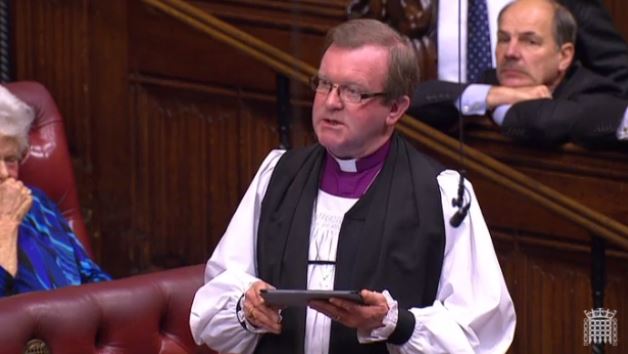 The Lord Bishop of Portsmouth: My Lords, by happy coincidence, this debate takes place almost exactly on the anniversary of the signing of the Armed Forces corporate covenant by the right reverend Primates the Archbishops of Canterbury and York. There has been excellent work with the Minister in developing the impact of that covenant, and it is a pleasure to mark that anniversary today and anticipate the maiden speeches this afternoon.
This Bill properly clarifies the obligations and responsibilities of those serving in the Armed Forces and strengthens provision for maintaining good order and handling any instances of indiscipline with proper regard for justice. These provisions and the contributions that we have heard already remind us, although they are often technical, that individuals in our Armed Forces serve, and occasionally offend, in situations of stress and danger.The House will not be surprised therefore if I briefly draw attention to the importance—and I hope the Minister in summing up can confirm this—that we should all give to the areas of pastoral and family support for those who volunteer to serve us and the nation in this way in the Armed Forces, even when their behaviour falls below highest standards. Continue reading “Armed Forces Bill: Bishop of Portsmouth highlights support for service families and work of military chaplains”
Welfare Reform Bill – Bishop of Portsmouth thanks Government for amendments
On 9th February 2016 the House of Lords passed the Government’s Welfare Reform and Work Bill at Third Reading. The Bishop of Portsmouth, Rt Revd Christopher Foster, spoke briefly to thank the Minister for the amendments agreed by Government.
The Lord Bishop of Portsmouth: My Lords, without wanting to detain the House, I add on behalf of this Bench our thanks to the Minister and offer our support and gratitude for the amendments he has brought forward today. The concerns that have been expressed around the House on many occasions for those who are most vulnerable in society have been passionate and heartfelt. It is good and reassuring when they are heard, and we offer our thanks as well.
(via Parliament.uk)
Trade Union Bill – Bishop of Chester supports amendment on electronic balloting
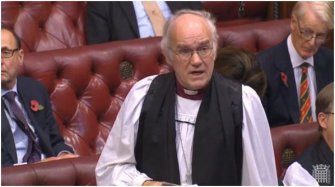 On 8th February 2016, the House of Lords considered the Government’s Trade Union Bill in committee. The Bishop of Chester, Rt Revd Peter Forster, spoke in favour of amendments to allowing electronic voting in union ballots alongside the Bill’s introduction of mandatory thresholds for strike ballots. Baroness Neville-Rolfe responded for the Government. Continue reading “Trade Union Bill – Bishop of Chester supports amendment on electronic balloting”
Immigration Bill: Bishop of Norwich supports amendment on review of family reunion programme for refugees
On the 3rd February 2016 the House of Lords considered the Government’s Immigration Bill in committee. The Bishop of Norwich, Rt Revd Graham James, spoke in support of an amendment co-sponsored by the Bishop of Southwark on family reunion for refugees. Following the response from the Government the amendment was withdrawn.
 The Lord Bishop of Norwich: My Lords, the right reverend Prelate the Bishop of Southwark, who has added his name to Amendment 234, cannot be in his place, but I am glad to speak on my own behalf and, I hope, for him, too, since we are of one mind on this matter. Continue reading “Immigration Bill: Bishop of Norwich supports amendment on review of family reunion programme for refugees”
Immigration Bill: Bishop of Norwich backs amendment on support for unaccompanied young people seeking asylum
On the 3rd February 2016 the House of Lords considered the Government’s Immigration Bill in committee. The Bishop of Norwich, Rt Revd Graham James, spoke in support of an amendment from Lord Alton of Liverpool proposing the extension of Local Authority support for young people and care leavers seeking asylum. The Bishop spoke about the danger of young people disappearing, without necessary support. The amendment was withdrawn after debate.
The Lord Bishop of Norwich: My Lords, I do not want to detain the Committee because we have heard the significance of these amendments, to some of which I have added my name. I want to follow what the noble Lord, Lord Judd, has just said because we all know that the consequence of not providing for these young people when they leave the care system is serious because they are going to remain in this country. Continue reading “Immigration Bill: Bishop of Norwich backs amendment on support for unaccompanied young people seeking asylum”
Immigration Bill: Bishop of Norwich urges Government to reconsider cuts in asylum support
On the 3rd February 2016 the House of Lords considered the Government’s Immigration Bill in committee. The Bishop of Norwich, Rt Revd Graham James, spoke in support of an amendment to clause 37 on levels of support for those seeking asylum. The Bishop echoed the concerns of the Bishop of Southwark, made at the Bill’s Second Reading, that further reducing the weekly support for people in the asylum system was unwelcome. After debate Peers decided to let the clause stand as part of the Bill.
The Lord Bishop of Norwich: My Lords, I support Amendment 230 in this group. My colleague, the right reverend Prelate the Bishop of Southwark, spoke at Second Reading of his concern about the architecture of Clause 37 and Schedule 8. I share his belief that the reduced weekly support of £36.95 per person, to which the noble Lord, Lord Rosser, referred, for an asylum seeker under the current system is inadequate. Where that financial provision is refused, it is subject to a right of appeal. I note that in nearly two-thirds of such appeal cases, the appeal is successful or the refusal is withdrawn. Continue reading “Immigration Bill: Bishop of Norwich urges Government to reconsider cuts in asylum support”
Immigration Bill: Bishop of Norwich supports amendments on welfare of child refugees
On the 3rd February 2016 the House of Lords considered the Government’s Immigration Bill in committee. The Bishop of Norwich, Rt Revd Graham James, spoke in support of an amendment to clause 34 of the Bill, related to appeals and certification of human rights claims. The Bishop spoke about the need for the new legislation to better identify and protect childrens’ best interests.
The Lord Bishop of Norwich: My Lords, I rise from these Benches to support Amendment 227 in the name of the noble Lord, Lord Rosser, and others.
The briefing note on Clause 34 to which the noble Baroness, Lady Lister, referred is a model of clarity. It was certainly very informative to me. It made clear, as the noble Baroness said, the statutory duty on the Secretary of State,
“to have regard to the need to safeguard and promote the welfare of any child in the UK who … may be affected by any immigration decision”—
that duty is not in doubt—and that,
“the best interests of the child are a primary consideration”.
While I understand that a primary consideration may not be the only one, I do not understand how a primary consideration can be set aside even if it is in some way qualified. If it is trumped by other factors, it does not seem to be a primary consideration. So there must be a risk that Clause 34 unamended could undermine the Secretary of State’s statutory duty. Continue reading “Immigration Bill: Bishop of Norwich supports amendments on welfare of child refugees”
Division: Renewable energy feed in tariff regulations
 On the 2nd January 2016 the Bishop of Salisbury, Rt Revd Nicholas Holtam, took part in a division on the Governments Feed-in Tariffs (Amendment) (No. 3) Order 2015. Baroness Featherstone proposed that the Regulations, which would see cuts made to the tariffs, be annulled.
The House Divided: Content: 91 | Not Contents: 230 | Result: Government Win.
The Bishop of Salisbury spoke in the debate . He voted Not Content.
(Via Parliament.UK)
Immigration Bill: Bishop of Southwark raises concerns about new search powers
On 1st February 2016, the House of Lords held the 3rd day of the Committee Stage of the Government’s Immigration Bill. The Bishop of Southwark, Rt Revd Christopher Chessun, spoke to an amendment that sought to remove Clause 17 from the bill (‘Powers to carry out searches relating to driving licences’)
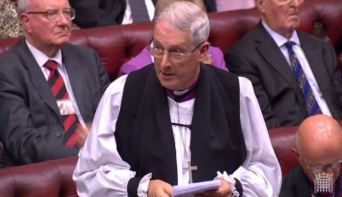 The Lord Bishop of Southwark: My Lords, I share some of the concerns of the noble Baroness, Lady Lawrence, who sketched out the problems with enacting this clause. As the Government rightly tell us, reasonable suspicion is a well-established precept in English law and policing practice. However, this does not mean that it is infinitely elastic in its application. A prior question needs to be asked when legislating: is it applicable in this circumstance, and with what effect?
Continue reading “Immigration Bill: Bishop of Southwark raises concerns about new search powers”
 The Church of England in Parliament
You must be logged in to post a comment.