On the 25th January 2016 two votes took place during the first day of Report Stage on the Government’s Welfare Reform and Work Bill.

House of Lords Division Lobby
Continue reading “Welfare Reform Bill Divisions, Report Stage day 1”

Legislation before Parliament
On the 25th January 2016 two votes took place during the first day of Report Stage on the Government’s Welfare Reform and Work Bill.
House of Lords Division Lobby
Continue reading “Welfare Reform Bill Divisions, Report Stage day 1”
On 25th January the House of Lords considered the Government’s Welfare Reform and Work Bill at its Report Stage. The Bishop of Durham, the Rt Revd Paul Butler,spoke to amendments he had co-sponsored with Baroness Lister of Burtersett, to replace Social Mobility definitions with those of ‘Life Chances’. The amendments were not put to a division, but withdrawn after the debate. The Bishop’s speech and those of others are below.
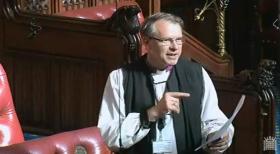
The Lord Bishop of Durham: My Lords, I support this amendment. Yesterday, I spent a delightful evening with a small number of academics after preaching at Evensong in an Oxford college—Worcester College. It was a very pleasant evening. However, as I sat there, I kept coming back in my mind to today’s debate because I was reminded of the extraordinary privilege of being in an Oxford college and the elite nature of it. This is not to criticise it or put it down; I had the privilege of studying in a private hall in Oxford when I trained for my ordination. However, I found myself thinking about the vast number of children and young people I meet in schools and colleges around the north-east, and have met in other parts of the country over the years, for whom such privilege is not their aim. Continue reading “Welfare Reform Bill: Bishop of Durham supports amendments to rename Social Mobility Commission with ‘Life Chances’”
On 25th January 2016, the Bishop of Durham, Rt Revd Paul Butler, led a debate on an amendment he had tabled to the Government’s Welfare Reform and Work Bill. The amendment, at the Bill’s Report Stage, sought to ensure that Government would continue to use income as part of its measurement for child poverty.The amendment was supported by the Labour and Liberal Democrat frontbench and by a crossbench Peer. The Bishop put the amendment to a vote, which the House passed by 290 to 198. His speech and others from the debate are below.
 On 25th January 2016, Baroness Campbell of Surbiton led a debate on an amendment she had tabled to the Government’s Welfare Reform and Work Bill. The amendment, at the Bill’s Report Stage, would require Government to commit to statutory reporting of the disability employment gap. The Bishop of St Albans, the Rt Revd Alan Smith, spoke in support of the amendment. It was withdrawn after the debate, following assurances by Government. The Bishop’s speech and extracts of those by the Minister and Baroness Campbell are below.
On the 20th January 2016 the Bishop of Southwark, the Rt Revd Christopher Chessun spoke in support of an amendment to the Government’s Immigration Bill, in the name of Lord Kennedy of Southwark. The Bishop supported the aim of the amendment that asylum seekers should be allowed to work whilst waiting for their claims to be processed. The Bishop pointed to a resolution from the General Synod of the Church of England, which considered this issue in 2009 and favoured a 9 month period after which individuals could seek work. The amendment was withdrawn at the end of the debate.
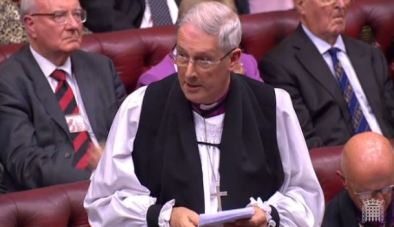 The Lord Bishop of Southwark: My Lords, Amendment 134, which I wish to support, is simple, just and proportionate in its aims. I accept that Home Office officials must, in the discharge of their duties in this area, deal with barriers of language, emotional distress, the fear of authority, the complexity of people’s lives and, on occasion, deceit. All this takes time. However, it is far from unknown for applicants for asylum to wait months or even years for a substantive decision in their case. This subjects them to a fearful limbo, with limited means of support and the background anxiety of not knowing for a very prolonged period what the outcome will be. Furthermore, we know from the experience of our own citizens the deleterious effects of prolonged inactivity on their emotional and physical well-being, and how this can erode an individual’s skill base
On 12th January 2016 the House of Lords considered the Government’s Welfare Reform and Work Bill in its fifth and final day of Committee.
The Bishop of Rochester, Rt Revd James Langstaff, co-sponsored an amendment to clause 22 of the Bill, concerned with exceptions. The amendment, which was withdrawn after the debate, sought to exclude supported housing from the proposed 12% cuts in social housing rents.
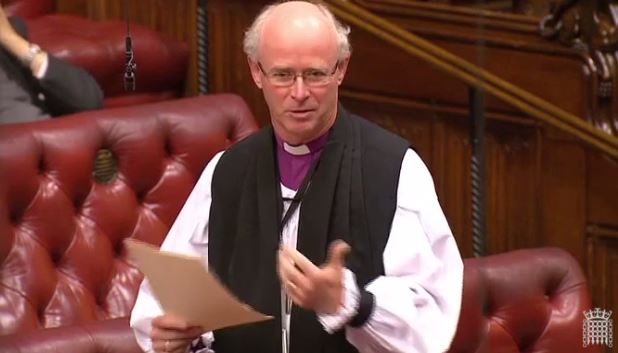
The Lord Bishop of Rochester: My Lords, when I added my name to the amendment in the name of the noble Lord, Lord Best, I did so in the naive belief that we might be pushing at an open door. I still maintain that belief because I hope that the Minister will reassure us on some of these matters. I, too, cannot believe it was intentional that we would be threatening to undermine the housing provision for some of the most vulnerable people in our society. The two noble Lords who have just spoken have made many of the points which I would have made, and others have been made earlier this evening. Continue reading “Welfare Reform Bill: Bishop of Rochester backs amendment on supported housing”
On the 11th January 2016 the Rt Revd James Langstaff, Bishop of Rochester, spoke during the Second Reading of the Government’s Trade Union Bill. The Bishop called on Government to foster a culture of good practice and partnership rather than introducing fresh measures to increase regulation and control.
The Lord Bishop of Rochester: My Lords, we on these Benches are always wary of involving ourselves in debates that, as we have already seen, are likely to become fairly polarised in political ways. Of course, this is a Second Reading debate, in which we try to focus on matters of intention and principle. Therefore, I dare to step in. Indeed, it is only because my right reverend friend the Bishop of Bristol has conspired to get himself on a plane to Uganda at this precise moment that I am standing in his place at all. I rather wish that he had been here instead of me, but there we are.
We have an interest in these matters, because many of the origins of the trade union movement lie in close partnership with the churches of this land, not least the Methodist Church but others also. From these Benches, we have a continuing concern for the flourishing of those things that are to do with civil society in our nation, and, within civil society, of those things that we think of as intermediate institutions, of which trade unions are a very good example. Therefore, the place of trade unions is of concern to us. Continue reading “Trade Union Bill: Bishop of Rochester calls for focus on better relationships over more regulation”
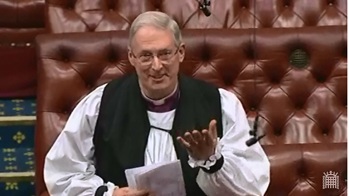 On 21st December 2015 the Bishop of Southwark, the Rt Revd Christopher Chessun, spoke in favour of amendment 90B during the fourth day of committee stage of the Government’s Welfare Reform and Work Bill. This amendment sought to exempt kinship carers from the impact of the reduced benefit cap.
The Lord Bishop of Southwark: My Lords, I rise to express my support for the intention behind the amendment in the name of the noble Earl, Lord Listowel, which makes both sound social and economic sense. If a child can be cared for within the family network, and that is not to be parents or step-parents, that is in most cases preferable for the emotional, physical and spiritual well-being of the child. Churches have watched and participated for centuries in the patterns of such relationships and know that while they can hide dangers, they provide in the main the best setting for the formation of life. Better that than the anxiety, grief and hardship that the imposition of benefit rules not designed for such scenarios imposes, and that a proportion of such children be an economic charge on local authorities and reap the emotional deficit that will all too often occur. Continue reading “Welfare Reform Bill: Bishop of Southwark supports amendment to exempt kinship carers from benefit cap reduction”
On 21st December 2015 the Bishop of Durham, the Rt Revd Paul Butler, spoke in favour of six amendments to the Government’s Welfare Reform and Work Bill, during the fourth day of its committee stage.
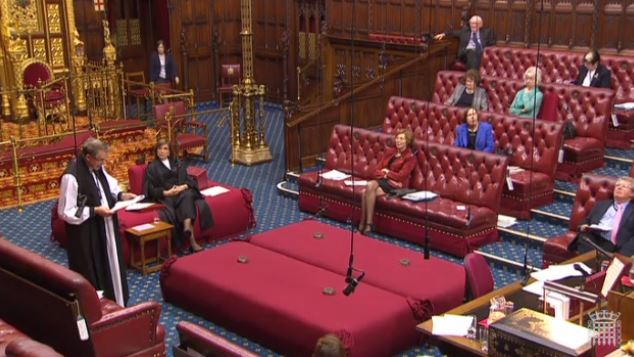 The Bishop spoke to amendments 93 and 94, which would introduce considerations for the safeguarding of children and the welfare of the disabled into any statutory review of the benefit cap; to amendments 95, 100 and 102, which would block the proposed benefits freeze; and to amendment 101 (on behalf of the Bishop of St Albans), which would protect ESA Support Group claimants from the impact of the freeze to the basic ESA rate. Continue reading “Welfare Reform and Work Bill: Bishop of Durham supports amendments on benefit cap and rate freezes”
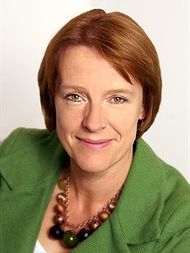 On 17th December 2015 the Second Church Estates Commissioner, Rt Hon Caroline Spelman MP, introduced the Marriage Registration Bill (a Private Member’s Bill) into the House of Commons. The Bill was co-sponsored by Caroline Lucas (Green), Victoria Prentis (Con), Julian Knight (Con), Frank Field (Lab), Christina Rees (Lab) and Huw Irranca Davies (Lab).
The Bill would reform the way all marriages are registered in the UK, bringing the process into the digital age and updating those who can be registered on a marriage certificate, allowing mothers’ names to appear. The bill can be read here
The presentation of the Bill follows a parliamentary debate on the subject led recently by Caroline Spelman.
Continue reading “Marriage Registration Bill introduced by Caroline Spelman MP”
 The Church of England in Parliament
You must be logged in to post a comment.