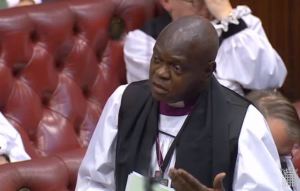
Bishop of Worcester argues for inclusion of RE in English Baccalaureate

On 21st January 2019 Lord Black of Brentwood asked the Government “what assessment they have made of the performance of pupils taking the subjects that make up the English Baccalaureate.” The Bishop of Worcester, Rt Revd John Inge, asked a follow-up question:

The Lord Bishop of Worcester: My Lords, one does not need to be an avid follower of the news to realise the huge impact that religion has for good and for ill geopolitically in our world. That is happening at the same time as we see a level of unprecedented and increasing religious illiteracy in our own society. Does the Minister regret the exclusion of RE from the baccalaureate, given the drop in numbers studying the subject at GCSE? Would its inclusion not assist in community cohesion as well as in an understanding of our world?

Continue reading “Bishop of Worcester argues for inclusion of RE in English Baccalaureate”
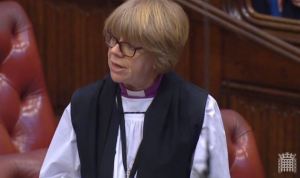
Bishop of London asks Government about funding for high-quality arts education

On 17th January 2019 the Earl of Clancarty asked the Government “what steps they are taking to encourage the teaching of art and design in schools”. The Bishop of London, Rt Revd Sarah Mullally, asked a follow-up question:
The Lord Bishop of London: My Lords, high-quality arts education as part of a broad curriculum has been shown not just to support our creative industries but to improve academic achievement and enable children to look at problems in different ways. In the light of Ofsted’s consultation on its new framework, which looks at quality, intent and impact in the curriculum, will the Minister say how this Government will ensure that there is no reduction in pupil funding in real terms? Good art education requires good teachers. Continue reading “Bishop of London asks Government about funding for high-quality arts education”

Church Commissioner Questions: historic buildings, Christian persecution overseas, promoting marriage

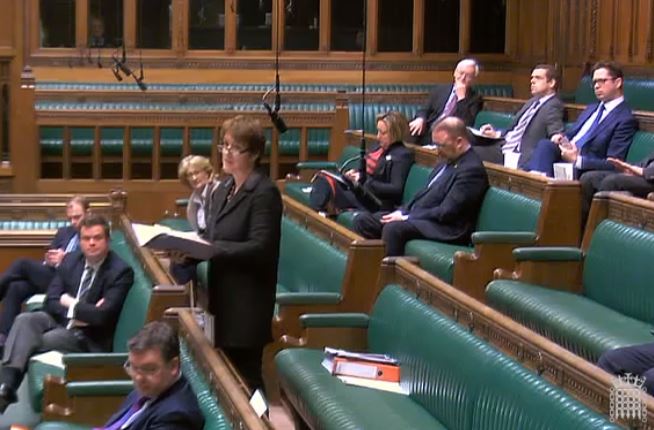
On 17th January 2019 the Second Church Estates Commissioner, Rt Hon Dame Caroline Spelman MP, answered questions from MPs on historic church buildings, Christian persecution overseas, and the promotion of marriage. A full transcript follows:

Church Commissioners
The right hon. Member for Meriden, representing the Church Commissioners, was asked—

Protection of Historic Church Buildings

Alex Burghart (Brentwood and Ongar) (Con): What steps the Church of England is taking to ensure that historic church buildings are protected. [908606]

The Second Church Estates Commissioner (Dame Caroline Spelman): The Church of England continues to suffer thefts of metal and other items of historical and architectural interest from its churches. The Archbishop’s Council conducted an inquiry into this, and the trend appears to be gradually moving from east to west and from south to north. I encourage my hon. Friend to look at the Church of England [Churchcare] website for ways of protecting his churches more successfully. Continue reading “Church Commissioner Questions: historic buildings, Christian persecution overseas, promoting marriage”

Bishop of Leeds appeals for more welcoming language on EU citizens in UK

On 16th January 2019 Lord Greaves asked the Government “what support they are giving to citizens of European Union countries who have been resident in the United Kingdom since before the United Kingdom joined the European Economic Community.” The Bishop of Leeds, Rt Revd Nick Baines, asked a follow-up question: 
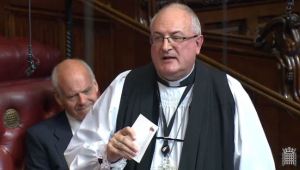
The Lord Bishop of Leeds: My Lords, is it possible that the language could be changed? I spoke to a German woman who has been here for 67 years and finds the language of “You may be allowed to stay” quite difficult, as opposed to “You belong”, when she has children and grandchildren, she has been a taxpayer and all that. This goes deeper than simply being allowed to stay. Continue reading “Bishop of Leeds appeals for more welcoming language on EU citizens in UK”

Bishop of Ely asks about school exclusions and education of Gypsies, Roma and Travellers

On 16th January 2019 the Bishop of Ely, Rt Revd Stephen Conway received three written answers to questions, on school exclusions and the education of Gypsies, Roma and Travellers:

The Lord Bishop of Ely: 

(i) To ask Her Majesty’s Government, following their Race Disparity Audits, what steps they are taking to ensure that educational institutions improve the standard of reading among Gypsies, Roma and Travellers aged 6–7.

(ii) To ask Her Majesty’s Government, following their Race Disparity Audits, what steps they are taking to ensure that educational institutions improve attainment at GCSE level for Gypsies, Roma and Travellers.

Continue reading “Bishop of Ely asks about school exclusions and education of Gypsies, Roma and Travellers”

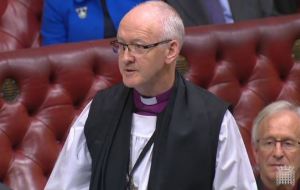
Archbishop of York asks Government about consultation process for new pension regulations

On 15th January 2019 the House of Lords debated a Motion to Approve the Occupational and Personal Pension Schemes (Amendment etc.) (EU Exit) Regulations 2018.  The Archbishop of York, Most Revd John Sentamu, spoke during the debate:

The Archbishop of York: My Lords, I just wanted to ask the Minister: how much consultation was undertaken with industry before the first regulations were produced? Did industry suggest, rightly, that this would cause trouble for the Pensions Regulator and others because it was bigger than just the United Kingdom? Continue reading “Archbishop of York asks Government about consultation process for new pension regulations”
Bishop of St Albans asks Government how it will regulate gambling advertising online focused on young people

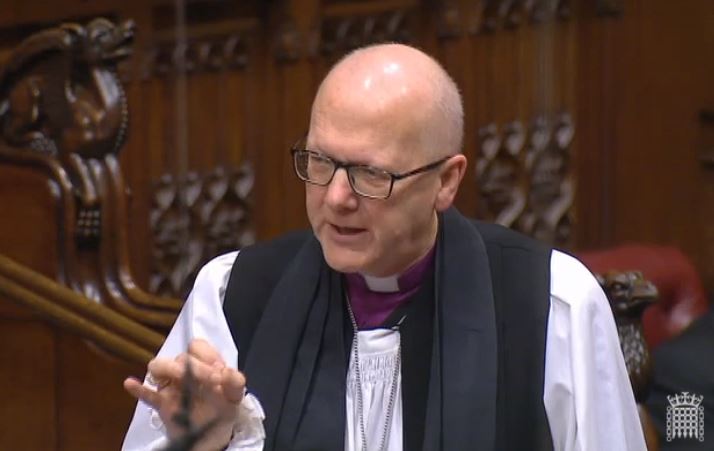
On 15th January 2019 the Bishop of St Albans, Rt Revd Alan Smith, asked a question he had tabled to Government in the House of Lords. The answer, his subsequent question and those of other Members are below:

Gambling: Children

The Lord Bishop of St Albans: To ask Her Majesty’s Government what assessment they have made of the prevalence of gambling among children and young people.

The Parliamentary Under-Secretary of State, Department for Digital, Culture, Media and Sport (Lord Ashton of Hyde) (Con): My Lords, protecting children is a priority for the Government. There are strict controls to prevent underage gambling. In 2011, 23% of 11 to 15 year-olds had gambled in the last week, including with friends. Last year, it was 12%. On the other hand, the Gambling Commission’s Young People & Gambling 2018 report shows an increase to 14%, though not to earlier levels. Sample sizes are small, and we do not know if this is a trend. We are of course monitoring the situation very carefully.

The Lord Bishop of St Albans: I thank the Minister for his reply. At a time when the gambling industry is spending about £1.5 billion a year on encouraging gambling, when children are seeing three gambling adverts every day on average and when 55,000 teenagers in this country are now classified as problem gamblers, we need to look at what is happening particularly online, where young people most often see the adverts, which is outside all the previous criteria for regulation. What are Her Majesty’s Government doing to regulate online advertising, which is particularly focused on our young people? Continue reading “Bishop of St Albans asks Government how it will regulate gambling advertising online focused on young people”

Archbishop of York urges Government to learn from Lawrence inquiry when defining Islamophobia

On 14th January 2019 Baroness Finn tabled an Oral Question ‘To ask Her Majesty’s Government what assessment they have made of the potential consequences of adopting an official definition of Islamophobia.’ The Archbishop of York, the Most Revd and Rt Hon Dr John Sentamu, asked a follow up question:

The Archbishop of York: My Lords, on the overall question of definitions, sometimes it is much easier to do things when we handle them as concepts. In the Stephen Lawrence inquiry, we struggled with the question of racism, particularly when it is found in institutions, so we ended up saying: “The concept that we apply to this case of institutional racism is this”. That is much easier than a definition because a definition can restrict what you want to say. Is it not better to learn from what the Stephen Lawrence inquiry did?

Continue reading “Archbishop of York urges Government to learn from Lawrence inquiry when defining Islamophobia”

Bishop of St Albans asks what is being done to address cholera epidemic in Yemen

On 14th January 2019, Lord Ahmed tabled an Oral Question ‘To ask Her Majesty’s Government what assessment they have made of the humanitarian situation in Yemen.’ The Bishop of St Albans, the Rt Revd Dr Alan Smith, asked a follow-up question:

The Lord Bishop of St Albans: My Lords, as well as the huge famine—I congratulate Her Majesty’s Government on what they are doing to respond to it—we are also seeing unfold before our eyes a huge medical crisis, with possibly the largest cholera epidemic in recorded history. Will the Minister update us on what plans and action are being taken with our partners to bring in medical help urgently to try to address this unparalleled, Dickensian level of preventable disease?

Continue reading “Bishop of St Albans asks what is being done to address cholera epidemic in Yemen”

Bishop of Gloucester asks about impact of benefit reforms and two-child limit on families with children

On 10th January 2019 the Bishop of Gloucester, Rt Revd Rachel Treweek, asked a question she had tabled to Government on benefit reforms and the impact on children. She specifically raised the issue of the two-child limit. A Government announcement on that was made the following day. The response to the question and to the Bishop’s subsequent question and those of other Members, can be seen in full below:

Benefit Reforms

The Lord Bishop of Gloucester: To ask Her Majesty’s Government what assessment they have made of the impact of benefit reforms on families with children.

​The Parliamentary Under-Secretary of State, Department for Work and Pensions (Baroness Buscombe) (Con): My Lords, this Government support families. Our welfare system supports those who are vulnerable and helps people into work. These reforms are working, with 3.3 million more people in work and 300,000 fewer children in absolute poverty than in 2010, a record low. Once fully rolled out, universal credit will result in an extra 200,000 people moving into work and will empower people to work an extra 113 million hours a year to support their families.

The Lord Bishop of Gloucester: I thank the Minister for her Answer and I am grateful for recent engagement with faith and other groups on this issue, but the Government’s own statistics show that child poverty is rising among families with more than two children, even when those families have an adult in work. One of the principal drivers of this increase is the Government’s two-child limit, which makes it harder for parents of more than two children to work their way out of poverty, contrary to the aims of universal credit. In light of this evidence, will the Government reconsider that two-child policy? Continue reading “Bishop of Gloucester asks about impact of benefit reforms and two-child limit on families with children”