Bishop of St Albans seeks assurances from Government on illegality of sex-selective abortion

Baroness Knight of Collingtree asked Her Majesty’s Government what action they intend to take in the light of recent analysis of the ratio of boys and girls in United Kingdom families suggesting that sex-selective abortion is taking place.

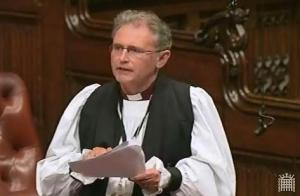
The Bishop of St Albans asked a supplementary question:

The Lord Bishop of St Albans: My Lords, there is an opportunity coming up where this can be underlined. At the moment, the procedures for the approval of independent sector places for the termination of pregnancy are being revised. Will Her Majesty’s Government undertake to ensure that they spell out clearly and unequivocally that termination on grounds of gender alone is illegal and that an appeal on gender alone is insufficient to satisfy the mental health criteria of the Abortion Act?

Earl Howe: My Lords, as I have said, the guidance to abortion providers will be updated and that will include the guidance to independent sector providers. It will be made abundantly clear that gender selection is illegal.

(via parliament.uk)

The Bishop of St Albans asks Government about support for healthy living in schools

Baroness Morgan of Ely asked Her Majesty’s Government what representations they have made to the food and drink industry about reducing levels of sugar in processed products in the United Kingdom.

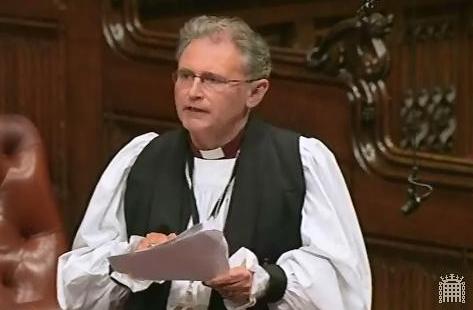
The Bishop of St Albans asked a supplementary question:

The Lord Bishop of St Albans: My Lords, while I support the need to reduce the level of sugar in processed food wherever possible, I am concerned that this alone will do little to improve the nation’s health or deal with the problem of obesity. What progress are the Department for Education and the Department of Health making on reducing the number of calories in meals served in schools, and what progress is being made on increasing the level of physical activities for the pupils in our schools?

Earl Howe: My Lords, tackling obesity calls for action by the widest possible range of partners, including the food industry but also including schools. That is what we are trying to do through the responsibility deal. Our National Child Measurement Programme, the School Food Plan, the School Games and the money that we are putting into school sports funding—£150 million a year—all contribute to the joint effort across government to influence the way in which calories are consumed by children. I have encouraging news on that front, which is that the level of child obesity is now the lowest that it has been since 1998, so we are moving in the right direction.

(via parliament.uk)

Bishop of Worcester commends the living wage as tool to tackle inequality

Lord Giddens asks Her Majesty’s Government what policies they have to address economic inequalities in British society.

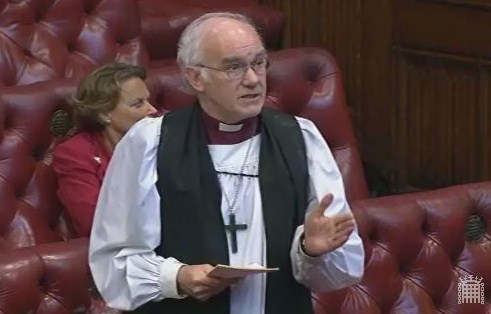
The Bishop of Worcester asked a supplementary question:

The Lord Bishop of Worcester: My Lords, is the Minister aware of the first report published today by the Living Wage Commission, chaired by my friend the most reverend Primate the Archbishop of York, which found that emerging economic recovery will have no effect on more than 5 million workers unless employers pay a living wage. It found furthermore that 6.7 million of the 13 million people in poverty in the UK are in a family where someone works—which, for the first time, is more than half the total. Will the Minister tell the House what steps the Government are taking to address this real concern?

Lord Newby: My Lords, the Government are encouraging employers to pay the living wage where they can. One of the key things about people in work on very low incomes is that a large proportion of them are working a small number of hours or a smaller number of hours than they would like. Economic growth will mean that more of those people are able to work longer hours, which will help deal with their household circumstances.

(via parliament.uk)

The Bishop of St Albans raises concerns about growing regional economic inequality

Baroness Wilcox asked Her Majesty’s Government what recent assessment they have made of the levels of manufacturing activity in the United Kingdom.

The Bishop of St Albans asked a supplementary question:

The Lord Bishop of St Albans: My Lords, I am sure we all want to encourage a much more robust manufacturing base in this country. An article in the Economist last week pointed out that, unlike the rest of the country, the north-east and south-west regions still saw an increase in unemployment up to the year ending November 2013. There are huge problems at the moment in the south-west, which was already facing a downturn in its tourist industry and now has floods and difficulties with trains. Is there anything the Government can do to encourage a more long-term, stronger economic and, indeed, manufacturing base in the south-west of England?

Viscount Younger of Leckie: Our industrial strategy focuses on the whole country. I note the right reverend Prelate’s point about the south-west where they are suffering so terribly from the floods. The industrial strategy has five main strands which are bearing fruit, particularly in places such as Liverpool and Tyneside, and the south-west is just as important.

(via parliament.uk)

Bishop of Worcester responds to Government statement on flooding

The Lord Bishop of Worcester: My Lords, I am grateful for the Minister’s Statement. As we all know, attention has rightly focused on the Somerset Levels and the terrible plight that people are enduring there, but when I left Worcester this morning the city was gridlocked as a result of the closure of the main bridge across the river and the situation remains acute. I do not want to apportion blame; I want to pay tribute to those who are working very hard and to the understanding and graciousness of the inhabitants of Worcester. However, it is true that the implications of this will be enormous, economically and from a human point of view. Can the Minister confirm that a coherent policy will be forthcoming for all the affected areas, not just those most terribly affected?

Lord De Mauley: The right reverend Prelate is absolutely right—I can confirm that. We have finite resources and must apportion them in a proper way, in accordance with priorities, and the priorities must be human life and property. While I am at the Dispatch Box, can I say that, although I have not given them credit, I know that the churches in Somerset in particular are playing a major part in helping people affected by this dreadful tragedy?

(via parliament.uk)

Bishop of St Albans raises plight of Roma communities in Parliament (Written Question)

The Lord Bishop of St Albans asked Her Majesty’s Government what analysis they have made of reports of the forced evictions of Roma communities in Cluj-Napoca, Romania; and whether they will discuss the matter with the government of Romania and ask that government to enforce the decision of the Cluj-Napoca County Court that evictions targeting the Roma community are illegal.

The Senior Minister of State, Department for Communities and Local Government & Foreign and Commonwealth Office (Baroness Warsi) (Con): Our Embassy in Bucharest has been monitoring this issue closely (along with other forced evictions of Roma e.g. in Eforie Sud and Baia Mare). We understand that the Cluj-Napoca Court recently ruled the forced eviction in December 2010 illegal. However this decision is not final and is subject to appeal. We have raised wider concerns about social inclusion of the Roma with the Romanian government on 28 January. With regard to this specific case, the British Embassy will visit Cluj on 11 February and will raise the issue of forced evictions with the local government. They will also launch a partnership with a local NGO to develop projects aimed at preventing disadvantaged Roma children leaving school before the minimum age. The UK government does not condone unjustified evictions of any community.

(via parliament.uk)

The Bishop of Wakefield asks question on electoral fraud

Baroness Hanham asked Her Majesty’s Government what assessment they have made of the recommendations in the final report of the Electoral Commission Electoral fraud in the UK.

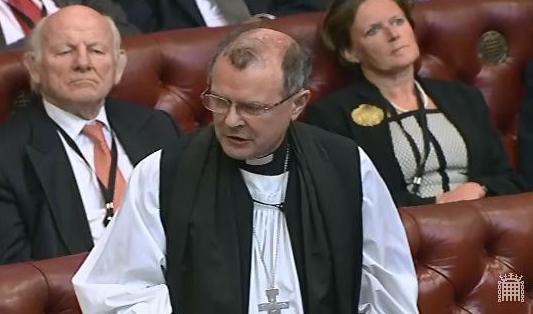
The Bishop of Wakefield asked a supplementary question:

The Lord Bishop of Wakefield: My Lords, following the question of the noble Lord, Lord Campbell-Savours, about areas of high risk, in our diocese of Wakefield the local authority of Kirklees has been pinpointed as just one such area for the sort of reasons that the noble Lord mentioned. The local authority is working hard with a number of agencies to ensure the probity of the next elections. Will the Minister say what sort of support will be given to councils to enable them to fulfil this important duty?

Lord Wallace of Saltaire: My Lords, I was discussing that exact question with the electoral registration officer of Kirklees the summer before last, including the authority’s co-operation with the police. We all know that there are pockets of problems within Kirklees. It is a matter for local co-operation with the police, who are well aware of this. We are also well aware that there is a certain tendency in some local elections for candidates to use allegations of electoral fraud against each other as part of the local campaign. That is one of the reasons why the police are occasionally a little sceptical about allegations being thrown around during the campaign.

(via parliament.uk)

Bishop of Chester receives answer to question on electricity market (Written Question)

The Lord Bishop of Chester asked Her Majesty’s Government what amount and proportion of the United Kingdom’s electricity requirement in 2013 was met by inputs through interconnectors with other countries; and how much electricity the United Kingdom exported during 2013.

The Parliamentary Under-Secretary of State, Department of Energy and Climate Change (Baroness Verma) (Con): The table below shows UK imports and exports of electricity, in GWh, January 2013 to September 2013. Data for 2013 as a whole will be available on 28th March 2014.

Imports and Exports in the UK for January-September 2013 in GWh
Imports 13,084
Exports 2,065
Net Imports 11,019
-as % of electricity supply 4.00%
Electricity Supplied 275,523

Source: Energy Trends table 5.2 available at: https://www.gov.uk/government/publications/electricity-section-5-energy-trends

(via parliament.uk)

Bishop of Wakefield speaks on use of church buildings during elections

Baroness Royall of Blaisdon asked Her Majesty’s Government what steps are being taken to increase the number of people who are registered to vote in the United Kingdom.

The Lord Bishop of Wakefield: My Lords, noble Lords will know that churches and the ancillary buildings connected with them are often the places where hustings take place, and indeed are used as polling stations. This is a key way of engaging local people in the democratic process. With the recent passing of the transparency of lobbying Act, will the Minister reassure us that churches and such places will continue to be used and will not be affected by the passing of that Act?

Lord Wallace of Saltaire: My Lords, I cannot see any way in which the use of churches as polling stations, and indeed the role of the clergy in encouraging people to do their community and civic duty, will be adversely affected. I very much hope that the church will continue to encourage all those who are part of its community to take a full part in civic, social and political life.

(via parliament.uk)

Bishop of Wakefield raises concerns about Islamophobia in Georgia

The Lord Bishop of Wakefield asked Her Majesty’s Government: what representations they are making to the Government of Georgia regarding Islamophobia in that country; and what steps they are taking to ensure freedom of religion and the rights of minority groups there.

Baroness Warsi: My Lords, the UK raises human rights issues on a regular basis with the Georgian Government, both bilaterally and through multilateral institutions such as the EU, the OSCE and the Council of Europe. We have not made any recent representations regarding Islamophobia, but we continue to follow minority rights closely, including through our embassy’s work in Tbilisi and its regional travel. We fund a local NGO to maintain an inter-religion working group, which involves a variety of faith groups, including Muslims.

The Lord Bishop of Wakefield: My Lords, last year, I was fortunate to spend a couple of nights with a Muslim family in Batumi, and the next morning I met the president of the semi-autonomous region there, Mr Archil Khabadze. I pressed the question to him of why there was only one mosque for something like 110,000 out of the 150,000 people, that being the number of Muslims in the city. He said that at that time they would take immediate steps to find more land made available for Muslims in that city. I said that I would be coming back in the next three months to open the mosque with other religious groups. Would Her Majesty’s Government please press the authorities to make sure that the local administration there is asked to fulfil the promise that they made; otherwise, these very open Muslims will soon become radicalised.

Baroness Warsi: The right reverend Prelate raises a really important issue. His Question prompted me to go away and do some research, and I was quite intrigued to find out that just over 10% of Georgia’s population are indeed Muslim—a much larger percentage than in our own communities. The right reverend Prelate will be aware that one of the challenges in Georgia is that the Muslim community is not particularly well engaged politically and therefore does not really put its head above the parapet. I have become aware of low-level discrimination and tensions towards the Muslim community there, but as Georgia moves towards closer EU integration part of its requirement is to fulfil its obligation to bring in anti-discrimination laws.

(via parliament.uk)