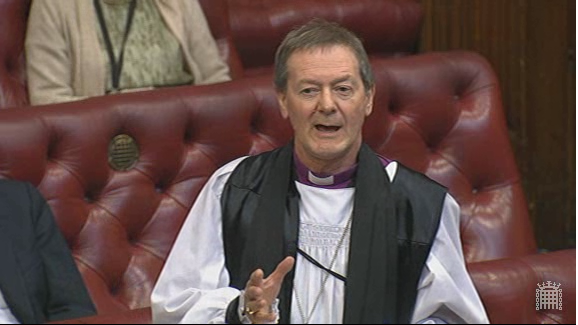
Bishop of Ripon and Leeds calls for Government to examine reform of winter fuel allowance

On 23rd October 2013, Lord Greaves asked Her Majesty’s Government what proposals they have to reduce the level of economic inequality. The Bishop of Ripon and Leeds, the Rt Revd John Packer, asked a supplementary question:

R_LThe Lord Bishop of Ripon and Leeds: My Lords, bearing in mind the way in which wealthy pensioners, such as many in this House, are protected against the austerity cuts that other welfare recipients face, will the Government consider how to enable us to begin to bear our share of the burden, whether by taxing or means-testing the winter fuel allowance or otherwise?

Lord Newby: My Lords, one of the commission’s recommendations was that intergenerational equity could be improved if pensioners paid a higher share. That has not been the view that the Government have taken. Particularly given the very high levels of pensioner poverty, against which many noble Lords have campaigned over many years, we have taken the view that the real value of pensions should be protected during this period of fiscal consolidation. However, we accept that there may be more to be done. Indeed, for people who receive payments such as the winter fuel allowance, there are now a number of voluntary schemes under which they can make that payment available via charities so that it can be used for people on low incomes.

(via Parliament.uk)
Bishop of Ripon and Leeds calls for co-ordinated international tax transparency efforts

On 22nd October 2013, Lord Chidgey asked Her Majesty’s Government what new millennium development goals they would prefer to see introduced post-2015. The Bishop of Ripon and Leeds, the Rt Revd John Packer, asked a supplementary question:

R_LThe Lord Bishop of Ripon and Leeds: My Lords, will the Minister press for tax justice to be a distinctive international goal in ensuring that major corporations pay appropriate taxes and in channelling taxes to the countries where profits are actually made?

Baroness Northover: The right reverend Prelate is right to highlight that and he will know that the UK Government are emphasising the importance of tax being collected appropriately within the developing countries. This will be transformative. Corporate transparency is one of the aspects required and he will know that my right honourable friend the Secretary of State for BIS, Vince Cable, is working very hard on that. BIS has just consulted and is considering responses, and DfID is trying to ensure that tax regimes in the developing countries are strengthened and built on.

(via Parliament.uk)

Bishop of Ripon and Leeds calls for greater research on impact of under-occupancy charge

On 21st October 2013, Baroness Hollis of Heigham asked Her Majesty’s Government what advice they give to social landlords whose tenants have fallen into arrears as a result of the under-occupancy charge. The Bishop of Ripon and Leeds, the Rt Revd John Packer, asked a supplementary question:

R_LThe Lord Bishop of Ripon and Leeds: My Lords, is the Minister aware of the evidence that people who are leaving accommodation to avoid the under-occupancy charge are being rehoused in private accommodation at greater cost? What steps are being taken to monitor this?

Lord Freud: My Lords, as I have just pointed out, we are undertaking an elaborate set of research programmes to understand this. If a family moves into private accommodation, which is more expensive, it does not necessarily mean that there is a net cost, because it frees up larger accommodation in the social rented sector to which a family can move from the expensive private sector.

(via Parliament.uk)

Second Church Estates Commissioner Answers Written Questions on Credit Unions and Food Banks

On the 21st October 2013, Sir Tony Baldry MP answered written questions about the Church of England’s attitude towards Credit Unions and its involvement in food banks14.01 CCQ Baldry Continue reading “Second Church Estates Commissioner Answers Written Questions on Credit Unions and Food Banks”

Bishop of Derby responds to Government Statement on Al-Madinah Free School

On 17th October 2013, a Government Statement was repeated in the House of Lords by the Parliamentary Under-Secretary State for Schools, Lord Nash, on the Al-Madinah Free School in Derby. The Bishop of Derby, the Rt Revd Alastair Redfern, responded to the statement during the subsequent question and answer session.

DerbyThe Lord Bishop of Derby: My Lords, I declare an interest as the Bishop of Derby and congratulate the Minister and his colleagues on the monitoring and firm action that is being taken. As I understand it, this is a very local initiative. What lessons can be learnt because if we do not have the local authority playing a key role, how are we providing the right kind of framework and guidance for local initiatives so that the right kind of standards, structures and expectations are put in place and met? What are we learning and how are we going to deal with that?

The Parliamentary Under-Secretary of State for Schools (Lord Nash): I am grateful to the right reverend Prelate for his question. This is a local initiative, it is quite a complicated situation and I do not have time to go into all the details now, but I can assure the House that we are all over this and will not allow this situation to continue.

(via Parliament.uk)

Written Answers – Civil Service, Freedom of Religion and the United Nations

Bishop of DerbyOn 17th October 2013 the Bishop of Derby, the Rt Revd Alastair Redfern, received answers to written question on the topics of civil service corporate credit cards, freedom of religion and the United Nations.

Civil Service: Corporate Credit Cards

The Lord Bishop of Derby: To ask Her Majesty’s Government what are the rules and criteria for the issuing of corporate credit cards to civil servants; and how the use of such cards is monitored and audited.

Lord Gardiner of Kimble: The Government Procurement Card (GPC) is a payment charge card used for making low value purchases. Its proper use contributes to making efficiencies.

All Departments have a clear policy for card allocation. The GPC Steering Group, established after the last General Election, has developed minimum policy standards for central Government departments and their Arm’s Length Bodies (ALBs). GPC Central Policy describes the roles and responsibilities for personnel that are required to govern and control local GPC programmes. These policies have been shared with the National Audit Office (NAO) and must be followed by all departments using GPCs. Before the last General Election there was no central oversight of Government GPC card use.

All Departments now operate compliance checking processes which include transaction logs that must be reconciled with bank statements and receipts each month; and the requirement for budget managers to reconcile GPC payment to ensure compliance with approved spend. The departmental controls, in accordance with GPC policy, include monthly compliance checking, including identifying off-contract spend and clear guidance for users on the correct route-to-buy.

All spend on GPCs over £500 is now published.

(via Parliament.uk) Continue reading “Written Answers – Civil Service, Freedom of Religion and the United Nations”

Bishop of Leicester asks question on peaceful settlement of Syrian conflict

On 15th October 2013, Lord Truscott asked Her Majesty’s Government whether they consider that the recent Russian-led Syrian peace initiative provides a model for defusing other international crises, for example relating to Iran. The Bishop of Leicester, the Rt Revd Tim Stevens, asked a supplementary question:

LeicesterThe Lord Bishop of Leicester: My Lords, does the Minister agree that this shift in fortunes in Syria is very largely due to the relationship of trust that the United States Secretary of State and the Russian Foreign Minister have developed in recent months, and that similar levels of trust will be vital to resolving other pressing international crises, not least with Iran?

Lord Wallace of Saltaire: My Lords, I agree. I should also say that the British Foreign Secretary has worked extremely hard over the past nine months and more to come to terms with the Russians and to develop a relationship with the Russian Foreign Minister. The European Union high representative, the noble Baroness, Lady Ashton, has also done a great deal of work with the Russians on Syria and as part of the E3+3 on Iran.

(via Parliament.uk)

Bishop of Leicester highlights consultative approach to appointment of bishops

On 14th October 2013, Lord Trefgarne asked Her Majesty’s Government what discussions they have had with the Church of England about the procedure for the appointment of bishops in the Church of England. The Bishop of Leicester, the Rt Revd Tim Stevens, asked a supplementary question:

LeicesterThe Lord Bishop of Leicester: My Lords, is the Minister aware that, typically, the Crown Nominations Commission consults some 100 members of civil society in each region to which appointments are made; that legislation to bring forward the possibility of women bishops is now before the General Synod and it is anticipated that it will be brought into law within two years; and that the Archbishop of Canterbury takes a very keen interest in the proceedings of this House, and will take careful note of any concerns about the speed of Episcopal appointments made in the course of this Question Time?

Lord Wallace of Saltaire: I thank the right reverend Prelate for his question. In consulting when preparing for this Question, I was struck by how many of the people I spoke to said, “You have to understand that the workload of a diocesan bishop is enormous and that some wish to retire before the age of 70 because they feel they have done more than they can sustain for another 10 to 15 years”.

(via Parliament.uk)

Bishop of Coventry asks Government for update on its support for humanitarian assistance in Syria

On 14th October 2013, the Bishop of Coventry received answers to two written questions on humanitarian assistance in Syria. 

13.10 Bishop of CoventryThe Lord Bishop of Coventry: To ask Her Majesty’s Government what steps they intend to take following the G20 Summit in St Petersburg to ensure unimpeded access for humanitarian workers inside Syria, including safe routes for aid convoys and the lifting of any bureaucratic hurdles imposed by the Assad regime.

Baroness Northover: It is vital that aid reaches those who have been affected by the Syria crisis. Since the G20 summit, the UK has successfully pushed the Security Council to capitalise on its strong chemical weapons resolution by applying its weight and authority to securing unfettered and immediate humanitarian access. On 2 October, the UN Security Council unanimously agreed a Presidential Statement setting out measures to facilitate access for humanitarian relief to all parts of Syria. The Minister of State for International Development, the right honourable Alan Duncan MP, met Baroness Amos of the United Nations Office for the Co-ordination of Humanitarian Affairs on 9 October to discuss these urgent matters.

** Continue reading “Bishop of Coventry asks Government for update on its support for humanitarian assistance in Syria”

Bishops of Derby and Wakefield seek clarification on UK’s position on EU Justice and Home Affairs measures

On 14th October 2013, the Bishop of Derby, the Rt Revd Alastair Redfern, and the Bishop of Wakefield, the Rt Revd Stephen Platten, both received answers to written questions on the European Union’s Justice and Home Affairs Measures.

Bishop of DerbyThe Lord Bishop of Derby: To ask Her Majesty’s Government, further to the Written Answer by Lord McNally on 29 August (WA 318), what guarantees they sought from other member states, prior to their decision of 9 July to opt out of 130 European Union Justice and Home Affairs measures, that the United Kingdom would be able to opt back in to various police and justice measures.

The Minister of State, Ministry of Justice (Lord McNally): Protocol 36 does not provide for guarantees to be obtained from Member States and no Member State would have been able to have given such a guarantee. We therefore did not seek any such guarantees from Member States. However, the issue has been discussed in meetings with our EU counterparts at both Ministerial and official level.

However, Protocol 36 to the Treaties places an obligation on the UK and the Union institutions to, “…seek to re-establish the widest possible measure of participation of the United Kingdom in the acquis of the Union in the area of freedom, security and justice without seriously affecting practical operability of the various parts thereof, while respecting their coherence”. Given this, we are confident that we will be able to reach agreement on a sensible final package of measures that the UK will formally apply to rejoin.

Final agreement is subject to approval by the Council in the case of Schengen measures and the Commission for all others. Continue reading “Bishops of Derby and Wakefield seek clarification on UK’s position on EU Justice and Home Affairs measures”