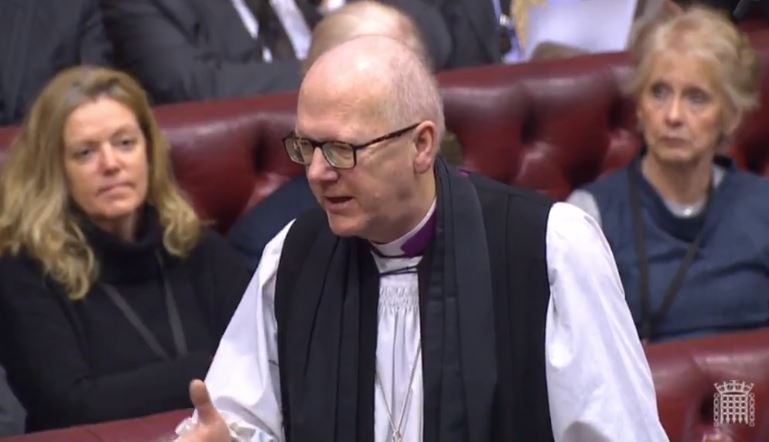
On 24th April 2024, the Bishop of Leeds asked a question on whether the government would consider taking back long term funding of the BBC World Service, rather than having the service funded through the licence fee:
The Lord Bishop of Leeds: My Lords, I notice that the funding agreement with the FCDO runs only until April 2025, which is not very far ahead. Can the Minister tell us whether the Government are considering, at the very least, taking back full funding of the World Service in the longer term rather than leaving it to the licence fee?
The Bishop of Southwark received the following written answer on 24th April 2024:
The Lord Bishop of Southwark asked His Majesty’s Government what progress they have made in allocating the Market Sustainability and Improvement Fund 2023 to 2024 for adult social care; and what are their plans for allocation in the financial year 2024–25.
The Bishop of Leicester received the following written answer on 24th April 2024:
The Lord Bishop of Leicester asked His Majesty’s Government, further to the Written Answer by Viscount Younger of Leckie on 27 March (HL3520), why it is not possible to undertake a robust assessment of the impact of the two-child limit.
During a debate on the Victims and Prisoners Bill on 23rd April 2024, the Bishop of Gloucester spoke in support of amendment 79 to the bill, which would aim to introduce protection for migrant victims of domestic violence:
The Lord Bishop of Gloucester: My Lords, from listening to this debate, I am struck again and again by how so much of what we are saying was said in this House during the passage of the Domestic Abuse Bill. We need to listen to and be aware of that. I hope the Minister will reflect on that.
The Bishop of Norwich spoke in a committee debate on the Offshore Petroleum Licensing Bill on 23rd April 2024, supporting amendments on safeguarding marine protected areas, and the establishment of skills passports to aid in worker mobility to new industries:
The Lord Bishop of Norwich: My Lords, I rise to support all the amendments in this group but I will focus my comments on Amendment 10 in the name of the noble Baroness, Lady Willis, and Amendment 2 in the name of the noble Baroness, Lady Hayman, to which I have added my name in support. I would also value hearing the rest of this debate.
On Amendment 10, I reiterate the question I asked at Second Reading: what steps are His Majesty’s Government taking to safeguard marine protected areas, and why are they not taking the IUCN’s recommendations seriously by excluding MPAs from extraction in the Bill?
I will not rehearse the valuable arguments that the noble Baroness, Lady Willis, has already made on whether we have a robust regulatory framework on MPAs. From the evidence she has provided, I am greatly concerned about whether that is the case. Certainly, the new Rosebank field overlaps with the Faroe-Shetland MPA—a fragile ecosystem and marine environment. Excluding MPAs from the licensing rounds altogether would ensure their protection and that is why I support Amendment 10.
On 23rd April 2024, the House of Lords debated the Victims and Prisoners Bill. The Bishop of Manchester spoke in support for his amendments 60, 64, and 70 to be the bill, which focus on establishing support services for victims of crime:
The Lord Bishop of Manchester: My Lords, I will speak to my Amendments 60, 64 and 70, which echo amendments on support services for victims that I tabled in Committee. I am grateful to the Minister for his responses at that stage and for his kindness in meeting me and representatives of Refuge and Women’s Aid in the interim. In light of those conversations, it is not my intention to press any of these amendments to a Division today. However, I hope that, in this debate and in the Minister’s response to it, we can clarify a little further how His Majesty’s Government will seek to ensure that victims across the country have access to quality support services provided by organisations that hold their confidence and understand their specific circumstances. As we are now on Report, I will not repeat the detailed arguments of Committee, but I think their force still stands.
Amendment 60 places a duty on the Secretary of State to define in statutory guidance
“the full breadth of specialist community-based support domestic abuse services”.
The Bishop of Gloucester asked a question on how the government’s proposed review of personal independence payments (PIP) would affect those with severe lifelong disabilities on 23rd April 2024:
The Lord Bishop of Gloucester: My Lords, yesterday I visited National Star, an FE college that serves young people with severe lifelong disabilities. Many of them are being subjected again and again to reassessment throughout their lives. That is not only traumatising but a complete waste of time and resources. What will the Government do to take this into consideration so that people with severe lifelong disabilities are not subjected to reassessment again and again, unless, of course, that disability is generative?
The Bishop of Oxford received the following written answers on 23rd April 2024:
The Lord Bishop of Oxford asked His Majesty’s Government whether they give third parties access to national pupil data or learner records, and whether they charge a fee for any such access.
Baroness Barran (Con, DfE): The department will only share pupil, or learner, level data with others where it is lawful, secure and ethical to do so. Where these conditions are met and data is shared, the department do not charge any fee.
The Bishop of Derby spoke in a debate on support for parents considering separation on 22nd April 2024, referencing the work of the Archbishops’ Commission on Families and Households and the need for open communication with children in cases of family separation:
The Lord Bishop of Derby: My Lords, I am grateful to the noble Lord, Lord Farmer, for bringing this debate on this important matter. As I hope noble Lords will know, the Archbishops’ Commission on Families and Households—with which I know the noble Lord was engaged—looked at this subject closely. It is out of this commission that I want to speak this evening. During the commission’s work, the Divorce, Dissolution and Separation Act became law. Opportunities could be taken through that legislation to ensure that couples separating and considering separating—and their children—are made aware of all the support that could be available to them. Surely this is an area in which pastoral concern must feature heavily, both in our policy-making and in our application of legislation and guidance.
As the Family Justice Review found more than a decade ago, too many families whose relationships disintegrate end up in the court system. While the creation of a single unitary family court was a step in the right direction, there is still much work to do, not least in reducing delays in the family courts. As we have heard, the removal of legal aid for separating couples, except where there are allegations of domestic abuse or where a child is at risk, means that couples may not receive the advice and support they need. The continued availability of family mediation vouchers is welcome but is not necessarily a substitute for the vital legal aid that could be in place.
You must be logged in to post a comment.