On 25th May 2021 the Bishop of Blackburn asked a question about finding energy saving solutions for historic and educational buildings.
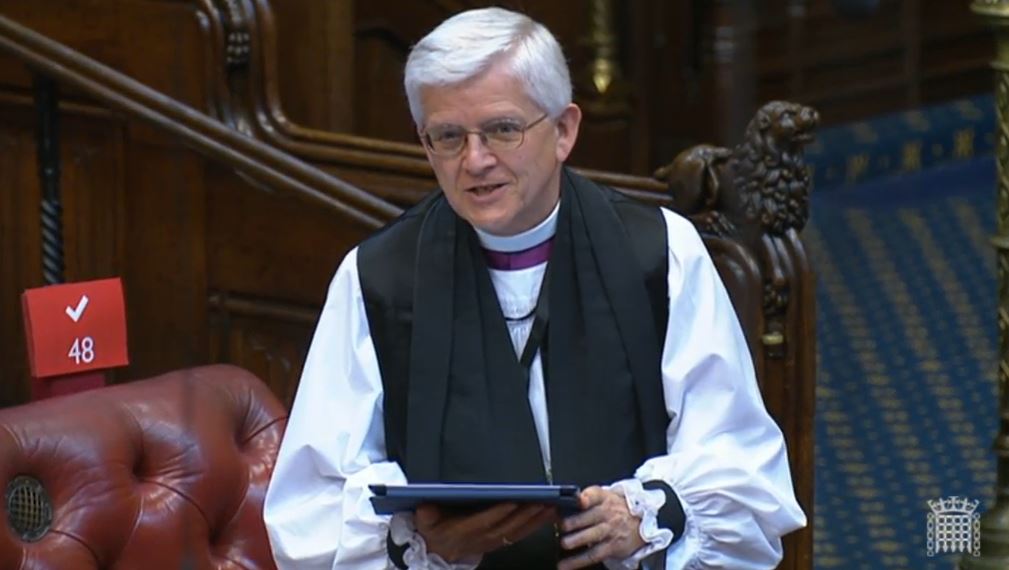
The Lord Bishop of Blackburn: My Lords, I am grateful for the Question and the Minister’s response. My question is about the outcome for the many heritage buildings and schools in this country, where the challenge is often the greatest. Will the Government do anything to make them part of the solution rather than the problem?
On 25th May 2021 the former Archbishop of York, Rt Revd John Sentamu was introduced to the House of Lords to sit as an independent Crossbench Peer. He will sit under the title Lord Sentamu of Lindisfarne in the County of Northumberland and of Masooli in the Republic of Uganda.
The ceremony of introduction for Baron Sentamu, 25th May 2021
Hansard records:
12.08pm The right reverend and the right honourable John Tucker Mugabi Sentamu, having been created Baron Sentamu, of Lindisfarne in the County of Northumberland and of Masooli in the Republic of Uganda, was introduced and took the oath, supported by Baroness Hale of Richmond and Lord Popat, and signed an undertaking to abide by the Code of Conduct.
Asked by The Lord Bishop of St Albans: To ask Her Majesty’s Government, further to the report that the Azerbaijani military blocked Russian peacekeepers accompanying Armenian pilgrims to the Dadivank Monastery in Nagorno-Karabakh, what representations they have made to the governments of (1) Azerbaijan, and (2) Russia, to ensure the continued rights of Armenians to practise their religion in sites located in the territory ceded to Azerbaijan. [HL91]
Asked by The Lord Bishop of St Albans: To ask Her Majesty’s Government what assessment they have made of the six recommendations in the report by the Centre for Social Justice Not a Game – A call for effective protection from the harms of gambling’, published in May, in creating a co-operative framework for effective affordability checks. [HL373]
On 24th May 2021 the Bishop of Blackburn asked a question on behalf of the Bishop of St Albans, on fire safety costs for leaseholders.
The Lord Bishop of St Albans: To ask Her Majesty’s Government what assessment they have made of the (1) current, and (2) future, incidence of leaseholder bankruptcies attributable to remedial fire safety works and interim fire safety costs.
The Lord Bishop of Blackburn: My Lords, on behalf of my right reverend colleague, I ask the Question standing in his name on the Order Paper.
The Bishop of Southwark: To ask Her Majesty’s Government, further to the conviction of Sefer (Aho) Bileçen of the Mor Yahqup d-Qarne Monastery on terrorism charges in April, what assessment they have made of the government of Turkey’s policies towards freedom of (1) religion, and (2) cultural expression.
The Bishop of Southwark: To ask Her Majesty’s Government what assessment they have made of the statement by Patriarch Abuna Mathias in April (1) that the government of Ethiopia and its allies are committing genocide in Tigray, and (2) that rape is being used as a weapon of war in that region.
Rt Hon Mark Pritchard (The Wrekin): To ask the Member for South West Bedfordshire, representing the Church Commissioners, if he will make a statement on what steps the Church of England is taking to support the diocese of (a) Hereford and (b) Lichfield; and what plans the Church of England has to support dioceses with large rural parishes.
Andrew Selous (South West Bedfordshire): Diocesan resourcing of mission and ministry is supported by congregational giving, historic investments and other income. Additional support is provided from national funds generated by the investments of the Church Commissioners and distributed by the Archbishops’ Council.
Andrew Rosindell (Conservative Romford): To ask the Member for South West Bedfordshire, representing the Church Commissioners, what steps the Church of England is taking to ensure the future of St. Paul’s Cathedral.
Andrew Selous (Conservative South West Bedfordshire): The Church Commissioners and other National Church Institutions have been in regular contact with the Dean and Chapter of St Paul’s Cathedral throughout the pandemic as they have with all the Anglican cathedrals in England. The Church Commissioners made additional financial support available to all cathedrals and dioceses throughout the pandemic over and above the financial support they regularly make available.
On 20th May 2021 the House of Lords debated the changes made to its working procedures as a result of the coronavirus pandemic. The Bishop of Birmingham, as convenor of the Lords Spiritual, spoke about the effect on the Bishops’ Benches and more widely in the country.
The Lord Bishop of Birmingham: My Lords, I share, from these Benches, our gratitude for all those who have worked so hard, with agility and rapidity, both the staff that serve the House and those who manage the business of the House, in a very challenging and, in fact, a unique time, as has been referred to several times already.
The noble Earl, Lord Howe, said that every aspect of life has been affected by the coronavirus pandemic. Even churches have become hybrid. Families have been separated and have kept in touch by Zoom. Employers and employees are now negotiating home and back-to-work settings. Online parents’ evenings at schools have become more popular than ever. As has been said already, I join those who are at a moment of learning lessons from what has happened to us, unexpected and unprepared, over the past 15 months. This great disruption means that we will face further change, not just here but in society as a whole.
The decisions we have to make are about what to keep that has been beneficial, or surprisingly new and advantageous, and what to go back to, as what works well for our purpose today. We do so in the context of an uncertain journey ahead, on the road map, and also with the priority to keep everyone safe and well in this terrible time of virus, as I believe we have tried to do in this House.



You must be logged in to post a comment.