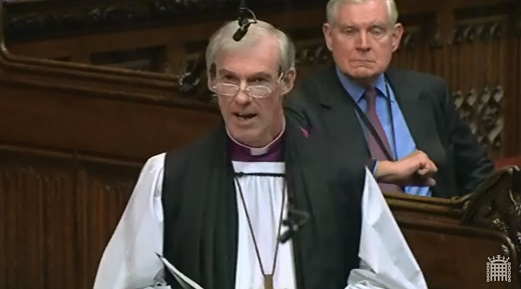
On 11th February 2020 the Bishop of St Albans, Rt Revd Alan Smith, asked a question he had tabled to Government on plans to tackle antisemitism. The response, his follow-up question and those of other Members is below:
Hate Crime: Anti-Semitism
The Lord Bishop of St Albans: To ask Her Majesty’s Government what steps they have taken to address antisemitic hate crime.
Baroness Berridge (Con): My Lords, the Government are committed to combating all forms of antisemitism. Our cross-party working group ensures that we are alive to Jewish community concerns and can respond effectively, alongside the advice of the noble Lord, Lord Mann, as our independent adviser. We have spent nearly £860,000 this year on projects tackling religiously and racially motivated hatred, including almost £150,000 to tackle anti-Semitism online.
The Lord Bishop of St Albans: I thank the noble Baroness for her Answer. According to the Community Security Trust, the number of anti-Semitic instances has risen for each of the past four years. It is a growing problem. We in the churches have been exploring with Jewish groups any role that we may have played in the past with any stereotyping. Recently, the entire College of Bishops of the Church of England signed up to the IHRA definition of anti-Semitism. Education will be key. I am grateful for what the noble Baroness has said, but can she tell us not only about the funds but which projects and resources Her Majesty’s Government are making available so that we can address, through education, the stereotyping and the troping of Jewish people to address this scourge.
Continue reading “Bishop of St Albans asks Government about plans to tackle antisemitic hate crime”
 The Lord Bishop of Leeds: My Lords, there are some wonderful examples of how old mills being rejuvenated and given new life, such as Salts Mill in Saltaire and Manningham Mills, although there is a vast amount of empty space there. If they were icons of the old northern powerhouse, they are now becoming icons of dereliction. Does the Minister agree that if nothing is going to happen, then it would be better to knock them down? I do not favour that, but there needs to be a strategy that allows these wonderful buildings to be brought back into life, to be given a sort of resurrection.
 The Lord Bishop of Winchester:
 The Lord Bishop of Southwark: My Lords, following on from the previous question*, will the Minister consider whether or not it is appropriate for this country to seek to deal with the offences and aftermath of those brought up here as children, rather than expel them to countries of which they know little, save in the most exceptional circumstances?
 Andrew Selous (South West Bedfordshire) (Con): It is a pleasure, albeit a sad necessity for many of us, to speak on a debate on this issue yet again in this House. The analysis I have seen from Open Doors and others shows that in the past three years alone more than 10,000 Christians have been killed for their faith—that is a staggering number. We are right to hold this debate today, because, as others have mentioned, the evidence shows that Christians are the target of about 80% of all the acts of religious discrimination or persecution around the world.
 The Lord Bishop of Oxford: My Lords, I warmly welcome this report and this vital debate. Never before in the scale of human history has there been such a wide and deep threat to our ecosystem or to human flourishing that was so clear and predictable on the horizon. Technology alone is not enough.
 The Lord Bishop of Carlisle: My Lords, this is a very timely debate. I am most grateful to the noble Lord, Lord Hunt of Kings Heath, for securing it. I also look forward very much to the maiden speech of the noble Baroness, Lady Wilcox. We have already heard many statistics with regard to NHS targets and shall no doubt hear many more. But there seems to be general agreement that one of the biggest problems facing the NHS is what many now call a crisis in social


You must be logged in to post a comment.