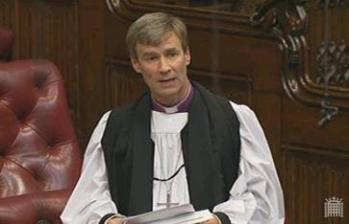
Bishop of Durham praises local partnerships in the north east

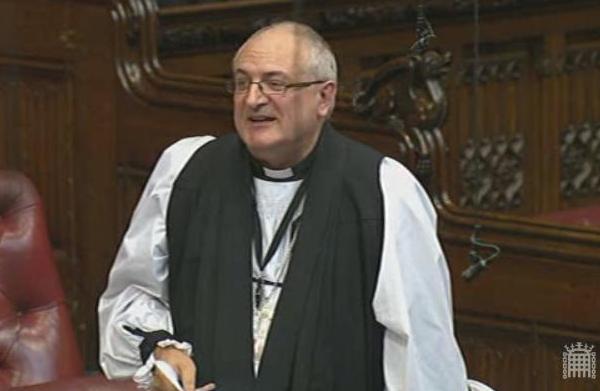
On 28th January 2016 the House of Lords debated a motion from Lord Shipley “that this House takes note of local democracy in the United Kingdom.” The Bishop of Durham, Rt Revd Paul Butler, spoke in the debate about the local authorities in the Durham diocese and partnership work with voluntary and civil society organisations.

14.06.10 Bishop of Durham 5The Lord Bishop of Durham: My Lords, I congratulate the noble Lord, Lord Stunell, on his excellent maiden speech and I look forward to listening to other maiden speeches later. What right does a bishop have to say anything about local democracy? Let me give some quick history. I was a curate in Wandsworth in the 1980s when the borough became either a cause celebre or something else, depending on how you thought about it. I then moved to the London Borough of Newham and experienced a democratically elected autocracy that avoided dictatorship because of the extremely fine leadership of Stephen Timms, who now, of course, serves as an MP in the other place. I then moved to the London Borough of Waltham Forest and worked both as team rector and as area dean on issues of social cohesion, through creating an interfaith project and through working on children’s and young people’s issues and on housing and homelessness. Continue reading “Bishop of Durham praises local partnerships in the north east”

Bishop of St Albans asks Government to engage with energy companies on prepaid meters

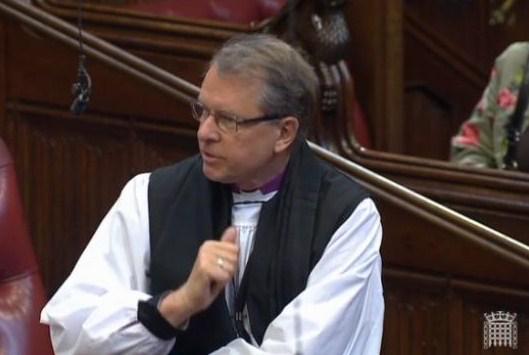
On 28th January 2016 Baroness Donaghy asked Her Majesty’s Government “what is their estimate of the number of households currently in fuel poverty; and what action they intend to take to reduce that number over the next five years.” The Bishop of St Albans, Rt Revd Alan Smith, asked a follow up question.

Bishop of St AlbansThe Lord Bishop of St Albans: My Lords, one concern is prepaid meters, which are an expensive way of paying for fuel. Will the Minister update the House on what progress is being made to promote the five principles agreed between Consumer Focus and the largest energy groups some years ago—I think it was back in 2011? Furthermore, will Her Majesty’s Government ask the large energy companies to reconsider income-differentiated tariffs again? Continue reading “Bishop of St Albans asks Government to engage with energy companies on prepaid meters”

Welfare Reform Bill: Bishop of Durham speaks in favour of measures to aid supported housing

On the 27th January 2016 the Bishop of Durham, the Rt Revd Paul Butler, spoke during the second day of the Report  Stage of the Government’s Welfare Reform and Work Bill. The Bishop spoke in support of an amendment in the name of Lord Best, to exclude supported housing from the proposed social housing rent reduction.

Bp Durham June 2015 b

Continue reading “Welfare Reform Bill: Bishop of Durham speaks in favour of measures to aid supported housing”

Welfare Reform Bill: Divisions, Report Stage day 2

On the 27th January 2016 bishops took part in one vote during the Report Stage day 2 debate on the Government’s Welfare Reform and Work Bill. The amendment was to negate planned reductions in payments for those receiving Employment Support Allowance in the work related activity group.

Lords No Division Lobby

House of Lords Division Lobby

Continue reading “Welfare Reform Bill: Divisions, Report Stage day 2”

Welfare Reform Bill: Bishop of Durham supports 2 child limit exemptions

On 27th January 2016 the Bishop of Portsmouth, the Rt Revd Christopher Foster, proposed an amendment at Report Stage to the Government’s Welfare Reform and Work Bill. The amendment, supported by Labour, Liberal Democrat and Crossbench Peers, set out exemptions from the two-child limit for new claimants of tax credit and universal credit for kinship carers, bereaved parents, those fleeing domestic violence and disabled children. The Bishop of Durham supported the amendment and his speech is below. During his response to the amendment the Minister Lord Freud offered a number of concessions, most notably on kinship carers, and as a result the amendment was not put to a vote.

Bp Durham June 2015 bThe Lord Bishop of Durham: My Lords, I would like to tell two stories that illustrate why I believe two of these exemptions are important. A good friend of mine and his wife were unable to have children, and they put themselves forward as adoptive parents. They went through the rigorous process—this was a few years ago—and with great pride entered a room with several of us who had our own children and presented a piece of paper that said, “I have been authorised to become a parent in a way that none of you ever have”. Continue reading “Welfare Reform Bill: Bishop of Durham supports 2 child limit exemptions”

Welfare Reform Bill: Bishop of St Albans supports move to halt cuts to Employment and Support Allowance

On the 27th January 2016 the Bishop of St Albans, Rt Revd Alan Smith, spoke to support an amendment to the Government’s Welfare Reform and Work Bill. The amendment, in the name of Lord Low of Dalston, would negative a reduction in the Work Related Activity Group of the Employment and Support Allowance. The Bishop highlighted the likely impact on disabled people. 

StAlbans171115The Lord Bishop of St Albans: My Lords, as I said in Committee, if this reduction in benefits for the disabled is about incentivising work rather than simply cutting costs from the benefit budget, I support the Government’s intention. However, the way in which they are going about the task to cut ESA WRAG and its universal credit counterparts is misguided. Clearly, other noble Lords agree with that. For that reason, I am inclined to support the removal of Clauses 13 and 14. Continue reading “Welfare Reform Bill: Bishop of St Albans supports move to halt cuts to Employment and Support Allowance”

Welfare Reform Bill: Bishop of Portsmouth proposes exceptions to the two child limit

BishPortsspeechtaxcreditsOn 27th January 2016 the Bishop of Portsmouth, the Rt Revd Christopher Foster opened the second day of Report Stage on the Government’s Welfare Reform and Work Bill with an amendment in his name. The amendment, supported by Labour, Liberal Democrat and Crossbench Peers, proposed exemptions from the two-child limit for new claimants of tax credit and universal credit for kinship carers, bereaved parents, those fleeing domestic violence and disabled children. During his response to the amendment the Minister Lord Freud offered a number of concessions, most notably on kinship carers, and as a result the Bishop did not press the amendment to a vote. A full transcript of the Bishop’s opening and closing remarks, the Minister’s response and an intervention from the Bishop of Durham, are below.

Continue reading “Welfare Reform Bill: Bishop of Portsmouth proposes exceptions to the two child limit”

Bishop of Chester asks Government about junior doctors’ remuneration

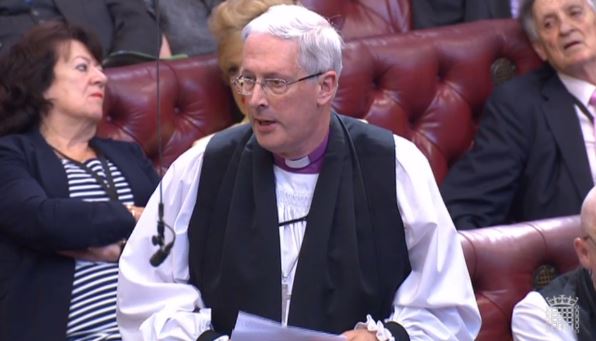
ChesterOn the 27th January 2016 Lord Harries of Pentregarth asked the Government “what assessment they have made of the remuneration of junior doctors”. The Rt Revd Peter Forster, Bishop of Chester, asked a follow up question.

The Lord Bishop of Chester: My Lords, I, too, declare that I have a daughter who is a junior doctor. She is in her fourth year since qualification. To get to the level of remuneration that the noble Lord mentioned—some £23,000—junior doctors have to work jolly long and unsocial hours. But my specific question is: what is the comparator with other developed western countries for the remuneration of our younger doctors?

Continue reading “Bishop of Chester asks Government about junior doctors’ remuneration”

Bishop of Worcester “stigmatising Muslim communities not conducive to community cohesion”

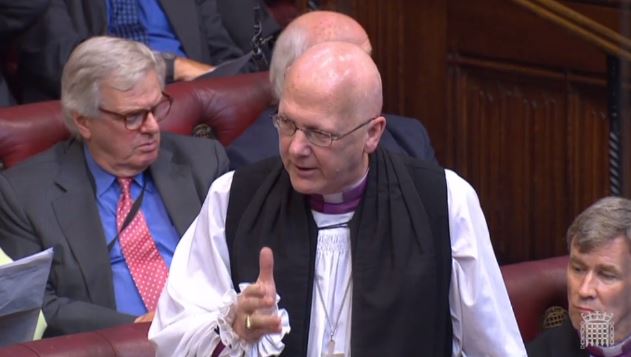
worcesterOn the 27th January 2016 Lord Pearson of Rannoch asked the Government “what assessment they have made of the risk that Christians could be recorded as having committed an anti-Muslim hate crime from April 2016 by preaching the divinity of Christ or by reading aloud sections of the Bible in public, such as 1 John, Chapter 4, verses 1 to 3.” The Rt Revd John Inge, Bishop of Worcester, asked a follow-up question criticising the phrasing of Lord Pearson’s question and highlighting the  contribution of religion to the enrichment of public life. The transcript in full is available below.

The Lord Bishop of Worcester: My Lords, does the Minister agree with me that Questions phrased in this manner are not conducive to building positive relations between faith communities, in particular with Muslim communities, as we are endeavouring to do in the church at a time when Muslims are feeling unfairly stigmatised? Does he further accept that Muslims, and people of all faiths, greatly enrich our society and make a significant contribution to the common good? Continue reading “Bishop of Worcester “stigmatising Muslim communities not conducive to community cohesion””

Housing Bill: Bishop of St Albans raises concerns on rural housing and right to buy

On 26th January 2016, the Bishop of St Albans, the Rt Revd Alan Smith, took part in the Second Reading debate of the Government’s Housing and Planning Bill. The Bishop raised concerns about the impact of the bill on rural affordable housing, right to buy, implications for local councils, and the effect of the Bill on Gypsy, Roma and Traveller communities.


StAlbans171115The Lord Bishop of St Albans: My Lords, I, too, add my congratulations to the noble Baroness, Lady Thornhill, and the noble Lord, Lord Thurlow, on their excellent maiden speeches.

I shall limit my comments to three areas. My first concern stems from the right-to-buy deal that has been agreed between the Government and the NHF, and the provisions within the Bill which will accommodate starter homes within affordable housing requirements. My concern is that housing which would once have been provided as affordable rented housing—affordable in perpetuity—will now be replaced by starter homes and homes to buy, with the only condition on their resale being that they be held off the market for a period of five years. Continue reading “Housing Bill: Bishop of St Albans raises concerns on rural housing and right to buy”