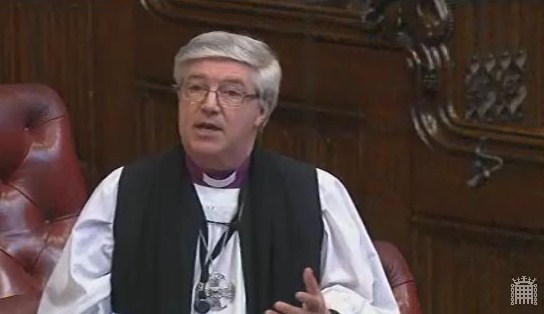
Archbishop of York: ‘working poor’ “a stain on the conscience of this country”

On 25th June 2014, Labour Peer Baroness Thornton asked Her Majesty’s Government what measures they are taking to address any fall in wages of women in the United Kingdom. The Archbishop of York, the Most Revd and Rt Hon John Sentamu,asked a supplementary question:

Archbishop of YorkThe Archbishop of York: My Lords, the Living Wage Commission published its final report yesterday. It makes it clear that people in the care industry are paid very poorly—and the majority happen to be women. Will the Government take a reality check and recognise that people in the care professions are paid poorly? Will they make sure that, in terms of procurement, local authorities encourage those in the care profession to pay at least the living wage, which we wanted to be voluntary and not compulsory? If that does not happen, concern about women being paid poorly will continue. It is a stain on the conscience of this country that people work hard and are still in poverty.

Baroness Northover: I read the report of the most reverend Primate’s commission with enormous interest. I note that he has just said that he is looking for a voluntary approach rather than regulation, but he challenges responsible employers to pay a fair wage. He is right to identify the difference in pay between men and women.

(via Parliament.uk)

Second Church Estates Commissioner praises role of Church in fostering tolerance and mutual respect

14.03.20 WH debateOn 25th June 2014, the Second Church Estates Commissioner, the Rt Hon Sir Tony Baldry MP, took part in a Westminster Hall debate on the teaching of British values. Taking inspiration from a speech made by Her Majesty the Queen at an event at Lambeth Palace, he spoke of the significant role played by the Church of England in creating and sustaining a space in society for the flourishing of those of all religions and those with no religious beliefs. He reflected on the Judeo-Christian values underpinning British society and the importance of tolerance and mutual respect in fostering good relations in communities and throughout society. 

The Second Church Estates Commissioner (Sir Tony Baldry): We are grateful to the right hon. Member for Southampton, Itchen (Mr Denham) for introducing this debate. I do not think we agree with his analysis. Continue reading “Second Church Estates Commissioner praises role of Church in fostering tolerance and mutual respect”

Bishop of St Albans asks questions on Apprentices and Iran

On the 25th June 2014 the Lord Bishop of St Albans received three written answers, on apprenticeship data and on the events in Evin Prison, Iran.

 Apprentices

Bishop of St AlbansThe Lord Bishop of St Albans: To ask Her Majesty’s Government whether their commitment to making better apprenticeship data available will involve publishing the retention rate of apprentices as employees by company and by occupational sector. Continue reading “Bishop of St Albans asks questions on Apprentices and Iran”

Bishop of Birmingham takes part in debate on autonomy and accountability of educational institutions

01.04.14 Bishop of BirminghamOn 24th June 2014, Baroness Perry of Southwark led a short debate to ask Her Majesty’s Government what assessment they have made of the appropriate balance between the autonomy and the accountability of educational institutions. The Bishop of Birmingham, the Rt Revd David Urquhart, took part in the debate and spoke of his involvement in the investigation of allegations of mis-management in schools in Birmingham. The Bishop told the House how autonomy and accountability have been reconciled in Birmingham through setting up a diocesan board of education trust which has published an academies accountability framework. The Bishop argued for local and trusted arrangements to be developed, which are trusted by pupils, staff and parents, by the whole community and the Secretary of State.


The Lord Bishop of Birmingham: My Lords, I welcome the opportunity to address the topic of autonomy and accountability in our educational institutions, particularly in our schools. As noble Lords can imagine, coming from Birmingham, this is a very pertinent topic. We are experiencing a perfect storm of anonymous allegations. Birmingham City Council is conducting various investigations, of which I am a part, into those allegations. Continue reading “Bishop of Birmingham takes part in debate on autonomy and accountability of educational institutions”

Bishop of St Albans speaks in support of greater availability of defibrillators in public spaces

Bishop of St AlbansOn 24th June 2014, Lord Storey led a short debate in the House of Lords, to ask Her Majesty’s Government what action they will take to ensure that all schools, sports clubs and public service buildings have defibrillators as part of their first-aid kit provision.The Bishop of St Albans, the Rt Revd Alan Smith spoken during the debate, and expressed his desire to see a greater number of defibrillators in public spaces including churches and church halls. The Bishop commended the work of charities such as the British Heart Foundation and the Community Heartbeat trust as well as the efforts of the community first responders.
The Lord Bishop of St Albans: My Lords, I am grateful to the noble Lord, Lord Storey, for raising this important issue and for keeping it to the forefront. When I was training to be ordained, I became used to some people going off for a little doze while I was preaching. What I did not know was that, during my very first sermon, somebody—a very nice lady—would have a heart attack. Fortunately, she did not die and I got to know her and her family very well during her convalescence. I saw something of the impact of such events on families; indeed, my sympathy goes out to those who know something of this in their own family.

Continue reading “Bishop of St Albans speaks in support of greater availability of defibrillators in public spaces”

Bishop of St Albans asks Government to consider link between under-occupancy charge and rent arrears in housing associations

On 24th June 2014, Baroness Quin asked Her Majesty’s Government when they expect to publish their interim review on the under-occupancy charge.The Bishop of St Albans, the Rt Revd Alan Smith, asked a supplementary question:

Bishop of St AlbansThe Lord Bishop of St Albans: My Lords, the Ipsos MORI report, undertaken by the National Housing Federation in February this year looked at 183 housing associations. It found that two-thirds of tenants affected by the underoccupancy charge were in rent arrears and 38% indicated that they were in debt. That is the equivalent of 72,000 tenants in housing associations in debt in England alone, which seems to be allied in some way to the underoccupancy charge. What assessment have Her Majesty’s Government made of the impact on housing associations of rent arrears because of the underoccupancy charge?

Lord Freud: We have a general look at the level of arrears through the Homes and Communities Agency, whose statistics show that arrears have fallen—not risen—for the past two quarters in a row. The average rent collection rate for associations remains at 99%, a very high figure, which is very much at variance with some of the stories that we hear and the data that the right reverend Prelate referred to.

(via Parliament.uk)

Bishop of St Albans asks Government for progress report on security and affordability of the off-grid energy supply (Written Question)

On 24th June 2014, the Bishop of St Albans, the Rt Revd Alan Smith, recieved an answer to a written question on off-grid energy supply.

Energy Supply

Bishop of St AlbansThe Lord Bishop of St Albans: To ask Her Majesty’s Government what progress was made towards improving the security and affordability of off-grid fuel supply at the third ministerial roundtable meeting on heating oil and liquid petroleum gas supply on 21 May.

The Parliamentary Under-Secretary of State, Department of Energy and Climate Change (Baroness Verma): My Rt. Hon. Friend the Minister of State for Energy chaired the third Ministerial Roundtable meeting on heating oil and LPG supply on 21 May. My rt. hon Friend the Minister of State for Climate Change joined the roundtable discussion on off gas grid fuel poor households and support for off gas grid consumers. This continued the useful discussions government has had at the previous two Roundtables with representatives from industry, consumer groups, oil buying groups and others on how to improve heating oil and LPG supply to UK consumers.

Issues covered at the third roundtable included the promotion of the Federation of Petroleum Suppliers’ Customer Charter, the messaging to consumers on buying oil early ahead of the winter and an update on the action government is taking more broadly to help fuel poor off-grid households. Full details of the meeting can be found in the minutes of the meeting which has been placed in the Library of the House.

(via Parliament.uk)

Church of England Week in Westminster, 16 – 20 June 2014

Church of England – Week in Westminster:16th – 20th June 2014

Welcome to the Church of England’s weekly round-up of activity in Parliament by the Lords Spiritual and the Second Church Estates Commissioner.

In the past week, bishops in the House of Lords have spoken on the Government’s Serious Crime Bill and Infrastructure Bill,   House of Lords reform, immigration removals, and the Middle East. They also received answers to written questions on financial education and climate change. In the House of Commons the Second Church Estates Commissioner answered a written question on responses to parliamentary questions.

Continue reading “Church of England Week in Westminster, 16 – 20 June 2014”

Bishop of Derby takes part in debate on the future of the House of Lords

“…we need a different kind of representation of the people besides that of MPs and those who vote for them. We need a supplementary system of representation that represents networks, groups, cultures and faiths—that whole complex ecology in which human beings live” – Bishop of Derby, 19/6/14

On 19th June 2014, the Bishop of Derby, the Rt Revd Alastair Redfern, took part in Baroness Taylor of Bolton’s take-note debate on the Labour Peers’ Working Group report on the future of the House of Lords and its place in a wider constitution. He spoke about the ability of the House of Lords to act as a advocate for a diverse number of voices from civil society and strengthen the democratic process.

Bishop of DerbyThe Lord Bishop of Derby: My Lords, it a great honour and privilege to follow the noble and right reverend Lord, Lord Harries of Pentregarth. I have spent a lot of my ministry following his example and inspiration. I thank him for his contribution.

I am grateful for this report and for the clear presentation of the noble Baroness, Lady Taylor. I welcome the continuing debate and the whole style of incremental reform, which is the right approach. The report begins by recognising a significant feature of our times: widespread disengagement with our parliamentary system. We keep saying that and then just moving on. I want to ask us to stop and think about that phrase for a minute.

Continue reading “Bishop of Derby takes part in debate on the future of the House of Lords”

Bishop of Derby promotes community-based strategy to tackle radicalisation

“I tell noble Lords from my own experience that if we are too heavy-handed we risk further radicalising families and communities at the grass roots, if some of their young are treated without any notion of a trial or evidence—all those British things that we try to stand for. We must handle this matter very carefully” – Bishop of Derby, 19/6/14

On 19th June 2014, Lord Dykes led a debate to ask Her Majesty’s Government what is their assessment of the threat from the spread of militant aggressive jihadism in the Middle East. The Bishop of Derby, the Rt Revd Alastair Redfern, took part in the debate, speaking of the challenges associated with tackling transnational groups, and the need for close international co-operation in dealing with them. He also spoke of the need for strong community-based work in the UK, to help tackle and reduce instances of British citizens fighting in the Middle East. He endorsed the strong heritage of European Islam and of the need to engage its voice in a sophisticated debate.

DerbyThe Lord Bishop of Derby: My Lords, I, too, congratulate the noble Lord, Lord Dykes, on securing this timely debate. I want to look at the Motion as it is set out. It concerns,

“the assessment of the threat from the spread of militant aggressive jihadism in the Middle East”.

Continue reading “Bishop of Derby promotes community-based strategy to tackle radicalisation”