Second Church Estates Commissioner urges Government to resist liberalisation of Sunday trading rules

On 19th June 2014, the Second Church Estates Commissioners, the Rt Hon Sir Tony Baldry MP, spoke during the weekly debate on the Business of the House. In his brief remarks, he called on the Government to resist amendments to the Deregulation Bill (debated 23rd June) that would deregulate Sunday trading. The Leader of the House of Commons gave assurances that the Government does not support a change in the Sunday trading rules.

14.01 CCQ BaldrySir Tony Baldry (Banbury): Next Monday, the House will debate the Report stage and Third Reading of the Deregulation Bill. My right hon. Friend will have noted that our hon. Friends the Members for Shipley (Philip Davies) and for Bury North (Mr Nuttall) have tabled a number of new clauses which, if passed, would completely deregulate Sunday trading. I must tell my right hon. Friend that any such move by the House would be seen by the Church of England—and, I am sure, by many other faith groups—as an act of bad faith on the part of Parliament. The present Sunday trading arrangements arose from a series of compromises that were agreed in the mid-1990s to strike a balance between keeping Sunday special and enabling more stores and shops to open on Sundays. I should welcome my right hon. Friend’s reassurance that if you, Mr Speaker, select any of the new clauses for debate, they will be resisted by the Government.

Continue reading “Second Church Estates Commissioner urges Government to resist liberalisation of Sunday trading rules”

How the church can help deliver community energy projects: Bishop of Derby speaks on the Infrastructure Bill

“We need to get people in their own backyards to understand, participate in and support this kind of culture change, without which our whole aspiration to deal with climate change issues will fall very far short” – Bishop of Derby, 18/6/14

Derby

The Government’s Infrastructure Bill was debated at its Second Reading in the House of Lords on 18th June 2014. During the debate, the Bishop of Derby, Rt Rev Alastair Redfern, focused on community energy provisions and, drawing on local examples, the role that churches can play as intermediary institutions. More details on the Bill, which also contains provisions on transport, planning and housing, can be found here.

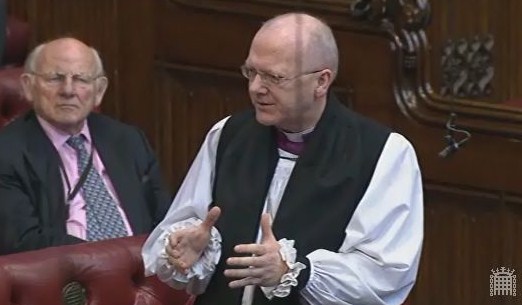
The Lord Bishop of Derby: My Lords, I, too, welcome the Infrastructure Bill and its joined-up thinking. A number of noble Lords have looked across the whole Bill and the large scale of it, but I shall look at only a specific area—that of community energy—and ask the Minister about how the Government can deliver on that. Continue reading “How the church can help deliver community energy projects: Bishop of Derby speaks on the Infrastructure Bill”

Impact on children and families of immigration removals: Bishop of St Albans questions Government

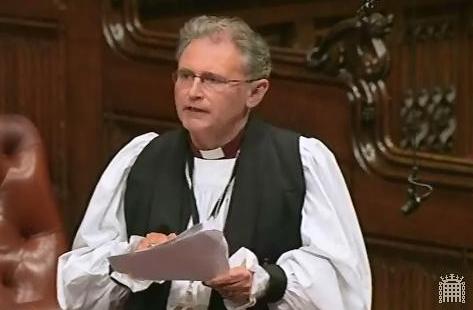
On 18th June 2014 Lord Roberts of Llandudno asked the Government “what assessment they have made of the report Cedars: two years on by Barnardo’s; and what plans they have to implement the recommendations made in that report.” The Bishop of St Albans, Rt Rev Alan Smith, asked a supplementary question:Bishop of St Albans

The Lord Bishop of St Albans: My Lords, the Chief Inspector of Prisons has written a subsequent report on Cedars. It describes a worrying incident where an arrest team arrived in full protective clothing and spent three minutes battering down the door of a house; there was no awareness of whether there was a child or children in the house, which could have been deeply traumatic for those young people. Does the noble Baroness agree that we need to have a full review of arrest procedures to try to prevent such situations?

Baroness Williams of Trafford: I thank the right noble Prelate for his question. I am sorry—I was so focused on the answer that I forgot the right reverend Prelate’s title. I think that there are lessons learnt from situations like that, and I know that refresher training is going on. I hope that, again, the specialist teams will provide that more consistent journey and that the lessons learnt will enable a better arrest and removal procedure in future.

(via Parliament.uk)

Church Commissioners – Written Answer

On 17th June 2014, the Second Church Estates Commissioner, the Rt Hon Sir Tony Baldry MP, answered a written question on behalf of the Church Commissioners.

Tony Baldry MPChurch Commissioners

Alison Seabeck: To ask the right hon. Member for Banbury, representing the Church Commissioners how many parliamentary questions tabled to the Church Commissioners in the last parliamentary Session did not receive a substantive answer by the time of the 2014 prorogation; and when each such question was first tabled.

Sir Tony Baldry: All written questions tabled to the Church Commissioners received a substantive answer by the time of the 2014 prorogation.

(via Parliament.uk)

Bishop of St Albans asks Government for update on international climate agreements (Written Question)

On 17th June 2014, the Bishop of St Albans, the Rt Revd Alan Smith, received an answer to a written question on climate change.

Climate ChangeBishop of St Albans

The Lord Bishop of St Albans: To ask Her Majesty’s Government what progress has been made in securing a deal on the European Union’s 2030 climate change reduction package, in advance of the United Nations Secretary-General’s Climate Summit in September.

The Parliamentary Under-Secretary of State, Department of Energy and Climate Change (Baroness Verma): The European Council in March 2014 discussed the 2030 climate and energy framework and agreed to make a final decision on the Framework no later than October this year.

The UK believes that the EU should urgently adopt a domestic emissions reduction target for 2030 of at least 40% on 1990 levels, moving to 50% in the context of an ambitious global climate agreement.

I am determined to continue working closely and intensively with all my colleagues in Europe to ensure that the EU is in a position to play a leading role at the Ban Ki-Moon Climate Summit in September.

(via Parliament.uk)

Bishop of Derby calls for strong partnerships between government and society to tackle serious crime

“This modern crime is not just about technical ingenuity; it is about people choosing the freedom to abuse others and society” – Bishop of Derby, 16/6/14

On 16th June 2014, the Bishop of Derby, the Rt Revd Alastair Redfern, took part in the Second Reading debate on the Government’s Serious Crime Bill. In his speech, he addressed the Bill’s provisions to tackle modern slavery and human trafficking – having served on the Joint Committee which provided the pre-legislative scrutiny to the Modern Slavery Bill – and also the need for joined-up work across government and civil society to challenge the sub-culture of exploitation and greed that drives organised crime and criminality.

DerbyThe Lord Bishop of Derby: My Lords, I very much welcome this Bill and think it is timely and appropriate. I congratulate the noble Lord, Lord Taylor, and his colleagues at the Home Office on pointing us in this direction. Noble Lords will have seen in the briefing that it is based on a strategy described as the four Ps: Pursue, Prevent, Protect and Prepare. For somebody like me, such laboured alliteration might indicate an overambitious sermon and I want to check the level of the ambition and what might be appropriate.

Continue reading “Bishop of Derby calls for strong partnerships between government and society to tackle serious crime”

Bishop of St Albans receives written answers on financial education

On 16th June 2014, the Bishop of St Albans, the Rt Revd Alan Smith, received answers to two written questions on financial education.


Bishop of St AlbansFinancial Services: Education

The Lord Bishop of St Albans: To ask Her Majesty’s Government how they intend to ensure that financial education is taught, to a high standard, in non-state-maintained secondary schools.

The Parliamentary Under-Secretary of State for Schools (Lord Nash): Independent Schools in England do not have to follow the national curriculum, though they do have to have a curriculum which gives pupils experience in linguistic, mathematical, scientific, technological, human and social, physical and aesthetic and creative education.

We will shortly be consulting on strengthening the standards which independent schools must meet, but there are no plans to introduce a requirement on financial education.

Continue reading “Bishop of St Albans receives written answers on financial education”

Bishop of Carlisle raises concerns about health inequalities for people with learning disabilities

“Even when all the other factors have been taken into account, the disparity in mortality between people with and without learning difficulties is alarming” – Bishop of Carlisle, 12/6/14

On 12th June, the House of Lords debated a motion from Baroness Hollins: ‘To ask Her Majesty’s Government what action they are taking to address the health inequalities found by the Confidential Inquiry into Premature Deaths of People with Learning Disabilities’. The Bishop of Carlisle, Rt Rev James Newcome, who is the lead CofE bishop for healthcare issues, spoke in the debate. He highlighted the need for greater monitoring of the causes of health inequalities for those with learning disabilities, better training for health professionals and improved advocacy and service design, especially to involve patients.

14.06.09 Bishop of Carlisle

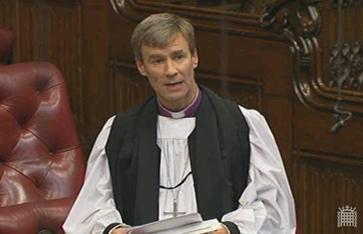
The Lord Bishop of Carlisle: My Lords, in this debate we are asking Her Majesty’s Government to do three things. The first is to recognise the situation that currently exists, as we have heard, with regard to people with learning disabilities. It has been pointed out that the situation is one of considerable inequality. Continue reading “Bishop of Carlisle raises concerns about health inequalities for people with learning disabilities”

House of Lords debates ‘the importance of the English Parish Church’

“No other country in Europe has less financial support from the taxpayer for ecclesiastical heritage than England—which, ironically, has an established church” – Bishop of Norwich, 12/6/14

On 12th June Lord Cormack led a debate in the House of Lords on the subject ‘That this House takes note of the importance of the English parish church.’ The Bishop of Norwich spoke in the debate, about the community and financial value of parish churches, their heritage importance and current financial pressures. Lord Ahmad responded for the Government. Their speeches are reproduced in full below. The Bishop’s speech can also be viewed at ParliamentLive.TV and a useful summary of the debate can be found on the Law & Religion UK website, here.

14.06.12 Bishop of Norwich

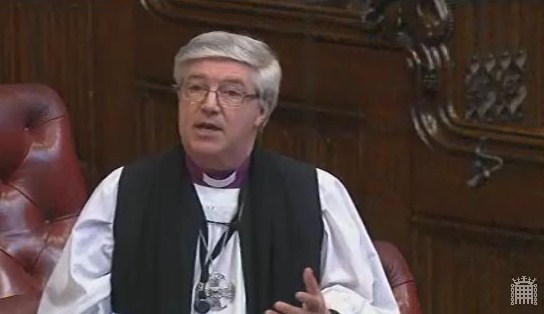
The Lord Bishop of Norwich: My Lords, we are meant to declare our interests in this House, but I think that standing here dressed like this is probably a visual declaration. Noble Lords will not be surprised to learn that I believe that the Motion tabled by the noble Lord, Lord Cormack, to take note of the importance of our parish churches, is one that I am happy to endorse. It applies in Wales and Scotland as well, of course, although I need to be a bit careful of the Presbyterian conscience and not presume any authority north of the border. Continue reading “House of Lords debates ‘the importance of the English Parish Church’”

Bishop of Norwich presses Government on lack of affordable new homes in rural areas

On 12th June 2014 Lord Dubs asked Her Majesty’s Government ‘what action they are taking to increase the supply of affordable housing.’ The Bishop of Norwich, Rt Rev Graham James, asked a supplementary question:14.06.12 Bishop of Norwich

The Lord Bishop of Norwich: My Lords, eight years ago the Affordable Rural Housing Commission estimated that we needed at least 11,000 affordable new homes every year in rural areas. We have scarcely ever managed more than a third of that number, and the proportion is falling. That means that those who need such homes in rural areas move to urban areas, adding to the numbers of the urban homeless and further obscuring the rural problem. What remedy does the Minister have for this state of affairs? Continue reading “Bishop of Norwich presses Government on lack of affordable new homes in rural areas”