On 13th April 2021, the House of Lords debated the Overseas Operations (Service Personnel and Veterans) Bill. Votes were held on amendments to the bill, in which Bishops took part:

On 13th April 2021, the House of Lords debated the Overseas Operations (Service Personnel and Veterans) Bill. Votes were held on amendments to the bill, in which Bishops took part:
The Bishop of Portsmouth asked a question on the potential negative impact of cuts to the size of the Armed Forces on 23rd March 2021, following a government statement on the Integrated Review: Defence Command Paper:
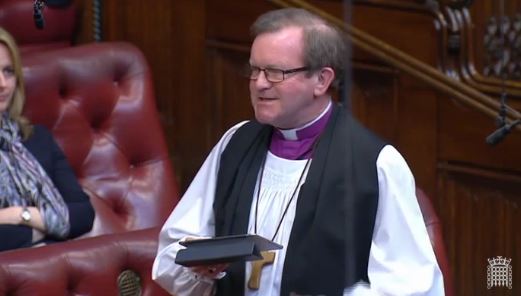
The Lord Bishop of Portsmouth: My Lords, there is much to be welcomed in the defence Command Paper and the integrated review. As the Bishop of Portsmouth, I particularly welcome the ambitious signals to British shipbuilding for the Navy. However, I worry that, noting the tilt to the Indo-Pacific and expansion of Britain’s geographical scope into Africa, the integrated review does not suggest reducing the UK Government’s commitments anywhere, yet the proposed cuts to the Armed Forces mean the smallest full-time Army for centuries. Size is not everything, but are we asking too much of the Armed Forces? Do we risk overstretch? We seem to be gaining commitments, while failing to resource the resolution of existing challenges. Can the Minister indicate how the Government intend to flesh out their order of priorities?
Continue reading “Bishop of Portsmouth asks about impact of cuts to the Armed Forces”The Bishop of Portsmouth spoke during a debate on the role of the UK armed forces in the government’s Global Britain agenda, raising the issue of the Armed Forces Covenant and the need to support the wellbeing and mental health of members of the armed forces and armed forces veterans:
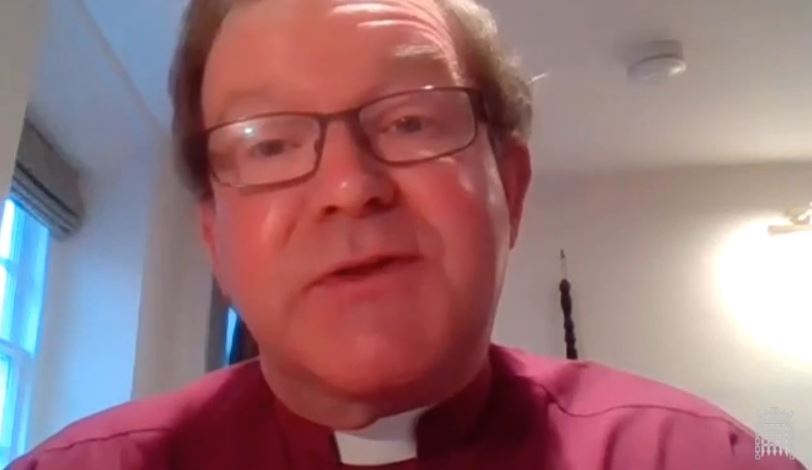
The Lord Bishop of Portsmouth [V]: My Lords, if the Armed Forces are to continue to promote global Britain, we must look after them and fulfil our obligations under the Armed Forces covenant. Research by the Royal British Legion and Poppyscotland points to the difficulties that veterans are encountering in getting benefits assessors to understand post-traumatic stress disorder when scoring health assessments for disability benefits. One stated that:
“I supplied a consultant psychiatrist’s letter stating all my mental health conditions. I scored zero. This is laughable”.
I agree. A government spokesman has said that the report would be given careful consideration, but consideration must be given both carefully and urgently if we are to continue to promote global Britain.
On 20th January 2021, the Bishop of Portsmouth spoke at the second reading of the Overseas Operations (Service Personnel and Veterans) Bill, questioning the effectiveness of the legislation and potential repercussions on legitimate claims against members of the the armed forces:
The Lord Bishop of Portsmouth [V]: My Lords, reflecting on the Bill, its intentions and likely legal effect reminded me of something I learned during my time as chaplain of Wadham College, Oxford, during the febrile days of the 1980s. Wadham was then, as now, a crucible of intellectual innovation, not least in literary studies. Its senior English fellow then was Terry Eagleton, who interested himself in a method of criticism known as deconstruction. This meant, I think, that the story we thought we were reading or being told was undermined by another narrative hidden within the text, so what we might have thought meant one thing often meant something entirely different.
The Bill before the House represents a model of deconstruction. The Government’s stated intention is, as we heard in the gracious Speech,
“to tackle vexatious claims that undermine our Armed Forces”.
I regret to say that I cannot see how the Bill, as drafted, fulfils that intention. The Government may then deserve two cheers for acting when other Governments have not, but action is not the same as outcome. The good intentions of Ministers and their statements in Parliament and the media do not match what the Bill will do. The Bill would do what the Bill states, not what the Government would like it to do, or what an MoD press release announces as its objectives. I leave it to other noble Lords far better qualified than I to reflect on the very troubling risk that the Bill might lead to crimes of torture going unpunished as well as providing an attractive precedent for those countries that have historically accepted lower standards than our own.
Continue reading “Overseas Operations (Service Personnel and Veterans) Bill: Bishop of Portsmouth speaks at second reading”On 3rd November 2020 the Bishop of St Albans received a written answer to two questions on gambling and the armed forces:
 The Lord Bishop of St Albans: To ask Her Majesty’s Government whether the existing syllabus for new recruits to the armed forces currently includes training on gambling related harm. [HL9440]
The Lord Bishop of St Albans: To ask Her Majesty’s Government what plans they have to enact legislation similar to the Gambling Addiction Prevention Act 2019 in the United States, which legally requires the development and implementation of policies and programmes to prevent and treat gambling disorders among members of the armed forces and their dependants. [HL9441] Continue reading “Bishop of St Albans asks about gambling and armed forces”
On 19th May 2020, Lord Touhig asked the Government “what steps they are taking to coordinate the response to the COVID-19 pandemic with NATO to prevent any security risks”. The Bishop of Portsmouth, Rt Revd Christopher Foster, asked a follow-up question:

The Lord Bishop of Portsmouth: My Lords, one of the most significant threats to our security would be if our Armed Forces were unable to guarantee that security and to play their part in NATO. With the recent positive tests for Covid among some of the crew on HMS “Queen Elizabeth”, is the Minister confident that any member of the Armed Forces who needs a test has ready access to one? How many have been tested, and how many of those tests have been positive?
Continue reading “Bishop of Portsmouth asks Government about Covid-19 tests for Armed Forces”
On 2nd April 2019 the House of Lords debated a Government motion “That this House takes note of the seventieth anniversary of the founding of NATO and its continuing role in the United Kingdom’s defence and security.” The Bishop of Portsmouth, Rt Revd Christopher Foster, spoke in the debate:
The Lord Bishop of Portsmouth: My Lords, it is as ever a pleasure to speak in your Lordships’ House, but today perhaps I feel the privilege especially. I cannot report that, 70 years ago, a Bishop contributed to this House’s debate on the founding of NATO. Without the personal, military, diplomatic or political experience to which the Minister alluded, I am grateful for the forbearance of your Lordships in listening to my contribution today.
Continue reading “Bishop of Portsmouth speaks on 70th anniversary of NATO”
On 19th October 2017 the House of Lords debated a motion from Lord Black “That this House takes note of the centenary of the Battle of Passchendaele and of Her Majesty’s Government’s plans to commemorate it.” The Bishop of Derby, Rt Revd Alastair Redfern, spoke in the debate, highlighting the role of chaplaincy in the First World War and the example of ‘Woodbine Willie’, Geoffrey Studdert Kennedy:
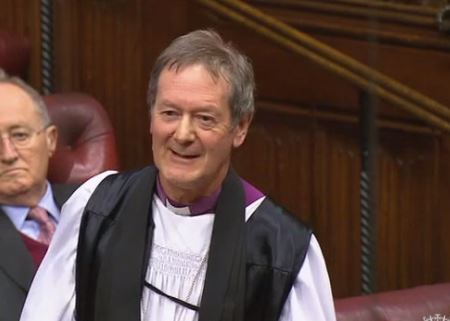 The Lord Bishop of Derby: My Lords, I, too, thank the noble Lord, Lord Black of Brentwood, and associate myself with the lovely phrase that it is both a privilege and very humbling to be part of this remembrance.
Passchendaele is, as we have heard, a symbol of war: the human cost, the sheer complexity of leadership and the sheer complexity of operations. Commemoration is not simply to remember but, as the noble Lord, Lord West, has just pointed out, to learn, to take something, to honour what people gave in their lives and commitment, and to see how that can inspire us and point us forward positively. It is a sign of huge issues in international relations, warfare and military and political leadership. Continue reading “Bishop of Derby on the role of chaplaincy in the First World War and ‘Woodbine Willie’.”
On 11th October 2017 the House of Lords voted on an amendment to the Government’s Armed Forces (Flexible Working) Bill [HL]. Two bishops took part in the vote. Continue reading “Votes: Armed Forces (Flexible Working) Bill”
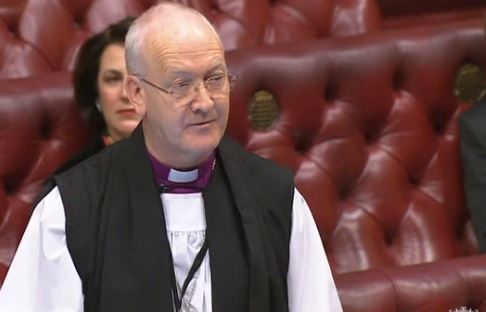 On 21st March 2017 the Government’s Armed Forces Act (Continuation) Order 2017 was laid before Parliament with a motion to approve. The Bishop of Leeds, the Rt Revd Nick Baines spoke in the debate, commenting on the UK’s relationship with Russia.
The Lord Bishop of Leeds My Lords, I hesitate to follow such eloquent speeches on so much detail, but I want to make one or two general points about a more specific area. I do so from an interest that began when I was a Soviet specialist at GCHQ in a previous incarnation, although I realise that that is probably not the right religious phrase to use.
It still seems to me that an SDSR should enable us to be flexible enough to cope with whatever changes are likely to come. My fear, which I have expressed in the House before, remains that in 15 to 20 years’ time we may end up with a force that meets the demands of now but perhaps not the demands of the situation 15 or 20 years down the line because the world changes so much. When I left GCHQ, the Soviet Union was intact, and we see what has changed since then. Therefore, I want to focus on Russia in particular. Continue reading “Bishop of Leeds comments on the capability of the armed forces and the UK’s relationship with Russia”
 The Church of England in Parliament
You must be logged in to post a comment.