EU (Notification of Withdrawal) Bill: Archbishop of York supports protecting rights of EU nationals, opposes amendment as vehicle to deliver

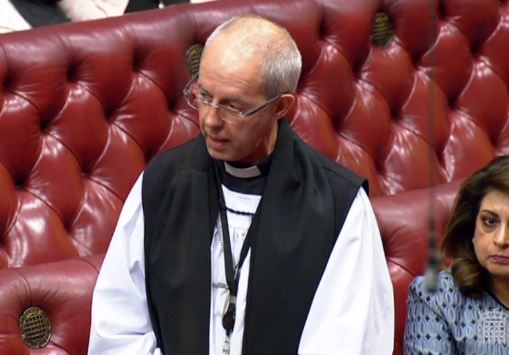
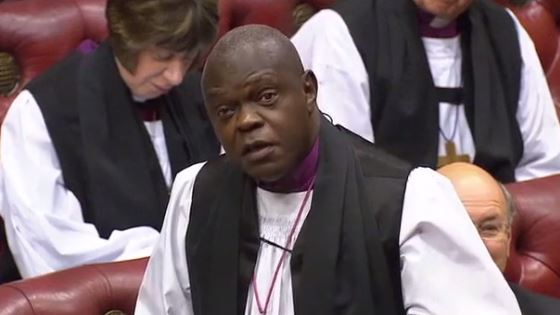
On 1st March 2017 the House of Lords considered the Government’s EU (Notification of Withdrawal) Bill in its second day of committee. An amendment was tabled by Labour Peer Baroness Hayter, requiring Ministers to bring forward proposals for guaranteeing continued rights for EU nationals residing in the UK, no more than three months after the formal negotiations to exit the EU had begun. The Archbishop of York, Most Revd and Rt Hon John Sentamu, argued against the amendment on the grounds that this was the wrong vehicle to address such serious and important matters. They would, he said, be better and more speedily dealt with if they were not enshrined in legislation that had the single purpose of giving Government authority to begin the Article 50 negotiation process. Peers voted t back the amendment in the subsequent vote.The Archbishop’s speech is in full below, followed by excerpts from some of the speeches that referred to his remarks:

 aby-010317The Archbishop of York: My Lords, Uganda was referred to by the noble Viscount, Lord Hailsham. It was regrettable that Idi Amin kicked out two types of Asians—British citizens and Ugandan citizens. My opposition to him was over the Ugandan citizens, who were the largest number. He kicked them out and my coming here in 1974 was as a result of my opposition to such behaviour. So I know how minorities can feel in a place. I know that we need to reassure our European friends who are resident here and want to remain here.

However, I have one great difficulty. Your Lordships’ House can scrutinise and revise legislation, but this simple Bill is simply to confer power on the Prime Minister to notify under Article 50 of the Treaty on the Functioning of the European Union that there is an intention to withdraw. It is giving her the power which I believe only Parliament—not the royal prerogative—can give her. Continue reading “EU (Notification of Withdrawal) Bill: Archbishop of York supports protecting rights of EU nationals, opposes amendment as vehicle to deliver”

Votes: EU (Notification of Withdrawal) Bill

On 1st March 2017 the House of Lords considered the Government’s EU (Notification of Withdrawal) Bill at committee. A vote was called on an amendment from Labour Peer Baronss Hayter. Five Lords Spiritual took part. Continue reading “Votes: EU (Notification of Withdrawal) Bill”

EU (Notification of Withdrawal) Bill: Bishop of Newcastle highlights contribution of Newcastle University to North East economy

Newcastle 8On 27th February 2017, Labour Peer Baroness Quin moved an amendment to the Government’s EU (Notification of Withdrawl) Bill, requiring Government to undertake an impact assessment of the impact of Brexit on the North-East of England. The Bishop of Newcastle, the Rt Revd Christine Hardman, spoke to the amendment to highlight the contribution of Newcastle University to the North-East economy. The amendment was later withdrawn after debate.
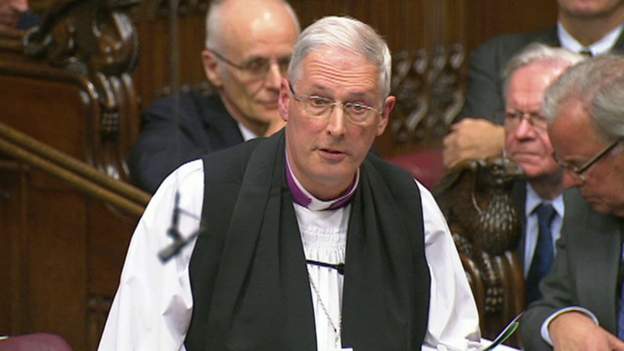
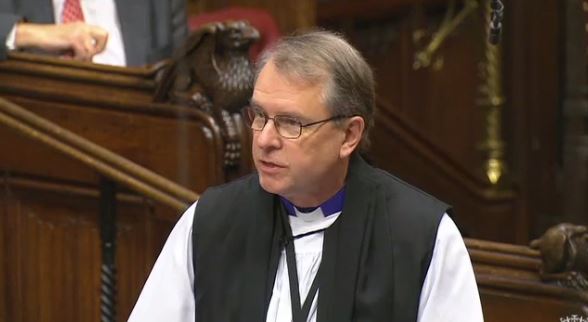
Bishop of Newcastle: My Lords, I declare an interest as a member of the court of Newcastle University. The amendment tabled by the noble Baroness, Lady Quin, and the noble Lord, Lord Shipley, asks for an impact assessment of the effect of Brexit on the economy of the north-east. When we think about that economy, perhaps our thoughts turn first to the EU funding that the economy receives and then to the manufacturing sector. But the city of Newcastle is deeply enriched by the presence of two first-class universities, and there are 50,000 students in Newcastle. Tomorrow a report will be released to the media which details the extraordinary contribution of Newcastle University to the economy of the north-east. Continue reading “EU (Notification of Withdrawal) Bill: Bishop of Newcastle highlights contribution of Newcastle University to North East economy”

EU (Notification of Withdrawal) Bill – speech by Bishop of Southwark

On 20th February 2017 the House of Lords held the first in a two-day debate on the Government’s EU (Notification of Withdrawal) Bill. The Bill would give the Government authority to begin the process of withdrawal from the European Union. The Bishop of Southwark, Rt Revd Christopher Chessun, spoke in the debate:

southwark-20feb17

The Lord Bishop of Southwark:As many in your Lordships’ House are aware, my diocese covers most of south London and east Surrey. The voters there opted to remain in the European Union on 23 June 2016 by some margin; in the borough of Lambeth, where I live, nearly 80% of those voting opted to remain. Only in Sutton and in Surrey did votes tip the other way. What I have occasionally heard articulated, but have yet to see in action, is how the aspirations of those people—and indeed, if one thinks more widely, Londoners in general, or Scots, or the people of Northern Ireland or simply people under the age of 45—are to be taken into account. The majority of all these groups voted to remain. If we adopt a model for leaving the EU that ignores them, we risk a regional divide, generational resentment and a threat to the union.

Continue reading “EU (Notification of Withdrawal) Bill – speech by Bishop of Southwark”

Bishop of St Albans says UK must be a world leader in disability rights, post-Brexit

On 2nd February 2017 Baroness Scott of Needham Market led a debate in the House of Lords “to ask Her Majesty’s Government what assessment they have made of the impact on disabled people of the United Kingdom’s withdrawal from the European Union.” The Bishop of St Albans, Rt Revd Alan Smith, spoke in the debate:

stalbans190117The Lord Bishop of St Albans: I too am grateful to the noble Baroness, Lady Scott, for giving us the opportunity to reflect on this important subject. For many years, the European Union has been an important driver of disability rights in the UK, helping to improve disability access and strengthen non-discrimination laws right across Europe. It was the European Union that ensured non-discrimination laws were extended to smaller businesses, and the European Court of Justice which extended rights to carers and those in relationships with a disabled person, to name just two examples. With the proposed European Accessibility Act still some time away from implementation, I hope the Minister can understand the fear expressed by many in this House and outside it that a post-Brexit UK may start to fall behind its European counterparts when it comes to disability rights. Continue reading “Bishop of St Albans says UK must be a world leader in disability rights, post-Brexit”

Bishop of St Albans asks for reassurances on food standards post-Brexit

On Thursday 2nd February Baroness Miller of Chilthorne Domer asked Her Majesty’s Government “what measures they will put in place following Brexit to safeguard environmental standards and biodiversity.” The Bishop of St Albans, Rt Revd Alan Smith, asked a follow-up question:

stalbans190117-bThe Lord Bishop of St Albans: My Lords, we are all reassured that EU environmental legislation is going to be enshrined within UK law, but we will probably be coming out of the single market and entering into a series of trade negotiations with, for example, the United States. Trade negotiations are just that: we will have to make compromises. Will the Minister assure the House that we will not be producing our food to lower standards or consuming food that has been produced more cheaply by undercutting our industry—for example, chicken washed in chlorine and beef reared on growth hormones? Continue reading “Bishop of St Albans asks for reassurances on food standards post-Brexit”

Bishop of Durham speaks of Brexit uncertainty for families with EU citizens in UK

On 26th January 2017 Labour Peer Baroness Hayter of Kentish Town led a debate on a Motion “That this House takes note of the impact of the United Kingdom’s withdrawal from the European Union and potential withdrawal from the single market on the rights of European Union citizens living in this country and the United Kingdom’s future economic requirements.” The Bishop of Durham, Rt Revd Paul Butler, spoke in the debate:

durham-230117The Lord Bishop of Durham: My Lords, I thank the noble Baroness, Lady Hayter, for introducing this debate. At the outset, I will take the opportunity to thank the Minister, the noble Lord, Lord Bridges, for his participation in ongoing conversations with the Church of England around these issues and for the time he has taken in hearing our concerns. Continue reading “Bishop of Durham speaks of Brexit uncertainty for families with EU citizens in UK”

Archbishop of Canterbury responds to Supreme Court Article 50 judgement

archbishops-canterbury-240117On 24th January 2017 the House of Lords heard the repeat of a Government statement to the House of Commons on ‘The Process for Triggering Article 50’, following the judgement of the Supreme Court that Parliament must be involved. The Archbishop of Canterbury, Most Revd Justin Welby, responded:

The Archbishop of Canterbury: Does the Minister agree that the Bill which will come to this House is essentially about process, not outcomes? The way we handle our processes is different from how we may argue about outcomes at the end of this whole two-year period. The use of language which may occasionally sound threatening is very unhelpful if, at the end of the two-year period we are to end up with a country which can go forward in a reconciled, prosperous and flourishing way. I hope the Minister agrees that those who, like the judges, have quite rightly come to an unbiased and impartial opinion, should be defended against criticism, as should the person who brought the case. We need to take our processes calmly and quietly, without issuing threats and with an eye to the unity of this country. Continue reading “Archbishop of Canterbury responds to Supreme Court Article 50 judgement”

Bishop of Leeds – liberal international order not a natural given or inevitable right

On 19th January 2017 Liberal Democrat Peer Lord Bruce of Bennachie led a debate “that this House takes note of challenges to the liberal international order posed by the development of populism and nationalism around the world.” The Bishop of Leeds, Rt Revd Nick Baines, spoke in the debate:

leeds-20117-bThe Lord Bishop of Leeds: My Lords, I am grateful for the opportunity to have a debate like this, which allows us to identify some of the more philosophical dynamics at play in contemporary political developments. The excellent Library note for this debate makes it clear that language matters, and that definition of terms is not incidental. Populism is clearly more than a movement of people who listen only to the facts that support the prejudices that they have already nurtured, but it can exploit assertive language in such a way as to obscure truth. This is what I wish to focus on here. Whereas others will discuss the importance of a rules-based international order, I want to say something about language in a post-truth or post-factual world, and pose a couple of questions about the assumptions we make regarding history. Continue reading “Bishop of Leeds – liberal international order not a natural given or inevitable right”

Archbishop of York asks Government about situation of those seeking asylum in the UK after Brexit