On 6th March 2024, the House of Lords debated the Safety of Rwanda (Asylum and Immigration) Bill in the final day of the report stage. Votes were held on amendments to the bill, in which bishops took part:

On 6th March 2024, the House of Lords debated the Safety of Rwanda (Asylum and Immigration) Bill in the final day of the report stage. Votes were held on amendments to the bill, in which bishops took part:
The Bishop of Bristol received the following written answer on 4th March 2024:

The Lord Bishop of Bristol asked His Majesty’s Government:
On 14th February 2024, during a debate on the Safety of Rwanda (Asylum and Immigration) Bill, the Bishop of Bristol spoke in support of amendments 19, 21, 25 and 28 to the bill on behalf of the Bishop of Manchester, relating to the proper implementation of the Rwanda Treaty, and introducing further safeguards relating to verifying Rwanda’s safety:
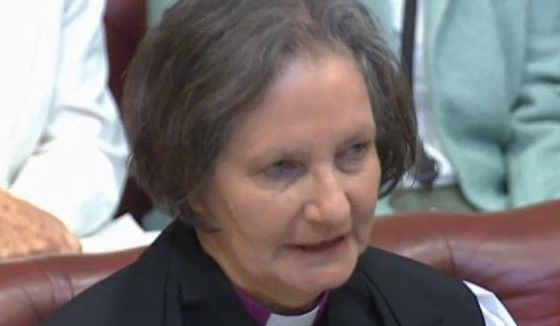
The Lord Bishop of Bristol: My Lords, my right reverend friend the Bishop of Manchester regrets that he cannot be here today to speak to Amendments 19, 21, 25 and 28 in the name of the noble Lord, Lord Carlile of Berriew, to which he has added his name. I am grateful to the noble Lord, Lord Anderson of Ipswich, for setting out the case clearly, and I am particularly grateful to follow the noble Lord, Lord Clarke of Nottingham, as he has made the case so powerfully.
My right reverend friend and I are concerned, not as lawyers but as citizens, about the constitutional precedent the Bill sets. The role of the judiciary as distinct from the Government and Parliament must not be infringed. Parliament creates laws but judges and juries are responsible for the finding of facts. Where the Supreme Court has ruled that Rwanda is not safe, it is an abuse of Parliament’s powers, as we have just heard, for it to attempt to declare otherwise.
We are concerned that the Bill represents a dangerous step. The amendments in the name of the noble Lord, Lord Carlile, therefore attempt to preserve the important principle that facts should be considered by the courts. We must surely be able to take into account credible evidence that Rwanda is not a safe country.
Continue reading “Safety of Rwanda (Asylum and Immigration) Bill: Bishop of Bristol supports amendments related to implementation of UK-Rwanda Treaty”On 14th February 2024, the House of Lords debated the Safety of Rwanda (Asylum and Immigration) Bill in committee. The Bishop of Bristol spoke in support of amendment 75 to the bill, which would introduce an exemption clause to prevent those who had worked with UK armed forces or the UK government overseas, or their families, from being sent to Rwanda. She also spoke in support of amendments 70, 73, and 85, on the issue of protecting victims of modern slavery from removal to Rwanda:

The Lord Bishop of Bristol: My Lords, I am grateful to all those supporting Amendment 75 and for the speeches on it. I am further grateful to the noble Lords, Lord Kerr and Lord Alton, and the noble Baroness, Lady Chakrabarti—they are all helping us to delve deeper into the legal and moral issues in these amendments. I am particularly grateful to the noble and learned Baroness, Lady Butler-Sloss, who has set out her Amendments 70, 73 and 85, to which I have subscribed my name.
This issue is close to my heart, as I speak on behalf of the Church of England on human trafficking and modern slavery issues. I do so from the city of Bristol, with its history of slavery and its current commitment to prevent human trafficking and slavery, including domestically—we train our lay officers to spot the signs of those hiding in plain sight—and to provide refuge for those on their journey through the NRM. I was also particularly grateful to the noble Lord, Lord Deben: I think that I will miss church downstairs, so I am grateful that he has brought church upstairs in his Ash Wednesday words to us about the deep moral issues in our debate today.
Continue reading “Safety of Rwanda (Asylum and Immigration) Bill: Bishop of Bristol speaks in favour of amendments protecting armed forces workers and victims of modern slavery”The Bishop of Bristol spoke in a debate on the Conversion Therapy Prohibition (Sexual Orientation and Gender Identity) Bill, (a private members bill brought by Baroness Burt of Solihull to ban the practice of conversion therapy for LBGT+ people) on 9th February 2024, supporting the bill and stressing the need to continue to work to protect LGBT+ people from harm, and expressing a desire for greater clarity in some parts of the legislation:
The Lord Bishop of Bristol: My Lords, I begin by thanking the noble Baroness, Lady Burt, for her Bill. I am grateful to the noble Baroness for engaging with the complexity of drafting legislation to prevent conversation therapy or practices, given the variety of views there clearly are in this Chamber and in wider society. I declare my interests: until December, I was one of the bishops leading on safeguarding in the Church of England and I am still co-chair of the APPG on Safeguarding in Faith Communities.
I have been aware for many years in pastoral ministry of some horrific practices, from physical punishment, counselling and prayer techniques akin to interrogation to, at worst, supposedly curative rape. Such practices are used against those in faith communities who are regarded as deviating from the communities’ norms for sexuality and gender identity. These more or less hidden practices must be prevented by statutory provision if they are not already. We should note too that those who are victims should be much better supported. I am also aware of the much more subtle impact on LGBTIQ people of faith—the pressure on them to conform to the norms set by the hierarchy of their faith community. The cultures which pervade many faith communities render those exploring their identity very vulnerable indeed to abuse, as the IICSA report reminded us.
Continue reading “Conversion Therapy Prohibition (Sexual Orientation and Gender Identity) Bill: Bishop of Bristol welcomes legislation whilst calling for greater clarity”On 8th February 2024, the Bishop of Bristol spoke in a debate on a report from the Communications and Digital Committee on digital exclusion, emphasising the impact of lack of digital access on children:
The Lord Bishop of Bristol: My Lords, it is a pleasure to follow the noble Lord, Lord Lipsey, whose speech imaginatively took us into the life and world of Joe Soap. I congratulate the noble Baroness, Lady Stowell, on securing this timely debate—timely in one sense—and I offer my thanks to all members of the Communications and Digital Committee for a thorough and wide-ranging report. I also lament the lack of a government cross-departmental strategy.
Today, I focus my comments on digital inclusion and exclusion in and around schools, about which I have a little knowledge. In 2021, UNICEF produced an excellent report on the effect of digital exclusion on schoolchildren. That report said that
“digital inclusion must be seen as the cornerstone to ensuring social justice and equitable life chances for every child”.
Those words were written while the pandemic was at its peak and the long-term impact on education was still difficult to predict.
Continue reading “Bishop of Bristol highlights negative impact of lack of digital access for children”The Bishop of Bristol spoke in a debate on the current humanitarian situation in Gaza on 8th February 2024, expressing concern about the rejection of a proposed ceasefire and the impact of total war on civilians:
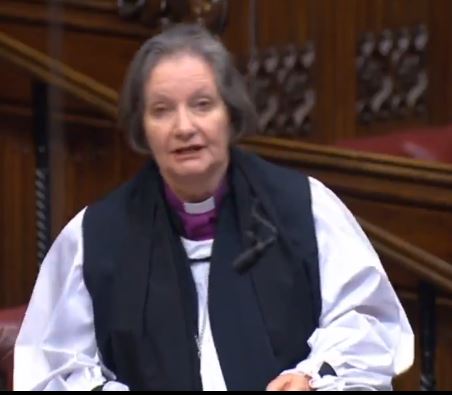
The Lord Bishop of Bristol: My Lords, I am grateful to the noble Baroness for securing this debate. Today the future seems bleak after Prime Minister Netanyahu, perhaps understandably, rejected a ceasefire because, as reported, total victory may be achieved in months. In my city of Bristol, women from Jewish and Muslim communities stand silently together in public vigil, and those of all faiths and none march each week campaigning for a cessation of violence on all sides.
Total victory within months—what does that mean for the hostages held in tunnels, for the women who are pregnant without medical support, for babies whose mothers have no breast milk? What we see is a horrible inversion of the word of the prophet Joel: the dreams of old men are shattered and the visions of young men are betrayed. The hopes of so many Jews, Muslims and Christians are destroyed. May God and our political leaders have mercy, source aid and work unrelentingly for peace.
The Bishop of Bristol spoke in a debate on a report from the Economic Affairs Committee on workers on 8th February 2024, emphasising the value of meaningful work and drawing attention to the findings of the Archbishops Commission on Families & Households:
The Lord Bishop of Bristol: My Lords, it is a pleasure to speak in this important debate about the nature of the UK workforce in a challenging economic climate. I pay tribute to the noble Lord, Lord Bridges, as have others, and all the members of the Economic Affairs Committee who worked to produce this report and have stimulated our thinking today.
On a personal note, having recently found it hard to recruit lay staff to my office in Bristol, I am very grateful for being informed by the report we are debating today. At the heart of my diocese, you can find the New Room, the chapel where John Wesley led the first Methodist congregation from 1739. As part of his pioneering ministry, he offered “Rules of a Helper” to ordained Ministers, the first of which is:
“Never be unemployed a moment, never be triflingly employed, never while away time”.
While the word “unemployed” might have pricked the ears of your Lordships in the context of this debate, the final clause may be the significant one here. In effect, we are reminded about the importance of using our time on earth well. There is work to be done, good news to share and disciples to be made. Wesley was on to something. There is great purpose and fulfilment to be found in using our time well, maximising our skills and ensuring we fulfil our potential. It enriches our lives and the lives of our community, and that is central to my remarks today.
Continue reading “Bishop of Bristol speaks in debate on workers and employment”The Bishop of Bristol received the following written answer on 7th February 2024:
The Lord Bishop of Bristol asked His Majesty’s Government how many people who have arrived into the UK illegally since 1 January 2022 and who would therefore be eligible for removal to Rwanda have been referred to the National Referral Mechanism for modern slavery.
Continue reading “Bishop of Bristol asks about modern slavery referrals for migrants arriving illegally in the UK”The Bishop of Bristol asked a question on the importance of de-carbonising heating on 6th February 2024, asking whether the government would refute speculation that they were considering a U-turn on this policy:
The Lord Bishop of Bristol: My Lords, as the Minister will know, net zero is impossible without decarbonising heating. The clean heat market mechanism is a crucial part of that. Does he recognise its importance? Will he refute media speculation that the Government are considering a U-turn on it? Will he make representations to boiler manufacturers that are unfairly passing these costs on to consumers?
Lord Douglas Miller (Con): Again, I will write to the right reverend Prelate in due course. I am doing rather a lot of writing today, am I not? This is a broad subject which I am slowly getting my head around.
 The Church of England in Parliament
You must be logged in to post a comment.