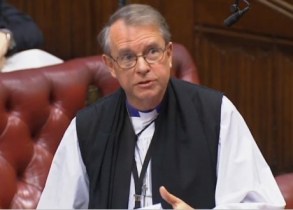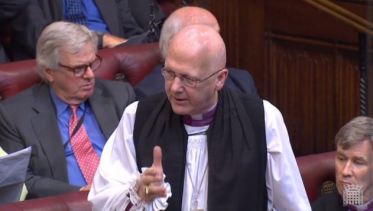
Bishop of Durham asks Government about impact on families of two-child limit on tax credits

On 25th January 2018 the Bishop of Durham, Rt Revd Paul Butler, received written answers to three questions about the impact on families of the two-child limit on tax credits:
The Lord Bishop of Durham: To ask Her Majesty’s Government how many families have had their tax credits reduced by the two -child limit in each  month since the introduction of the limit in April 2017; how many of those families had one or more parents in work; how many families were (1) lone parent families or (2) two -parent families; and what was the number of children per family involved.

Continue reading “Bishop of Durham asks Government about impact on families of two-child limit on tax credits”

Bishop of Durham asks Government about impact of benefit cap on larger families

Durham161117On the 23rd January 2018 the Bishop of Durham, the Rt Revd Paul Butler received a written answer to a question about the impact of the benefit cap on larger families:

The Lord Bishop of Durham: To ask Her Majesty’s Government how many families with three or more children have been affected by the benefit cap in each month since April 2017; how many children were included in each affected family; how many families were (1) lone parent families or (2) two-parent families; and how many of those families had one or more parents in work. [HL4636]

Continue reading “Bishop of Durham asks Government about impact of benefit cap on larger families”

Bishop of Gloucester urges greater requirements for online platforms to identify and remove harmful content

On 11th January 2018 the House of Lords debated a motion from Baroness Kidron “That this House takes note of the role played by social media and online platforms as news and content publishers.” The Bishop of Gloucester spoke in the debate:

The Lord Bishop of Gloucester: My Lords, I thank the noble Baroness, Lady Kidron, for obtaining this debate. I, too, thank her for her tireless work in this area.
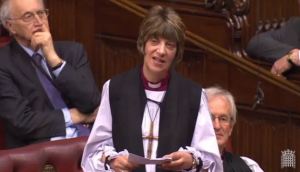
Social media and online platforms now play an enormous role in shaping national dialogue and accepted social standards. In my visits to primary schools and secondary schools in the diocese of Gloucester, I have spent time talking with children about social media, and I affirm all that is good. Yet, as children progress to secondary school, their view of themselves and the world is increasingly being shaped by social media and online platforms. Young people are receiving strong messages about worth being about looking a certain way and about success being measured in online likes. Furthermore, their fears about the world they are growing up in are being fuelled by what they read online. Continue reading “Bishop of Gloucester urges greater requirements for online platforms to identify and remove harmful content”

Bishop of Gloucester asks Government about child refugee policy post-Brexit

On the 8th January 2018 Lord Roberts of Llandudno asked Her Majesty’s Government “what new arrangements they propose to introduce to support child refugees following the United Kingdom’s withdrawal from the European Union.” The Bishop of Gloucester, Rt Revd Rachel Treweek, asked a follow up question:

The Lord Bishop of Gloucester: Can the Minister confirm that any new provision will be at least as generous as under the Dublin III regulations and that there will be even wider scope for child refugees to join ​not only parents in the UK but also other relatives such as uncles, aunts, grandparents and adult siblings? Will they also be given the support they need to live safely and in decent conditions? Continue reading “Bishop of Gloucester asks Government about child refugee policy post-Brexit”

Bishop of Durham asks Government about schemes to address school holiday hunger

On 4th January 2018 the Bishop of Durham, Rt Revd Paul Butler, received a written answer to a question on school holiday schemes to combat food poverty:

The Lord Bishop of Durham: To ask Her Majesty’s Government whether they intend to consider the funding and provision of holiday programmes that would provide free meals and activities for children who would otherwise not have access to such arrangements. Continue reading “Bishop of Durham asks Government about schemes to address school holiday hunger”

Bishop of Carlisle asks Government about effect on religious families of two-child limit on benefits

On 11th December 2017 Baroness Sherlock asked Her Majesty’s Government “why kinship carers who subsequently have their own child are not exempt from the two child limit.” The Bishop of Carlisle, Rt Revd James Newcome, asked a follow up question:

The Lord Bishop of Carlisle: My Lords, the Government have chosen to pursue a deficit-reduction strategy by opting for a fiscally cautious welfare policy. However, ​has the Minister considered that some British families are larger for reasons of faith or principle? Speaking on behalf of people of all faiths in this country, my question is: what plans does the Minister have for ensuring that such families and children are not discriminated against by the policy? Continue reading “Bishop of Carlisle asks Government about effect on religious families of two-child limit on benefits”

Education debate – Bishop of Gloucester on early needs, children’s mental and physical health and self-esteem

On 8th December 2017 the Archbishop of Canterbury, Most Revd and Rt Hon Justin Welby, led a debate in the House of Lords, ‘That the House takes note of the role of education in building a flourishing and skilled society.’ The Bishop of Gloucester, Rt Revd Rachel Treweek, spoke in the debate and her speech is below. The Archbishop’s opening and closing speeches can be seen here.

 The Lord Bishop of Gloucester: I too thank the most reverend Primate for bringing forward today’s debate, and indeed for naming the recently established Church of England Foundation for Educational Leadership, of which I am privileged to be a trustee.

In my own diocese, I am delighted that we have 116 Church of England schools—not single-faith schools but centres of community cohesion in urban and rural areas, committed to offering each child the opportunity to discover life in all its fullness, as spoken about by Jesus Christ. The Church of England’s vision for education highlights the ideas of wisdom, hope, dignity and community, and we aim to make our schools places where fulfilling academic potential is not separated from our children’s spiritual, physical, emotional, moral and social development. Continue reading “Education debate – Bishop of Gloucester on early needs, children’s mental and physical health and self-esteem”

Church Commissioners’ Written Answer: Transphobic Bullying

On 7th December 2017 the Second Church Estates Commissioner, Rt Hon Dame Caroline Spelman MP, answered a written question from Ranil Jayawardena MP about guidance to schools on transphobic bullying. 

Mr Ranil Jayawardena (North East Hampshire): To ask the right hon. Member for Meriden, representing the Church Commissioners, what assessment has been made of the merits of the Church of England’s recent guidance to nursery and primary school teachers on transphobic bullying. Continue reading “Church Commissioners’ Written Answer: Transphobic Bullying”

Bishop of Gloucester – crucial to work with young people on internet and social media reforms

On 7th November 2017, the House of Lords debated a motion from Lord Best, ‘That this House takes note of the Report from the Communications Committee, Growing up with the internet.’ The Bishop of Gloucester, Rt Revd Rachel Treweek, spoke in the debate, which was also reported in the Telegraph newspaper.

The Lord Bishop of Gloucester: My Lords, like other noble Lords, I am very grateful to the Select Committee for this report, and I agree with so much that has been said already. So many young people today source their identities from social media and internet advertising, which has resulted in low self-esteem and poor mental health. Over the last 18 months or so, I have been spearheading a campaign called Liedentity, which is focused around body image and challenging the lie that our value comes from our physical appearance. Continue reading “Bishop of Gloucester – crucial to work with young people on internet and social media reforms”

Bishop of Chelmsford says digital world needs children’s best interests at heart

On 7th November 2017, the House of Lords debated a motion from Lord Best, ‘That this House takes note of the Report from the Communications Committee, Growing up with the internet.’ The Bishop of Chelmsford, Rt Revd Stephen Cottrell, who serves on the Communications Committee, spoke in the debate. His speech is below, and was also reported in the Telegraph and Mail newspapers.

The Lord Bishop of Chelmsford: My Lords, it is a great joy to follow the noble Baroness, Lady Kidron. I support the amendments she is pioneering through the House. They are extremely important. It is also a great honour, and a great education, to serve on the Select ​Committee on Communications. As other members of it have said, I pay tribute to the noble Lord, Lord Best, for the admirable and skilful way he led us through this. I welcome the noble Lord, Lord Gilbert, as our new chair.

So much in this report is critical to the sort of world we want to live in, the well-being of our nation, our public life and particularly our children. In his opening speech the noble Lord, Lord Best, outlined disturbingly well the challenges and dangers. Although I welcome the initial responses we have heard from the Government, much more still needs to be done to join all this up and make sure the needs of the child are put at the centre. Among the many important recommendations we offer, I draw attention to just two, because they are important in themselves and illustrate the larger, central point of our report—that government must take up the challenge to ensure that all those who work in the digital world work together to support the needs of children in an integrated and overarching response. Continue reading “Bishop of Chelmsford says digital world needs children’s best interests at heart”