
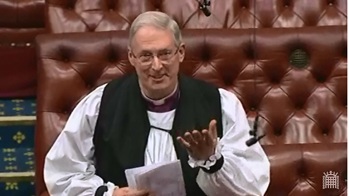
 On 21st December 2015 the Bishop of Southwark, the Rt Revd Christopher Chessun, spoke in favour of amendment 90B during the fourth day of committee stage of the Government’s Welfare Reform and Work Bill. This amendment sought to exempt kinship carers from the impact of the reduced benefit cap.
The Lord Bishop of Southwark: My Lords, I rise to express my support for the intention behind the amendment in the name of the noble Earl, Lord Listowel, which makes both sound social and economic sense. If a child can be cared for within the family network, and that is not to be parents or step-parents, that is in most cases preferable for the emotional, physical and spiritual well-being of the child. Churches have watched and participated for centuries in the patterns of such relationships and know that while they can hide dangers, they provide in the main the best setting for the formation of life. Better that than the anxiety, grief and hardship that the imposition of benefit rules not designed for such scenarios imposes, and that a proportion of such children be an economic charge on local authorities and reap the emotional deficit that will all too often occur. Continue reading “Welfare Reform Bill: Bishop of Southwark supports amendment to exempt kinship carers from benefit cap reduction”
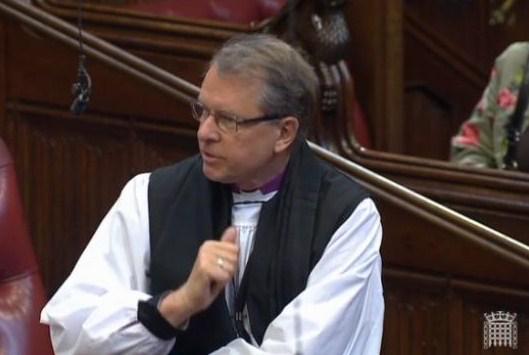
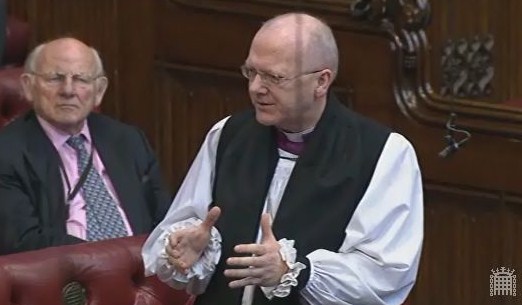
 The Lord Bishop of Portsmouth: My Lords, I tabled Amendment 21 to highlight the impact of this measure on different faith communities who share our concerns with this part of the Bill in particular. Noble Lords who attended the special briefing we organised two weeks ago will have heard Chaya Spitz, chief executive of the Interlink Foundation, speak passionately about the implications for the Orthodox Jewish community that she represents and is a member of. For her community, larger families are the norm and the central pivot around which everything else revolves. There is a positive, faith-based imperative to have children, to create the next generation in service of God. There is also a commonly held conscientious objection to the use of artificial contraception, except in prescribed circumstances, and to abortion, except in rare circumstances. By limiting financial support to the first two children, this policy is making a judgment that touches on deeply personal and strongly held religious and cultural beliefs about the family, and that threatens the viability of whole faith communities.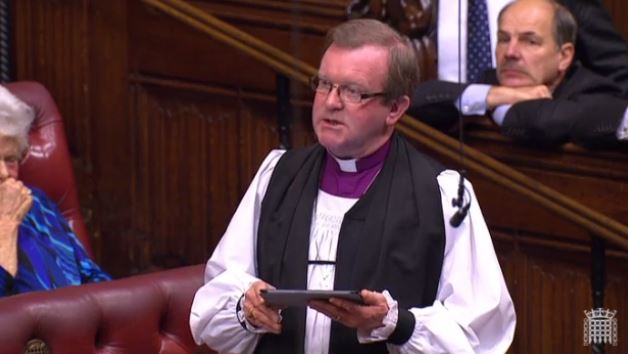
 The Lord Bishop of Portsmouth: My Lords, I highlight two particularly vulnerable groups in my Amendments 5, 6, 13 and 14, groups that I believe should be exempted from this measure. These are bereaved parents and victims of domestic abuse. In focusing so heavily on promoting personal responsibility, there is always a danger with welfare reforms that we neglect our collective responsibility to look after those who fall on difficult times, people we will probably never meet but whom we support through our taxes in their time of need so that we, too, will be supported when we need help.
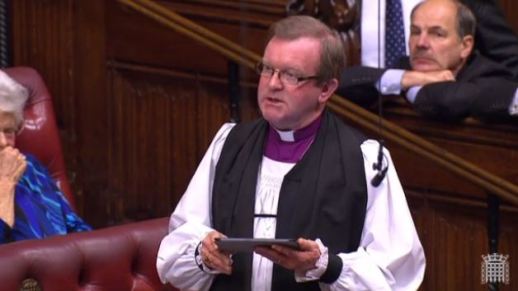 The Lord Bishop of Portsmouth: My Lords, my concerns about this measure, along with those of other faith groups and organisations, are set out in the briefing note that my colleague the right reverend Prelate the Bishop of Durham circulated to all Members of the House prior to the Second Reading debate. In that note we expressed our belief that children are a blessing and that anything that sends an implicit or explicit message that a child is unwanted or burdensome should be strongly resisted.
  The Lord Bishop of Durham: My Lords, I support many of the principles underlying this Bill: the importance of personal, as well as collective, responsibility; the value of decent work, not just financially, but for human dignity; the role of the welfare system in encouraging positive behaviours; the recognition that poverty is not simply about lack of income; and the desire for fairness for those who receive from and contribute to the system, including the vast majority of us who do both at different points in our lives. None of these is completely new, but the Government’s approach to welfare reform has certainly reinvigorated the debate about poverty, helping to challenge implicit assumptions and some very tired thinking. Governments naturally want to distinguish themselves, but in seeking to introduce a fresh perspective on old problems, there is always a danger of going too far or of throwing out the good with the bad. That is my concern about some of the measures being discussed today.
 The Church of England in Parliament
You must be logged in to post a comment.