On 12th March 2020 the House of Lords debated a motion from Baroness Parminter, “To move that this House takes note of the case for investing in, and embracing, a green economy that promotes resource efficiency and zero carbon usage.” The Bishop of Bristol, Rt Revd Viv Faull, spoke in the debate:
The Lord Bishop of Bristol: My Lords, I am grateful to the noble Baroness for bringing this debate before the House. As has been said already, and will no doubt be said again, our climate is at a crisis point. As your Lordships are well aware, we continue to see significant losses of biodiversity, increases in global temperatures, rising sea levels and extreme weather events. In the knowledge that these circumstances will disproportionately affect the poorest, and as a nation that has historically consumed large amounts of carbon, it is our moral imperative to act now.
I find myself in the privileged position of representing both a Church and a city to which this issue matters a great deal. Only two weeks ago, Bristol welcomed Greta Thunberg to its College Green, where she addressed more than 15,000 young people. She said that
“nothing is being done to halt this crisis despite all the beautiful words and promises from our elected officials.”
It is my hope that our work here today and in the future will amount to much more than just beautiful words.
Continue reading “Bishop of Bristol speaks of climate commitments, Government praises “strong leadership” of church”

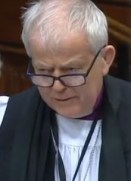 On 17th March 2020 the Bishop of Salisbury, Rt Revd Nicholas Holtam, received a written answer to a question on climate change and migration:
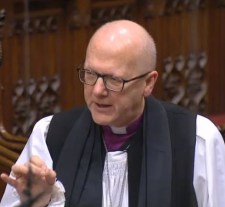 The Lord Bishop of St Albans: My Lords, I too thank the noble Earl, Lord Kinnoull, for obtaining the debate and the noble and learned Lord, Lord Cope of Craighead, for his excellent introduction. For these Benches, and indeed for many Members of your Lordships’ House, trees have a special significance. They feature in the first chapter of the holy scriptures in Genesis and they reappear in the final chapter of the Bible in the Book of Revelation chapter 22, where we find that enigmatic phrase:
 On 13th February 2020 the Second Church Estates Commissioner, Andrew Selous MP, answered written questions from Jim Shannon MP, on carbon emissions, religious freedom, strategic development funding, church planting, green investments, the Democratic Republic of Congo and South Sudan, the Primates’ Meeting, new technologies, marriage and family life.
 The Lord Bishop of Oxford: My Lords, I warmly welcome this report and this vital debate. Never before in the scale of human history has there been such a wide and deep threat to our ecosystem or to human flourishing that was so clear and predictable on the horizon. Technology alone is not enough.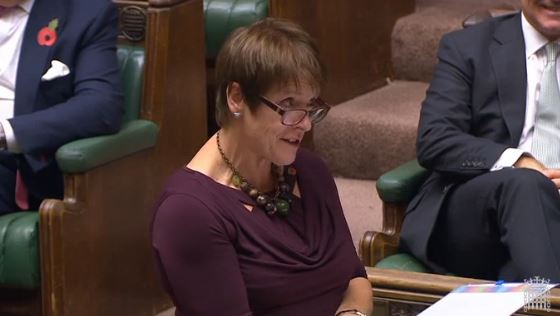
 On 24th October 2019 Baroness Randerson asked the Government “what plans they have to encourage more people to travel by bus”. The Bishop of St Albans, Rt Revd Alan Smith asked a supplementary question about public transport and air pollution:
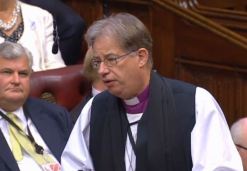 On 26th June 2019 Lord Bird asked the Government, “by what means, if at all, they require public bodies to act, and to demonstrate how they act, in a manner which seeks to ensure that the needs of the present generation are met without compromising the ability of future generations to meet their own needs.” The Bishop of Oxford, Rt Revd Steven Croft, asked a follow-up question:

You must be logged in to post a comment.