
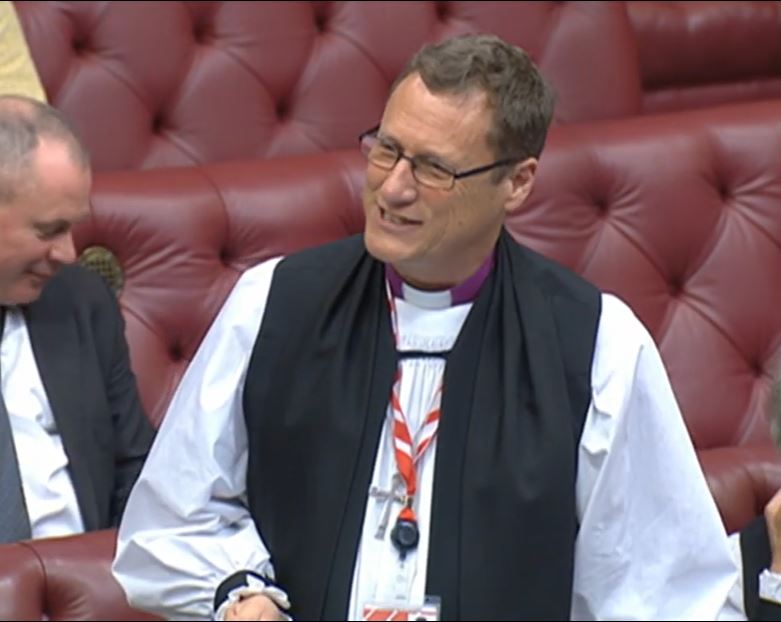
The Bishop of Leicester spoke in a debate on the future affordability and quality of higher education on 2nd July 2026, stressing the need for joined up approaches to encouraging higher and further education:
The Lord Bishop of Leicester: My Lords, I too am grateful to the noble Baroness, Lady Deech, for initiating this debate. It is good to have the opportunity to contribute to thinking about the future affordability and quality of higher education. I do so as the Bishop of Leicester, but also with a close interest in the Cathedrals Group of Universities—14 universities whose distinctive history and mission speak directly to the themes before us: public service, social inclusion and the flourishing of local communities.
At its best, higher education is not simply an individual good but a common good. It forms professionals, nurtures civic responsibility and strengthens the social fabric of our nation. Many institutions across our system, including those in the cathedrals group, exemplify this tradition, with roots in civic purpose and long-standing commitment to education as a vehicle for service inclusion and human flourishing.
Historically, a number of these institutions were founded to train teachers for communities experiencing deprivation. That purpose continues to shape their work today: they now educate not only teachers but nurses, social workers, physiotherapists and paramedics—often in close partnership with schools, multi-academy trusts and health bodies. In my own diocese of Leicester, we see clearly how vital this local and regional role is. Our universities—that of Leicester, De Montford and Loughborough—are deeply embedded in place. They help to sustain public services, provide pathways for local people and act as anchors of opportunity within diverse communities.
This brings me to the importance of widening participation. This is not simply about entry into higher education but about ensuring success beyond it. It therefore requires sustained engagement, starting in schools, continuing through further education and extending into higher education and beyond. In many parts of the country, including areas of Leicester and beyond, the challenge is not only individual disadvantage but structural fragmentation. Too often, the system can feel disjointed, with schools, FE colleges and universities operating under different pressures, incentives and expectations. If we are serious about both quality and affordability, we must also be serious about coherence.
I argue that we need a more joined-up approach across the whole education sector, one that recognises the vital role of further education alongside higher education and the importance of strong, sustained partnerships with schools. A flourishing system is one in which learners can move with confidence along clear and supported pathways, whether academic, technical or vocational. Higher education institutions have a key role to play in this, but they cannot do it alone, particularly in the face of growing financial pressures.
Among these pressures are externally determined and potentially volatile costs, which continue to constrain universities’ ability to sustain the very activities we value most. One example is the increasing costs of pensions across the sector. The teachers’ pension scheme, in particular, has placed significant strain on university finances in recent years, with employer contributions at high levels. While a reduction is anticipated in 2027, this will not resolve the underlying challenge. The point is not to weaken pensions but to ensure that institutions have sufficient flexibility to manage these costs without undermining their broader mission. Without that flexibility, rising costs inevitably place pressure on staffing, investment and the range and quality of provision offered to students.
There is a moral dimension within all of this. If universities are less able to invest in partnerships with schools and further education, or to sustain provision in key professional areas such as supporting social good, the consequences will be felt not only in higher education but across our schools, our health service and our communities. If we fail to build a more coherent system linking schools—both FE and HE—into one flourishing system, then we risk leaving too many learners without clear and supported routes to flourishing.
I therefore urge the Government to take a broad and integrated view of higher education sustainability. Yes, we must consider funding levels and student experience. Yes, we must safeguard equality. But we must also address the structural pressures that sit beneath these debates, and we must strengthen the relationships across the whole education system. Universities know that they need to adapt and continually iterate their offer for a changing world. In order for this to be possible, greater flexibility for institutions and a stronger emphasis on partnership will be essential.
The universities of the Cathedrals Group remind us that higher education is not only an economic endeavour—
[sitting suspended due to fire alarm]
Baronss Finlay of Lanlaff (CB):My Lords, we are resuming at 3.35 pm. That means that the debate was adjourned for 34 minutes. We will add injury time to the end time, so the new end time is 6.01 pm. The right reverend Prelate the Bishop of Leicester has some time left. We will resume with his speech and then proceed with the speeches in order.
The Lord Bishop of Leicester: I thank the noble Baroness very much. I am not used to having quite such a dramatic effect when I speak—I did not realise that what I was saying was quite so inflammatory.
I will be brief. The universities of the Cathedrals Group remind us that higher education is not only an economic endeavour but a moral and social one. It is about the formation of people, the strengthening of communities and the pursuit of the common good. If we are serious about that vision then we must ensure that the structures surrounding our institutions—financial, organisational and relational—enable them to fulfil that purpose.


You must be logged in to post a comment.