
Bishop of Durham responds to spending round with need for focus on society’s most vulnerable

19.01.07 durham bOn 25th September 2019 the House of Lords took note of the Government’s Spending Round 2019. The Bishop of Durham, Rt Revd Paul Butler, contributed to the debate:

Lord Bishop of Durham: My Lords, like others, I welcome the fact that we are able to hold a debate on the spending round 2019. When the political point-scoring is redacted from the Chancellor’s original Statement, as I note it is on the GOV.UK website, there are aspects to welcome in the overall spending increase and some of the specific commitments. I am pleased that the Chancellor recognised in his speech that in the nation there are anxieties and divisions,

“between regions and communities, rich and poor, rural and urban, young and old”,—[Official Report, Commons, 4/9/2019; col. 180.]

and between black and white. The test for me is always around the impact of spending on the most vulnerable in our society. It is this that leads me to ask some questions.

Continue reading “Bishop of Durham responds to spending round with need for focus on society’s most vulnerable”

Bishop of Durham asks Government about funding for education of girls in Burundi and countries torn by conflict

Durham040219On 3rd September 2019 the Leader of the Lords, Baroness Evans of Bowes Park, repeated a Government Statement about the G7 summit in Biarritz. The Bishop of Durham asked a follow-up question about girls’ education in Burundi:

Lord Bishop of Durham: I return to the question of girls’ education in the Statement. As it happens, last week I was visiting the tiny east African country of Burundi, and one of the most impressive pieces of work that I saw there was with adult women who had not had education when they were girls and who have now gone through literacy and financial and business training and were running small businesses in their local rural communities. I welcome the fact that more money is being put into the education of girls and of children in countries torn by conflict, because Burundi is one such. Will the Minister explain a little more about how that might be put into practice, particularly in a nation such as Burundi—and there are others—where at the moment there are restrictions on the Foreign Office giving it money because of its internal conflict, and will she promise that DfID will be able to put money into such countries through this kind of system?

Continue reading “Bishop of Durham asks Government about funding for education of girls in Burundi and countries torn by conflict”

Bishop of Durham asks about welfare of children of those with restricted immigration status

19.04.24 Durham 2On 7th August 2019 the Bishop of Durham, Rt Revd Paul Butler, received a written answer from Government regarding the children of restricted immigrants:

The Lord Bishop of Durham: HL17455 To ask Her Majesty’s Government, further to the answer by Baroness Williams of Trafford on 23 July (HL Deb, cols 668–70), how many children have been affected by having no recourse to public funds in each of the 54 local authorities; and what estimate they have made of the total number of children so affected. Continue reading “Bishop of Durham asks about welfare of children of those with restricted immigration status”

Bishop of Durham asks Government about support for Congolese refugees

On 5th August 2019 the Bishop of Durham, Rt Revd Paul Butler, received a written answer from Government regarding support for Burundi’s government in hosting DRC refugees:

The Lord Bishop of Durham: HL17454 To ask Her Majesty’s Government what support they are offering the government of Burundi in hosting Congolese refugees being displaced through the ongoing conflict in the Democratic Republic of the Congo.

Continue reading “Bishop of Durham asks Government about support for Congolese refugees”

Bishop of Durham asks Government about free school meals for children of those with no public funds immigration status

19.01.07 durham bOn 30th July 2019 the Bishop of Durham, Rt Revd Paul Butler, received a written answer, from Lord Agnew of Oulton, regarding free school meals for children of those with no recourse to public funds because of their immigration status:

The Lord Bishop of Durham: HL17456 To ask Her Majesty’s Government, further to the answer by Baroness Williams of Trafford on 23 July (HL Deb, cols 668–70), what plans they have to review access to free school meals for children who are affected by having no recourse to public funds.

Continue reading “Bishop of Durham asks Government about free school meals for children of those with no public funds immigration status”

Bishop of Durham asks about EU Settlement Scheme, vulnerable groups and children

19.04.24 DurhamOn 30th July 2019 the Bishop of Durham, Rt Revd Paul Butler, received a written answer from Government, in reply to three questions about children and vulnerable EU nationals and the EU Settlement Scheme:

The Lord Bishop of Durham: (i) HL17344 To ask Her Majesty’s Government what is the status of the guidance issued on 3 April to all local authorities and health and social care trusts in regard to the EU Settlement Scheme and looked-after children and care leavers; and whether it is mandatory for local authorities to follow that guidance.

(ii) HL17345 To ask Her Majesty’s Government what evidence was collected on the children who were non-UK European nationals accommodated under section 20 of the Children Act 1989, their family situations and possible vulnerabilities, before drafting the guidance on EU Settlement Scheme and looked-after children and care leavers issued on 3 April.

(iii) HL17346 To ask Her Majesty’s Government what plans they have to evaluate the impact of the funding of support and its provision to vulnerable groups, including analysis of what future work is needed to ensure that vulnerable groups are able to apply to the EU Settlement Scheme after funding ends in March 2020. Continue reading “Bishop of Durham asks about EU Settlement Scheme, vulnerable groups and children”

Bishop of Durham challenges Government on Universal Credit pilots and two-child limit

Durham040219On 23rd July 2019 the Government Minister Baroness Buscombe repeated a government statement about Universal Credit. The Bishop of Durham, Rt Revd Paul Butler, asked some follow-up questions:

The Lord Bishop of Durham: My Lords, I thank the Minister for all she said and look back several months to how she involved us and engaged with a group of us in a range of helpful ways. The regulations that have been laid show evidence of the Government having listened. I am deeply grateful for the ongoing engagement with stakeholder groups. However, along with my noble friends who have already spoken, I wish to highlight that this House and the other place, not the stakeholder groups, have to scrutinise the regulations, so to land them on us at this point in a negative form seems quite hard to take, if I am being honest.

Continue reading “Bishop of Durham challenges Government on Universal Credit pilots and two-child limit”

Bishop of Newcastle asks about vulnerable women released from prison

newcastle230119bOn 16th July 2019 the Home Office Minister Baroness Williams of Trafford repeated a Government statement about domestic abuse. The Bishop of Newcastle, Rt Revd Christine Hardman, asked a follow-up question:
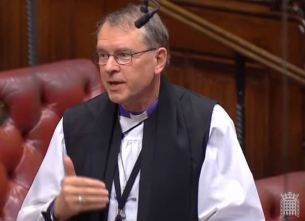
The Lord Bishop of Newcastle: My Lords, I crave the forbearance of the House. I have two questions; one of my own and one from the right reverend Prelate the Bishop of Durham, who, due to the adjournment, has had to leave. My question relates to the needs of very vulnerable people, mainly women, on release from prison.

During my visits to our local women’s prison, I have learned that a higher proportion of women in prison than is the case in the general population come from violent and abusive relationships. It is critical that such women and other vulnerable people who have been abused are released into a safe, secure place with secure accommodation. Is the Minister aware that on occasion, due to things such as poor communication between the probation service in prison and the probation service outside prison, things go wrong and, tragically, a woman is released into danger.

Continue reading “Bishop of Newcastle asks about vulnerable women released from prison”

Bishop of Durham says UK asylum policy should be based on compassion not fear

Durham040219On 16th July 2019 Lord Roberts of Llandudno asked the Government “what assessment they have made of reports that children have been separated from their parents in migrant detention camps on the United States border with Mexico, and whether the human rights of migrants have been violated in those camps”. The Bishop of Durham, Rt Revd Paul Butler, asked a follow-up question:

The Lord Bishop of Durham: Last week the six Texan bishops of the Episcopal Church on the border with Mexico wrote a letter stating:

“We call on our state and national leaders to reject fear-based policy-making that targets people who are simply seeking safety, and a chance to live and work in peace”.

Does the Minister agree with their view, and that we too need to ensure that our policy-making towards asylum seekers and refugees must be based never on fear but on humane, compassionate grounds? Continue reading “Bishop of Durham says UK asylum policy should be based on compassion not fear”

Bishop of Durham asks Government for response to report on children’s experiences of the hostile environment’

Durham161117On 9th July 2019 the Bishop of Durham, Rt Revd Paul Butler, led a debate in the House of Lords on the question to Government,  “what assessment they have made of Project 17’s report Not Seen, Not Heard: Children’s experiences of the hostile environment”:

The Lord Bishop of Durham: My Lords, I am delighted to introduce this debate on Project 17’s report, Not seen, Not heard. In doing so, I draw attention to my interests as listed on the register and, in particular, to the research support I receive from the Good Faith Partnership’s RAMP project on immigration policy.

In this report, Project 17 highlights the way that vulnerable families and children are trapped between overstretched local authorities and punitive immigration controls. As with the ongoing harm caused by the two-child limit, it seems that cost-cutting and punitive notions of control are prioritised over the flourishing and protection of families. We need a radical change of direction away from seeing vulnerable children as a burden. Like many in this Chamber, I believe that a policy built on the gift and voices of children is not a naive aspiration but the very definition of good policy.

Continue reading “Bishop of Durham asks Government for response to report on children’s experiences of the hostile environment’”