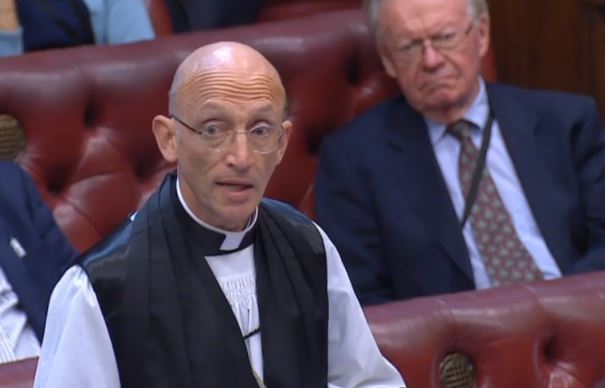
Bishop of Chichester responds to government statement on spending review

The Bishop of Chichester asked a question on investment in children’s futures and the cost of living on 12th June 2025, following a government statement on the recent spending review:

The Lord Bishop of Chichester: My Lords, there are things to welcome in the spending review: I would point in particular to His Majesty’s Government’s steps to support the most vulnerable, tackle regional inequality, increase investment in schools, social housing and healthcare and maintain some level of support for the arts and culture, recognising their importance. More support for libraries, which act as community hubs, is welcome. I hope that the benefit of churches, which are also public buildings that contribute to community life, especially in rural areas, will also be recognised and that DCMS will do this by resolving the long-term uncertainty about the future of the listed places of worship grant scheme beyond 2026 and the capping of grants, effectively, by VAT liability.

Continue reading “Bishop of Chichester responds to government statement on spending review”
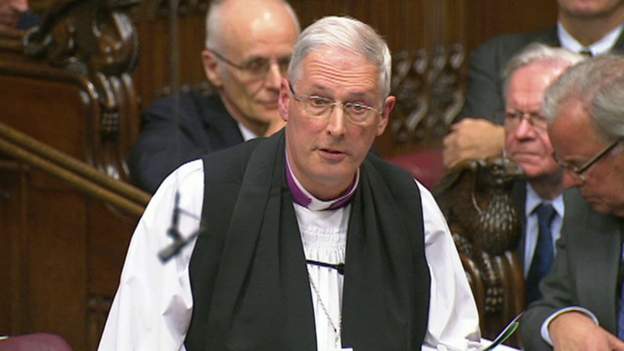
Bishop of Southwark asks about impact of US tariffs on vulnerable populations

The Bishop of Southwark asked a question on the need to protect the vulnerable in the event of economic downturn on 3rd April 2025, following a government statement on UK-US trade and tariffs:

The Lord Bishop of Southwark: My Lords, I am grateful to the Secretary of State for his cautionary words in the other place, repeated here, about eschewing simplistic solutions and “loud voices”, following the imposition of these arbitrary and unwarranted tariffs, and to the shadow Secretary of State for advocating cool heads. That is vital.

Does the Minister agree that, if the impact of this very regrettable development is to depress economic activity—which is all too likely, sadly—there needs to be a priority assigned to protect the most vulnerable in this country from its effects? Will she further comment on any co-ordinated action with other countries to mitigate the effects on those territories, particularly in the Commonwealth, whose economic resilience is far less than our own?

Continue reading “Bishop of Southwark asks about impact of US tariffs on vulnerable populations”

Bishop of St Albans emphasises potential of the rural economy and need for strategic thinking in rural affairs

The Bishop of St Albans spoke in a debate on the effects of the government’s economic measures on farming and rural communities on 3rd April 2025, raising the potential of the rural economy and the need for strategic policy towards rural affairs:

The Lord Bishop of St Albans: My Lords, I too am grateful to the noble Lord, Lord Roborough, for securing this debate and for his excellent opening speech. I declare my interests as president of the Rural Coalition and a vice-president of the Local Government Association.

I have already spoken in your Lordships’ House on changes to the agricultural property relief and business property relief, so my views are already recorded in Hansard. I lament the sudden closure of the sustainable farming incentive, and the reforms to compulsory purchase in the Planning and Infrastructure Bill.

If your Lordships’ House will indulge me, I want to focus on two associated areas which are pertinent to this whole debate. First, the rural economy has great potential to contribute to the economic growth that is needed. I think we all believe in this; it is just a matter of how we achieve it. Secondly, I will make a few comments about the almost complete lack of strategic rural policy or effective rural-proofing in government decision-making.

Continue reading “Bishop of St Albans emphasises potential of the rural economy and need for strategic thinking in rural affairs”

Bishop of St Albans asks about investment in rural areas

The Bishop of St Albans received the following written answers on 26th March 2025:

The Lord Bishop of St Albans asked His Majesty’s Government  further to the Written Answer from Baroness Gustafsson on 11 March (HL5279):

  • which rural partners they are engaging with as they design the industrial strategy.
  • whether they are meeting rural partners to discuss the industrial strategy; and if so, which rural partners they have met so far.
Continue reading “Bishop of St Albans asks about investment in rural areas”

Bishop of St Albans speaks in support of farming families and communities

The Bishop of St Albans spoke in a debate on the continuity of farming families on 21st November 2024, highlighting the levels of stress among farmers and the need to reconcile raising revenue with supporting farming communities:

The Lord Bishop of St Albans: My Lords, I too congratulate the noble Baroness, Lady Northover, on securing this debate. I declare my interests as president of the Rural Coalition and a vice-president of the LGA. I am a farmer’s son, and one of the great privileges of my job serving in a diocese that covers Bedfordshire and Hertfordshire is going into some of the most wonderful, forward-looking and innovative farms in this country, which are at the forefront of farming across Europe.

Even though there are many successful, go-ahead farmers, there is nevertheless a huge level of mental stress among them. That has been true for many years. Sadly, there is an extraordinarily high number of suicides among the farming community. As one elderly farmer put it, “Many of us are feeling so depressed because these announcements suggest that we are not wanted and are worth more dead than alive”. He pointed out that if he manages to die before April 2026, his assets will be passed on; if he does not, the farm will probably not survive.

Continue reading “Bishop of St Albans speaks in support of farming families and communities”

Bishop of St Albans asks about the rural economy

The Bishop of St Albans received the following written answers on 28th October 2024:

The Lord Bishop of St Albans asked His Majesty’s Government what assessment they have made of the performance of the rural economy compared to that of other countries in Europe.

Continue reading “Bishop of St Albans asks about the rural economy”

King’s Speech Debate: Bishop of Newcastle highlights importance of communities in economic growth

The Bishop of Newcastle gave a speech on the topic of the economy and economic growth during the King’s Speech debate on 22nd July 2024, highlighting the importance of local communities in relation to businesses and social enterprises:

The Lord Bishop of Newcastle: My Lords, I welcome the gracious Speech and the importance it places on economic growth. I congratulate the noble Lords, Lord Vallance and Lord Petitgas, on their excellent maiden speeches.

The Government’s bold articulation of fiscal reality, and the resistance to colluding with demands for short-term fixes, present a helpful foundation for next steps. One question is: when striving for growth, who will most feel its impact? The UK has some of the highest levels of geographic inequality in Europe. According to a survey conducted in 2022 by YouGov and the Resolution Foundation, 41% of those surveyed in the north-east felt that their region has generally declined in recent years—the highest out of any region in the UK. This feeling is not unfounded when real wages in half of the north-east’s local authorities are still below 2008 levels. The impact can be felt in take-home pay and on our high streets, and it is borne out in the investment decisions of businesses.

Continue reading “King’s Speech Debate: Bishop of Newcastle highlights importance of communities in economic growth”

King’s Speech Debate: Bishop of Leeds raises issues effecting the economy in the North of England

During the King’s Speech debate on 22nd July 2024, the Bishop of Leeds gave a speech on the topic of the economy, expressing admiration for the government’s ambition and commitment to a long term view, and raising issues affecting the economy in the North of England:

The Lord Bishop of Leeds: My Lords, I am not an economist, but I care deeply about the economy. I shall limit myself to a couple of observations, and I am sure that I can save a few minutes in the length of the debate.

First, I welcome the Minister and thank him for his illuminating and articulate speech. I admire the new Government’s ambitions, but I worry a bit that there is too much. Holding all this together in a coherent development framework will be challenging beyond words, but I wish the Government well in doing it.

Continue reading “King’s Speech Debate: Bishop of Leeds raises issues effecting the economy in the North of England”

Budget Debate: Bishop of Worcester highlights need for increased spending on overseas aid

On 18th March 2024, the Bishop of Worcester spoke in a debate on the spring budget, paying tribute to aspects of the budget such as the continuation of the household support fund and the reduction in National Insurance, and expressing regret that the international aid budget had not been increased:

The Lord Bishop of Worcester: My Lords, I congratulate the noble Lord, Lord Kempsell, on an excellent maiden speech, which was thoughtful and brief—and, as we all know, concision is next to godliness.

I have learned a lot in this debate, including the operation of the VAT regime on nuts—probably more than I would have wanted to have known. However, I will not concentrate my remarks on that.

It is clear that the Chancellor had a difficult task in producing the Budget, as has been observed by one of his predecessors, the noble Lord, Lord Lamont, who knows better than anyone. I want to pay tribute to the many good things in the Budget: the continuation of the household support fund, the reform of non-dom status, the increase in public services spending by 1% above inflation, and the welcome reduction in national insurance, to name but a few. However, I was very disappointed by one lacuna, to which I want to address my remarks now. That is, that the aid budget was not increased.

Continue reading “Budget Debate: Bishop of Worcester highlights need for increased spending on overseas aid”

Bishop of Norwich asks about development assistance rates

The Bishop of Norwich received the following written answer on 19th February 2024:

The Lord Bishop of Norwich asked His Majesty’s Government, following the Autumn Statement 2023, what assessment they have made of the suitability of the economic climate to enable them to return Official Development Assistance to 0.7 per cent of gross national income.

Baroness Vere of Norbiton (Con, Treasury): The government remains committed to returning to a target of spending 0.7% of GNI on ODA when, on a sustainable basis, the government is not borrowing for day-to-day spending and underlying debt is falling.

Hansard