On 18th March 2021, the House of Lords voted on a regret motion to the Heather and Grass etc. Burning (England) Regulations 2021. A Bishop took part in the vote:

On 18th March 2021, the House of Lords voted on a regret motion to the Heather and Grass etc. Burning (England) Regulations 2021. A Bishop took part in the vote:
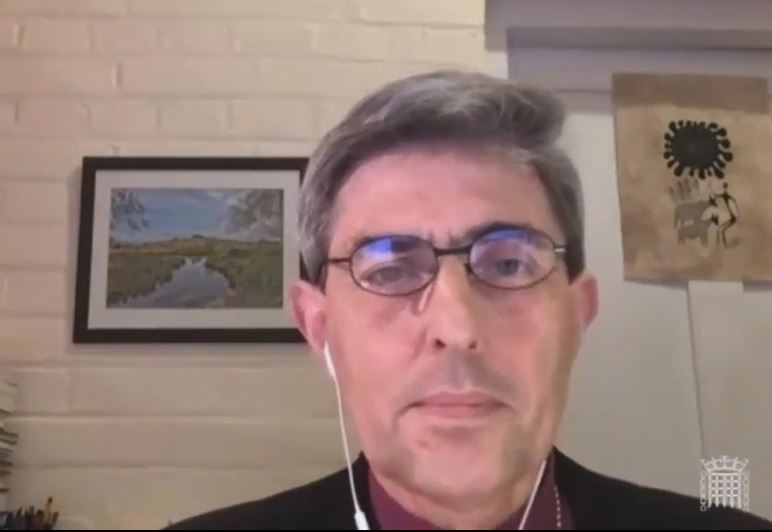
The Bishop of Winchester asked a question on support for communities to reduce carbon emissions on 16th March 2021, during a discussion on the Climate Change Committee’s Carbon Budget Report.
The Lord Bishop of Winchester [V]: My Lords, at local and national levels, in communities across the country, the Church of England is committed to reducing net carbon emissions to zero by 2030. Can the Minister say a bit more about the plans Her Majesty’s Government have to offer practical support for local communities already committed to transformation, using new, low-carbon technologies to achieve net-zero emissions?
Continue reading “Bishop of Winchester asks about support for community efforts to cut carbon emissions”
On 11th March 2021, the Second Church Estates Commissioner, Andrew Selous MP, gave the following written answers to questions from an MP:
Church Land
Jim Shannon MP (DUP, Strangford): To ask the Member for South West Bedfordshire, representing the Church Commissioners, what steps the church is taking to provide affordable, sustainable and beautiful housing on land it owns.
Continue reading “Church Commissioners Written Questions: Church Land, Religious Freedom, Greenhouse Gas Emissions, Remote Education”
The Bishop of St Albans received the following written answers on 22nd February 2021:
The Lord Bishop of St Albans asked Her Majesty’s Government what plans they have to ensure that farmers involved in the Environmental Land Management Scheme are adequately compensated for the impact of introducing nature-based solutions on future flood risk on their land.
Continue reading “Bishop of St Albans asks about management of surplus water and flood risks”
The Bishop of Coventry asked a question on ensuring representation of voices from UK Overseas Territories at COP 26 on 9th February 2021, following a discussion on the preparedness of these territories for humanitarian and disaster relief operations:
The Lord Bishop of Coventry: My Lords, climate change is the context in which this conversation is happening. Given the marine diversity and repository of so much of the world’s biodiversity in the overseas territories, how will the Government ensure that the voices of the overseas territories will be amplified in the forthcoming COP 26 summit?
Continue reading “Bishop of Coventry asks about voices of UK Overseas Territories at COP 26”
The Bishop of St Albans tabled a question on potential risks associated with genetically modified food production in the UK on 8th February 2021:
The Lord Bishop of St Albans [V]: To ask Her Majesty’s Government what assessment they have made of the potential (1) health, and (2) environmental, risks associated with approving genetically modified food production in the United Kingdom.
Continue reading “Bishop of St Albans asks about risks posed by genetically modified food”
The Bishop of Salisbury asked a question on research and investment in renewable energy on 3rd February 2021, during a discussion on the impact of electricity delays on the UK energy supply:
The Lord Bishop of Salisbury [V]: My Lords, the price of electricity from Hinkley is remaining unchanged at £92.50 per megawatt hour, and EDF is expecting the same profit of more than 7.1% on its investment. Given that, can the Minister explain the points that she has just made about how the additional 30% of construction costs on the initial £18 billion budget is being absorbed at no cost to consumers? As the price of electricity from renewables has dropped—with wind now at £40 per megawatt hour—might not research and development into renewals have been a better investment? Hinkley already looks like transitional technology.
Continue reading “Bishop of Salisbury asks about investment in renewable energy”On 16th December the Bishop of St Albans received answers to two written questions on fly-tipping of electronic and hazardous waste:
 The Lord Bishop of St Albans: To ask Her Majesty’s Government, further to the Written Answer by Lord Goldsmith of Richmond Park on 6 February (HL944), what progress they have made on the introduction of a mandatory electronic waste tracking system to combat fly tipping. [HL11049]
Continue reading “Bishop of St Albans asks about fly-tipping of electronic and hazardous waste”
 The Lord Bishop of Salisbury [V]: My Lords, the Government have made a number of statements, which, with the 10-point plan and the upping of the nationally defined contributions to the Paris Agreement, are very welcome. The Government’s manifesto commits to planting 30,000 hectares of trees per year. That is a really key target to aim for in relation to the climate change committee’s report, but it is one that we have missed by 71% in the last year and consistently over previous years. I much admire the Prime Minister’s ambition, but how are the Government to ensure that performance exceeds or matches that ambition?
Continue reading “Bishop of Salisbury asks Government about missing its tree planting targets”
On 10th December the Bishop of Salisbury received a written answer to a question on a potential environmental governance gap after the end of the Brexit transition period:
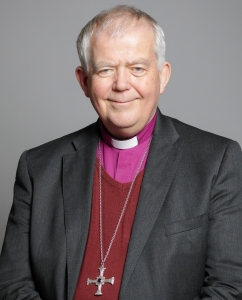 The Lord Bishop of Salisbury: To ask Her Majesty’s Government what measures are in place (1) to prevent, and (2) to minimise the impact of, any environmental governance gap after 31 December. [HL10783]
 The Church of England in Parliament
You must be logged in to post a comment.