On 10th January 2019 the Bishop of Gloucester, Rt Revd Rachel Treweek, asked a question she had tabled to Government on benefit reforms and the impact on children. She specifically raised the issue of the two-child limit. A Government announcement on that was made the following day. The response to the question and to the Bishop’s subsequent question and those of other Members, can be seen in full below:
Benefit Reforms

The Lord Bishop of Gloucester: To ask Her Majesty’s Government what assessment they have made of the impact of benefit reforms on families with children.
The Parliamentary Under-Secretary of State, Department for Work and Pensions (Baroness Buscombe) (Con): My Lords, this Government support families. Our welfare system supports those who are vulnerable and helps people into work. These reforms are working, with 3.3 million more people in work and 300,000 fewer children in absolute poverty than in 2010, a record low. Once fully rolled out, universal credit will result in an extra 200,000 people moving into work and will empower people to work an extra 113 million hours a year to support their families.
The Lord Bishop of Gloucester: I thank the Minister for her Answer and I am grateful for recent engagement with faith and other groups on this issue, but the Government’s own statistics show that child poverty is rising among families with more than two children, even when those families have an adult in work. One of the principal drivers of this increase is the Government’s two-child limit, which makes it harder for parents of more than two children to work their way out of poverty, contrary to the aims of universal credit. In light of this evidence, will the Government reconsider that two-child policy? Continue reading “Bishop of Gloucester asks about impact of benefit reforms and two-child limit on families with children”

 On 23rd July 2019 the Government Minister Baroness Buscombe repeated a government statement about Universal Credit. The Bishop of Durham, Rt Revd Paul Butler, asked some follow-up questions:
 On 22nd November 2017 Lord Lennie asked Her Majesty’s Government “what action they have taken to address the concerns raised in the Social Mobility Commission’s State of the Nation report published in November 2016.” The Bishop of Coventry, Rt Revd Christopher Cocksworth, asked a follow up question:
 The Lord Bishop of St Albans: My Lords, I am deeply concerned—as I know are many other Members of this Chamber—about rising levels of household debt in this country. Households in the UK are taking on far more debt than they used to and overall are taking on more debt than they bring home in income. While the ratio of household debt to income has not yet eclipsed the 160% peak hit in early 2008, it currently hovers around 140%, a dramatic shift from the ratio of 95% in 1997.
 On 19th October 2017 the Bishop of Durham, Rt Revd Paul Butler, received a written answer to a question about families with children on Universal Credit: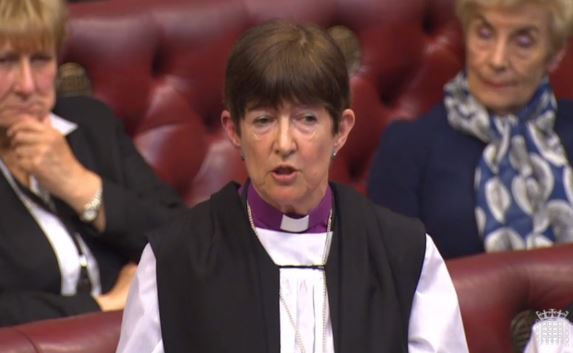
 On 12th September 2016 Baroness Massey of Darwen asked the Government “how they will respond to the unpublished report on the effectiveness of the Troubled Families programme.” The Lord Bishop of St Albans, the Rt Revd Alan Smith, asked a follow-up question.
 The Church of England in Parliament
You must be logged in to post a comment.