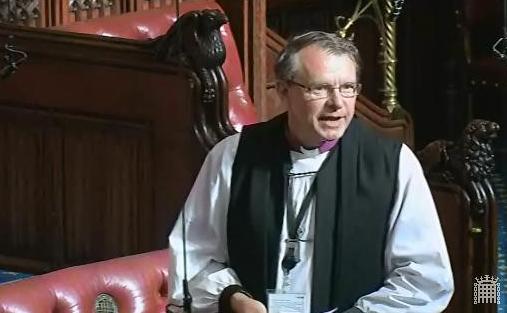
Bishop of St Albans asks Government about fuel poverty

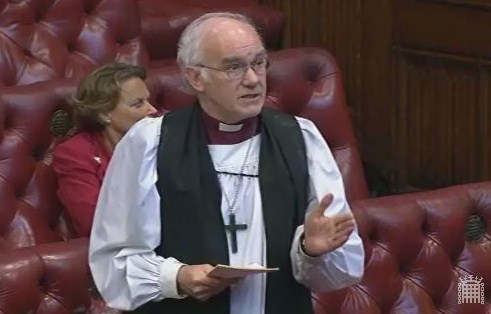
On 15th June 2015 the Bishop of St Albans, Rt Revd Alan Smith, received two written answers from Government to questions about the Warm Home Discount Scheme.

Bishop St Albans June 2015Asked by The Lord Bishop of St Albans:
(1) To ask Her Majesty’s Government what consideration they have given to providing eligible families with the Warm Home Discount automatically.

Continue reading “Bishop of St Albans asks Government about fuel poverty”

Bishop of Rochester on the role of churches, voluntary and community groups in building the common good

On 11th June 2015 the Bishop of Rochester, Rt Revd James Langstaff, spoke during the House of Lords debate on the Bishops’ Pastoral Letter for the 2015 General Election. The text is below and the speeches of others in the debate can be read here

Bishop of RochesterThe Lord Bishop of Rochester: My Lords, I, too, am grateful to my friend the right reverend Prelate the Bishop of St Albans for initiating this debate, and the opportunity to reflect on the House of Bishops’ pastoral letter, which, although issued in the context of an election, was written in the hope that it would provide an ongoing stimulus to thinking and reflecting on the shape of our society and the kind of society that we wish to be. Not least, it will provide something of a challenge to the churches, to which it is primarily addressed, but to others also, to discover afresh something that is a treasure and very much part of our story. Reference has been made to Magna Carta, and as Bishop of Rochester I would be remiss not to remind noble Lords of the existence of the Textus Roffensis, which predates the Magna Carta, although it is not quite so long, and which also merits celebration. Continue reading “Bishop of Rochester on the role of churches, voluntary and community groups in building the common good”

Right to buy and rural housing – Bishop of Rochester question to Government

On 9th June 2015 Baroness Gardner of Parkes asked the Government “what plans they have to consult Housing Associations, local authorities and the general public before finalising the proposal to extend the right to buy to Housing Association properties”. The Bishop of Rochester, Rt Revd James Langstaff, asked a supplementary question:

Bishop of RochesterThe Lord Bishop of Rochester: My Lords, I am grateful to the Minister for confirming that intention to consult the sector. Is she able to offer any indication of how Her Majesty’s Government propose to implement this right to buy in relation to housing-association properties in small and rural communities, where such housing is often built on rural exception sites defined in the National Planning Policy Framework as intended,

“for affordable housing in perpetuity”?

Baroness Williams of Trafford: The right reverend Prelate is absolutely correct when he says that rural communities are different. The development of that particular policy is ongoing, and details will be set out in due course.

(via Parliament.uk)

Bishop of Rochester call for improvements to housing

On 3rd June 2015, during the debate on the Queen’s Speech, the Bishop of Norwich, the Rt Revd James Langstaff, spoke on improvements needed to the housing market and the far-reaching impacts that these would have. The text of his speech is below and can be watched online here:

Bishop of Rochester

The Lord Bishop of Rochester: My Lords, I welcome the opportunity to speak in this debate on the gracious Speech. I am delighted to follow the noble Earl because he has paved the way for me in reminding us of some of the contributions which were made in yesterday’s debate on matters to do with housing and the proposed housing Bill. He has illustrated the points rather more graphically and personally than I might be able to do. I make that connection between yesterday and today because I think it is very clear that issues to do with housing have a real relevance to the matters which are our main focus in today’s debate in your Lordships’ House. For example, research over decades has underlined the point which has just been so graphically made—that there is a clear connection between the quality and conditions of housing on the one hand, and people’s mental and physical health and well-being on the other. There can be very little debate about that; I do not need to labour the point. Continue reading “Bishop of Rochester call for improvements to housing”

Bishop of Durham asks about creation of jobs and apprenticeships through brownfield construction

On 3rd June 2015, Lord Greaves asked Her Majesty’s Government what action they intend to take to encourage the use of brownfield sites in the North of England for public and private housing developments. The Bishop of Durham, the Rt Revd Paul Butler, asked a supplementary question:

14.06.10 Bishop of Durham 5The Lord Bishop of Durham: My Lords, the low levels of value in the north of England—the north-east as much as the north-west—have already been noted. Does the Minister recognise that one incentive is the possible creation of jobs and apprenticeships in things like bricklaying, plumbing and so forth, which we are desperately in need of in our region and in the nation as a whole?

Baroness Williams of Trafford: The right reverend Prelate makes an excellent point. Because of the speed and the size of housing development—indeed of construction in general—we now find ourselves needing to upskill those people who we need to do those jobs through apprenticeships, as he says, and through other initiatives. This is what lies behind the idea of the northern powerhouse—that the north will play its part in economic growth, as well as the south of England.

(via Parliament.uk)

Construction (Design and Management) Regulations 2015 – Bishop of Chester

On 26th March 2015 the House of Lords debated a motion “that this House takes note of the Construction (Design and Management) Regulations 2015”. The Bishop of Chester, Rt Revd Peter Forster, spoke briefly on a point of clarification:

14.03 Bishop of ChesterThe Lord Bishop of Chester: My Lords, I have just one brief question for the Minister on the regulations. Paragraph 20 of the impact assessment refers to financial impact. It states that the deemed approach—which is much the better one, I am sure—will cost £1.3 million to homeowners and £4.6 million to contractors. All my experience is that costs to contractors get handed on to the people for whom they are providing their services, so how do we know that the £4.6 million will not simply be handed on to the homeowners to whom the services are being provided? How can one make that distinction? Continue reading “Construction (Design and Management) Regulations 2015 – Bishop of Chester”

Bishop of St Albans- Company Pay and Homelessness (Written Answers)

On Monday 9th March 2015, the Lord Bishop of St Albans, Rt Revd Alan Smith, received  answers to two written questions on (i) company pay differentials, and (ii) the impact of relationship breakdown on homelessness.

Bishop of St AlbansThe Lord Bishop of St Albans: To ask Her Majesty’s Government what consideration they have given to requiring all listed companies to report annually on the ratio between the pay of chief executives and the median pay of workers in that company.

Continue reading “Bishop of St Albans- Company Pay and Homelessness (Written Answers)”

Bishop of Rochester commends ‘Houses into Homes’ initiative to reduce levels of empty housing

On 12th February 2015, Lord Dubs to ask Her Majesty’s Government what further steps they are taking to reduce the number of residential properties left vacant by their owners. The Bishop of Rochester, the Rt Revd James Langstaff, asked a supplementary question:

Bishop of RochesterThe Lord Bishop of Rochester: My Lords, the contributions already made have underlined the importance of this and the potential for tackling some of the issues in the housing market and the lack of housing. While this may be a relatively small part of that, is the Minister aware of schemes such as the Houses into Homes initiative in Wales, which uses recyclable loans mainly to private individuals and has managed to return some 2,000 empty homes to use since 2012? Do the Government have further plans to encourage such initiatives, particularly those that are at a local level and involve private individuals and the voluntary sector? Continue reading “Bishop of Rochester commends ‘Houses into Homes’ initiative to reduce levels of empty housing”

Bishop of Rochester calls for action on affordable housing in rural communities

On 12th January 2015, Lord Roberts of Llandudno asked Her Majesty’s Government what steps they are taking to safeguard village life. The Bishop of Rochester, the Rt Revd James Langstaff, asked a supplementary question:

Bishop of RochesterThe Lord Bishop of Rochester: My Lords, reference has been made at various points to housing. The Minister will be well aware of the importance for the sustainability and vitality of rural communities of a good mix of housing, housing tenure and so forth. Does he agree that community land trusts are a valuable and perhaps essential way of ensuring a continuing and permanent supply of affordable housing in rural communities? If so, what commitment have the Government made to increasing the number of such trusts? Continue reading “Bishop of Rochester calls for action on affordable housing in rural communities”

Bishop of St Albans calls on Government to uphold its commitment to zero-carbon homes

On 5th November 2014, the Bishop of St Albans tabled an amendment to the Infrastructure Bill, during its Report Stage, which sought to hold the Government to its commitment to a zero-carbon homes strategy as originally envisaged, including removing exemptions for small construction companies and allowing construction companies to buy themselves out of their obligation to build zero-carbon homes. Following the debate on the amendment, assurances were given tat consultation on the commitment were ongoing, and the Bishop did not press it to a division of the House.

Bishop of St AlbansThe Lord Bishop of St Albans: My Lords, in speaking to Amendment 108A, I should like to thank the noble Lord, Lord Berkeley, for co-sponsoring it. I bring forward this amendment out of concern that the standard proposed in the Bill is significantly lower than that already agreed through cross-industry consensus. I fear that an excessive focus on off-site carbon savings will undermine the effectiveness of the proposals and that an exemption for small sites will create confusion by causing the emergence of a two-tiered regulatory system. It is essential that housebuilders meets the carbon compliance standards that have already been agreed through cross-industry consensus. This was endorsed by the Government back in 2011 and strongly supported by around 70% of those responding to their consultation. I am therefore troubled by the proposal of a new on-site energy performance standard for zero-carbon homes that is lower than the one already agreed. It is not clear why this reduction is necessary. The proposed exemptions from the standard for homes built on small sites and for starter homes would also serve to undermine the main purpose behind the zero-carbon standard: namely, that of prioritising carbon reduction. It is to address the lack of measures necessary to realise the Government’s stated commitment to carbon neutrality that I have tabled this amendment which requires the previously agreed carbon compliance standard to be met on-site before allowable solutions can be undertaken. It also requires all homes to meet that standard, ensuring that no exemptions are allowed. Continue reading “Bishop of St Albans calls on Government to uphold its commitment to zero-carbon homes”