On 22nd July 2025, the House of Lords debated the Universal Credit Bill. A vote was held on a regret motion associated with the Bill, in which a Bishop took part.

On 22nd July 2025, the House of Lords debated the Universal Credit Bill. A vote was held on a regret motion associated with the Bill, in which a Bishop took part.
The Bishop of Sheffield asked a question on government plans to tackle regional inequalities in education outcomes on 17th October 2024, during a discussion on equality of opportunity in the education sector:

The Lord Bishop of Sheffield: My Lords, according to data published by the Education Policy Institute, disadvantaged learners in Yorkshire and the Humber are typically 21.4 months behind their more advantaged learners by the end of secondary school. This is opposed to a disadvantage gap of half that size, at just 10.4 months, in London. What steps will the Government take to reduce such perniciously stubborn regional inequalities in educational outcomes?
Continue reading “Bishop of Sheffield asks about tackling regional inequalities in education”
The Bishop of St Albans received the following written answer on 15th April 2024:
The Lord Bishop of St Albans asked His Majesty’s Government what assessment they have made of value lost to the economy through period inequity, as set out in the report, The State of Period Equity in the UK, published by In Kind Direct on 29 February.
Continue reading “Bishop of St Albans asks about effect of period poverty on the economy”The Bishop of London took part in a debate on health and wellbeing in a post-COVID-19 world on 29th November 2023, raising the issue of health inequalities and opportunities for faith groups to aid in promoting local community health and resilience:
The Lord Bishop of London: My Lords, I declare my interests as set out in the register. First, it is a pleasure to be participating in an important debate on this report. I thank all those involved in the committee, particularly the chair, for all the work they have done. This report rightly encourages us to increase our understanding of the lessons we can learn from the pandemic and to act on them in having a long-term view of the future.
This is a crucial topic. I support the noble Baroness, Lady Lane-Fox, in her view that our electoral system does not naturally lend itself to having a long-term view of the future. I shall focus today on recommendations 1 and 2. They are, in fact, interconnected. Those topics are first, inequalities, following the noble Lord, Lord Patel, particularly in health, and, secondly, community engagement.
Continue reading “Bishop of London speaks on health inequalities and community engagement in a post-COVID world”On 23rd November 2023, the Bishop of St Albans asked a question on addressing structural pay gaps following the Chancellor’s autumn statement:
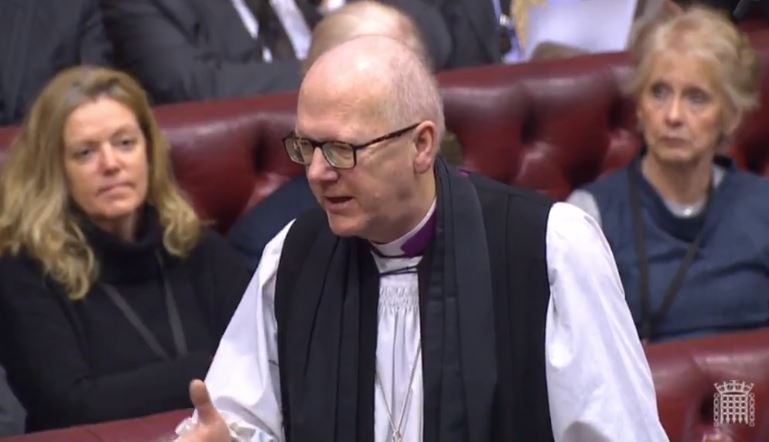
The Lord Bishop of St Albans: My Lords, we on these Benches welcome a number of aspects of the announcements yesterday in the Autumn Statement, not least the rises in the living wage and in pensions. There is an issue, though, over structural pay gaps which hide even greater disparities: pay gaps to do with gender, disability, social mobility and regional disparities, which are vital as we think about our levelling-up strategy. Can the Minister give us some indication of how the Government hope to address those structural pay differentials and gaps?
Continue reading “Bishop of St Albans asks about structural pay gaps”The Bishop of London received the following written answer on 21st June 2023:

The Lord Bishop of London asked His Majesty’s Government what recent progress they have made towards reducing health inequalities; and what further steps they intend to take in the future.
Lord Markham (Con): The Government is committed to improving healthy life expectancy by five years by 2035 and reducing the gap between areas where it is highest and lowest by 2030, as stated in the Levelling Up White Paper.
Continue reading “Bishop of London asks about reducing health inequalities”The Bishop of London received the following written answers on 20th June 2023:
The Lord Bishop of London asked His Majesty’s Government, further to The Hewitt Review: an independent review of integrated care systems, published on 4 April, what plans they have to implement the recommendation contained in that review to publish a strategy for the social care workforce.
Continue reading “Bishop of London asks about patient care and health inequalities”On 19th June 2023, the Bishop of London tabled a question on reducing inequality of access to primary care using the Community Health Worker Model:
The Lord Bishop of London: To ask His Majesty’s Government what assessment they have made of the community health worker model in relation to reducing inequality of access to primary care.
Lord Evans of Rainow (Con): My Lords, the Government have made no formal assessment of the community health worker model. However, they are supporting the development of models like the Brazilian one through the additional roles reimbursement scheme. We have delivered on our manifesto commitment to recruit 26,000 additional primary care professionals a year ahead of the March 2024 target. Our Delivery Plan for Recovering Access to Primary Care will also create a more equitable approach, regardless of patients’ routes to access.
Continue reading “Bishop of London asks about community healthcare models to tackle health inequality”The House of Lords debated the Levelling Up Bill in its second reading on 17th January 2023. The Bishop of Carlisle spoke in the debate, focusing on health inequalities between the North and South of England:

The Lord Bishop of Carlisle: My Lords, in the brief time available, I will address health inequalities between the north of England, where I live, and the south, and their implications for levelling up and regeneration. Health inequalities are defined as avoidable, unfair and systematic differences in health between different groups of people. In 2010, Sir Michael Marmot conducted his celebrated review into such inequalities, in the hope that this might lead to some improvement. Instead, we have seen an increase, rather than a reduction, of such inequalities over the last 12 years. For instance, life expectancy in deprived areas of the north-east is at least five years lower than it is in similar areas here in London. A baby boy born in Blackpool today can expect an additional 17 years of poor health compared with a baby born in Richmond upon Thames. People in all social groups in the north of England, male and female, are consistently less healthy than those in the south, and premature death rates are about 20% higher across all age groups in the north, due not least to lower lifetime chances.
These statistics—there are many more—are a stark reminder that inequalities in health are often closely linked to people’s socioeconomic circumstances. This has been forcefully illustrated by the Covid pandemic, which, in the words of one commentator, exposed “deep fractures of inequality” running across our society. During the first year of the pandemic, the mortality rate was 17% higher in the north than in the south, unemployment was 19% higher and there were significant differences in mental well-being between the north and the south. It is now reckoned that health issues account for about 30% of the gap in productivity between the north and the south.
Continue reading “Levelling Up Bill: Bishop of Carlisle speaks on health inqualities”On 12th January 2022, the House of Lords debated changing mortality rates in the UK in Grand Committee. The Bishop of London spoke in the debate, advocating for greater inclusion of faith groups to aid in tackling health inequalities:
The Lord Bishop of London: My Lords, I thank the noble Lord, Lord Sikka, for securing this important debate. I also look forward to hearing from the noble Lord, Lord Evans, in his maiden speech.
The paper at the heart of this debate provides a useful focus, because it highlights one of the worst health outcomes that we have seen in the past 10 years: that of widening inequalities. It is also helpful because, by focusing on the impact of austerity, we begin to see that public health is impacted by many factors besides healthcare access—factors called the social determinants of health. Those include housing, our jobs, our environment, our education and much more. They can be summed up as the opportunities that we have to lead healthy lives. The Heath Foundation noted that 50% of people in the most deprived areas report poor health by the age of 55 to 59, which is more than two decades earlier than in the least deprived areas. It is not just about life expectancy; it is also about healthy life expectancy.
The debate is poignant also because it comes at a time of great strain on the NHS and on social care, and at a time when those other determinants of health are challenging for many of us. We are also at a moment when I hope we are beginning to realise the importance of prevention of ill health, which is essential for the sustainability of our healthcare system.
Continue reading “Bishop of London urges government to work with faith groups to tackle health inequalities” The Church of England in Parliament
You must be logged in to post a comment.