Bishop of Oxford asks about ethics in neurotechnology

The Bishop of Oxford received the following written answer on 20th October 2025:

The Lord Bishop of Oxford asked His Majesty’s Government whether they will work with international partners to ensure that the proposed Recommendation on the Ethics of Neurotechnology from the United Nations Educational, Scientific and Cultural Organization upholds (1) international human rights standards, including safeguards for equity, mental integrity and privacy, (2) the precautionary principle, and (3) protections for children and other vulnerable groups.

Continue reading “Bishop of Oxford asks about ethics in neurotechnology”

Bishop of Chelmsford asks about potential debate on implications of whole-genome sequencing of infants

The Bishop of Chelmsford asked a question on the opportunity for the House to debate the implications of whole genome-sequencing on 18th September 2025:

The Lord Bishop of Chelmsford: When will the House have the opportunity to debate this policy for whole-genome sequencing with all its details, given that it has such weighty and far-reaching implications for healthcare, prevention and a number of ethical issues, as we have already heard?

Continue reading “Bishop of Chelmsford asks about potential debate on implications of whole-genome sequencing of infants”

Bishop of Oxford asks about ethical use of medical data

The Bishop of Oxford asked a question on the ethical questions around use of medical data and outsourcing of this data to private companies on 9th July 2025, following a government statement on the NHS 10-Year Plan:

The Lord Bishop of Oxford: My Lords, I welcome the Minister to her place and, like others, send good wishes to the noble Baroness, Lady Merron.

I welcome very much, as others have done, the three aspirations in Fit for the Future. I think that they are significant and that they are the right ones. I think they are bold and visionary. However, while I welcome the move from analogue to digital, for me, the document raises significant questions. We are looking to build a National Health Service which cares for whole people, not machines. We need, therefore, to be concerned for physical, mental, emotional and spiritual health, at every stage of life, across the NHS. That demands continuous investment in people, including, of course, chaplains.

Continue reading “Bishop of Oxford asks about ethical use of medical data”

Bishop of St Albans asks about plastic surgery consultation

The Bishop of St Albans received the following written answer on 15th April 2024:

The Lord Bishop of St Albans asked His Majesty’s Government when they intend to publish feedback to the Licensing of non-surgical cosmetic procedures consultation, which ran from 2 September to 28 October 2023.

Lord Markham (Con, DHSC): We are currently analysing the feedback received during the consultation, and intend to publish the Government’s response later in the spring.

Hansard

Bishop of Carlisle asks about medical approval for age assessments of refugees

The Bishop of Carlisle asked a question on whether the government would seek approval from relevant medical bodies for methods of age-assessment used on refugees on 6th December 2022, during a debate on the ethical considerations of such assessments:

The Lord Bishop of Carlisle: My Lords, further to that answer, in determining what constitutes an appropriate scientific method of age assessment, can the Minister assure us that any future methods will be formally approved by the relevant medical body before they come into use?

Lord Murray of Blidworth (Con): Plainly they will be formally approved by the advisory committee to the Home Secretary, and one suggests that the views of relevant professional bodies will be of great weight in making such a decision.

Hansard

Organ Tourism and Cadavers on Display Bill: Bishop of St Albans welcomes bill, highlights repression of the Uighur minority in China

On 16th July 2021, the House of Lords debated the Organ Tourism and Cadavers on Display Bill [HL] in its second reading. The Bishop of St Albans spoke in support of the bill, bringing up the persecution of the Uighur minority in China:

The Lord Bishop of St Albans: My Lords, I too support this Bill and welcome the very excellent speech by the noble Lord, Lord Hunt of Kings Heath, and this important priority to equalise the law so that, whether a body or an organ comes from someone in this country or some other part of this world, they will be given the same protections and treated with the same dignity.

Noble Lords have already spelled out with great and horrifying clarity some of the allegations of organ harvesting by the Chinese authorities targeting minorities. I have risen to speak today because I have been raising again and again in this House the issue of the Uighurs, and this absolutely touches on what is happening to this incredibly persecuted group of people. It is terrifying to see what is unfolding before our very eyes. In June 2021, a group of independent UN experts said that they had received information that detainees from ethnic and religious groups such as the Uighurs, Tibetans, Falun Gong and Chinese Christians were being subjected to examination without their consent, with the express intention to facilitate organ allocation.

Continue reading “Organ Tourism and Cadavers on Display Bill: Bishop of St Albans welcomes bill, highlights repression of the Uighur minority in China”

Bishop of Carlisle asks about informed consent in collection of medical information

On 8th June 2021, during a discussion on collection of patient care records by the NHS, the Bishop of Carlisle asked a question on the issue of informed consent for patients to opt out of having their data collected and stored:

The Lord Bishop of Carlisle: My Lords, informed consent is at the heart of good patient care. Can the Minister tell us what plans Her Majesty’s Government have to inform patients that they have the right to opt out of having their personal medical information collected in this way? How will this be advertised?

Continue reading “Bishop of Carlisle asks about informed consent in collection of medical information”

Bishop of Newcastle asks about COVID-19 resuscitation orders

On 24th March 2021, Bishop of Newcastle tabled a question on a report from the Care Quality Commission on decisions relating to resuscitation orders for care home residents and those with learning disabilities during the COVID-19 pandemic:

The Lord Bishop of Newcastle: To ask Her Majesty’s Government what assessment they have made of the report by the Care Quality Commission Protect, respect, connect—decisions about living and dying well during COVID-19, published on 18 March, on decisions about the use of ‘do not attempt cardiopulmonary resuscitation’ orders for (1) care home residents, and (2) people with learning disabilities, during the pandemic.

Continue reading “Bishop of Newcastle asks about COVID-19 resuscitation orders”

Bishop of Carlisle highlights ethical issues involved with gene editing

On 30th January 2020 the House of Lords debated a motion from Baroness Bakewell, “that this House takes note of recent developments in the field of gene editing, and its status in scientific research around the world.” The Bishop of Carlisle, Rt Revd James Newcome, took part in the debate:

The Lord Bishop of Carlisle: My Lords, I add my own congratulations and gratitude to the noble Baroness, Lady Bakewell, on securing this timely and important debate. Unlike my noble friend Lord Patel and other noble Lords yet to speak, I am not a scientist. However, I have vivid memories of following the Human Genome Project with a mixture of excitement and awe as I realised its huge potential for good. I have been equally impressed by the many recent developments in gene editing, including the 100,000 Genomes Project and CRISPR-Cas9, which we have heard about, and their implications for the prevention or treatment of diseases such as cystic fibrosis, muscular dystrophy and cancer. Continue reading “Bishop of Carlisle highlights ethical issues involved with gene editing”

Bishop of Bristol supports Abortion (Disability Equality) Bill

“Not only children but adolescents and adults with Down’s syndrome live valued and valuable lives, contributing greatly to the welfare of those around them. All of this is undermined by the continued existence on our statute book of a law that, in effect, states that Down’s syndrome is a ground for abortion.” – Bishop of Bristol, 21/10/16
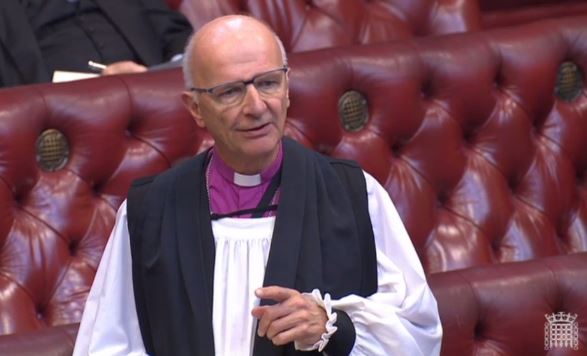
Bristol160226 cOn the 21st October 2016 Conservative Peer Lord Shinkwin led a debate on the Second Reading of his Abortion (Disability Equality) Bill. The Bishop of Bristol, Rt Revd Mike Hill, spoke in support of the Bill.

The Lord Bishop of Bristol: My Lords, I too am grateful to the noble Lord, Lord Shinkwin, for introducing this Bill. I understand that its focus is the principle of disability equality, not some underhand attempt to limit women’s access to abortion services. Noble Lords will, of course, have a variety of opinions on the ethics of abortion, but that is not, in principle, the focus of the Bill. It needs to be said that, in general, historically and indeed today, churches and other faith groups have always maintained a cautious approach to how the rights of women and the rights of the unborn child can somehow be maintained without, we hope, falling in to those who reside at the extremes of arguments around ethics on both sides of this debate. Continue reading “Bishop of Bristol supports Abortion (Disability Equality) Bill”