
On 12th February 2020 the House of Lords debated a motion from Lord Clement-Jones, “To ask Her Majesty’s Government what steps they have taken to assess the full implications of decision-making and prediction by algorithm in the public sector.” The Bishop of Oxford, Rt Revd Steven Croft, asked a follow-up question:
 The Lord Bishop of Oxford: My Lords, I declare an interest as a board member of the CDEI and a member of the Ada Lovelace Institute’s new Rethinking Data project. I am also a graduate of the AI Select Committee. I am grateful to the noble Lord, Lord Clement-Jones, for this important debate.
Almost all those involved in this sector are aware that there is an urgent need for creative regulation that realises the benefits of artificial intelligence while minimising the risks of harm. I was recently struck by a new book by Brad Smith, the president of Microsoft, entitled Tools and Weapons—that says it all in one phrase. His final sentence is a plea for exactly this kind of creative regulation. He writes:
“Technology innovation is not going to slow down. The work to manage it needs to speed up.”
 The Lord Bishop of Oxford: My Lords, I warmly welcome this report and this vital debate. Never before in the scale of human history has there been such a wide and deep threat to our ecosystem or to human flourishing that was so clear and predictable on the horizon. Technology alone is not enough.
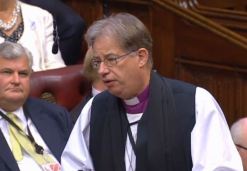 On 26th June 2019 Lord Bird asked the Government, “by what means, if at all, they require public bodies to act, and to demonstrate how they act, in a manner which seeks to ensure that the needs of the present generation are met without compromising the ability of future generations to meet their own needs.” The Bishop of Oxford, Rt Revd Steven Croft, asked a follow-up question:
 The Lord Bishop of Oxford: My Lords, I too welcome this debate and thank the noble Lord, Lord Bird, very warmly for bringing it. I welcome his proposals. As the noble Lord, Lord Layard, said, the foundation is a moral and ethical case. That moral case has shifted in recent years because of the realisation of the effects of the Anthropocene era. Humanity’s effect on the environment means that the interests of not just the next generation but every generation beyond that need to be protected in our policy-making and debate.
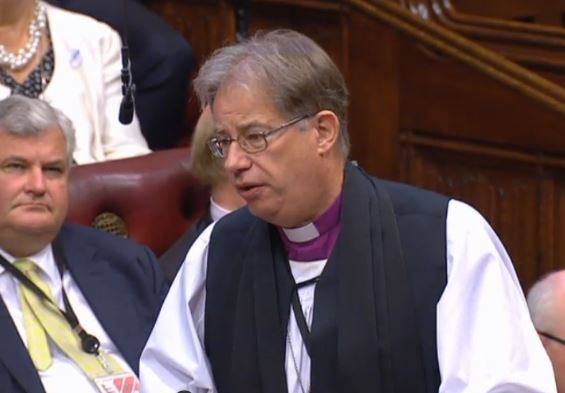 The Lord Bishop of Oxford: My Lords, those were extremely moving speeches. I thank the noble Lords, Lord Faulkner, Lord Collins and Lord Cashman, and the noble Baroness, Lady Brinton, for the contributions they have made in the Chamber today and the moving way in which they have spoken. I thank them for sharing their personal experiences so movingly, and for the important and necessary articulation of the views they have heard within the broader Church of England in favour of movement and inclusion. I deeply regret the language used in writing to the noble Lord, Lord Collins, and others; it has no place in the contemporary Church.


You must be logged in to post a comment.