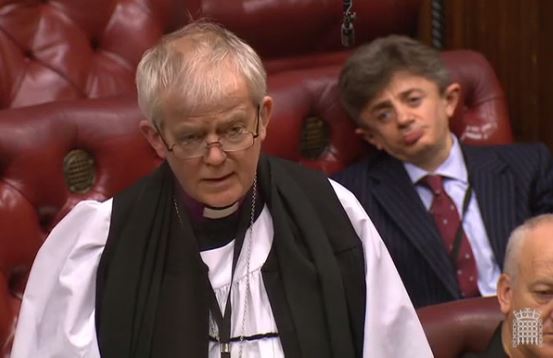
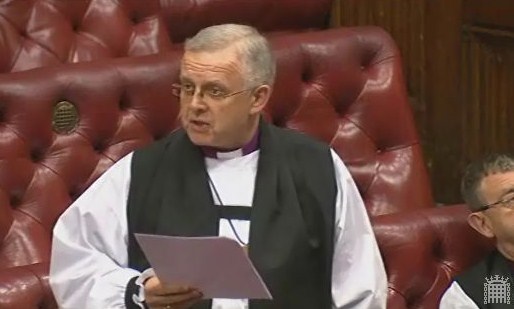
On 15th September 2016 the Bishop of Rochester, Rt Revd James Langstaff, received a written answer to a question on vetting of prison chaplains:Continue reading “Bishop of Rochester asks about extremism vetting process for prison chaplains”
On 27th & 30th June 2016 the Bishop of Rochester, Rt Revd James Langstaff, received written answers to questions on radicalisation in prisons.
The Lord Bishop of Rochester: To ask Her Majesty’s Government what discussions they are having with prison chaplains, including those of Muslim and Christian faith, to address concerns about radicalisation and extremism in prisons. [HL599] Continue reading “Bishop of Rochester asks Government about radicalisation and extremism in prisons”
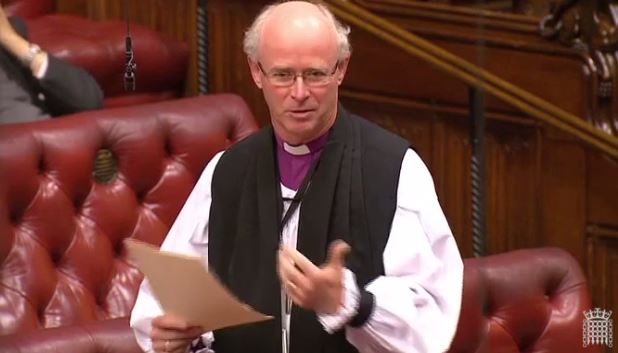
On 24th May 2016 the Bishop of St Albns, Rt Revd Alan Smith, spoke in the third day of debate on the Queen’s Speech. The Bishop focused on human rights issues, including the proposed new Bill of Rights, prison reform, counter-extremism and investigatory powers.
The Lord Bishop of St Albans: My Lords, in response to Her Majesty’s gracious Speech I will make just a few points on the subject of human rights, rights which from my perspective arise from the inherent and God-given dignity of every human being. In 1213, St Albans Cathedral was the setting for the first meeting of the bishops and barons which was to lead, two years later, to the sealing of Magna Carta, the 800th anniversary of which we celebrated just last year as a foundational document in the history of human rights.
However, the proposals for a British Bill of Rights to replace the Human Rights Act make me question whether the celebrations last June were something of a missed opportunity.
Continue reading “Queen’s Speech: Bishop of St Albans on human rights and human dignity”
On 24th May 2016 the Bishop of Rochester, Rt Revd James Langstaff spoke during the third day of debate on the Queen’s Speech. In his capacity as lead bishop for prisons, the Bishop welcomed the proposals outlined by Government for prison reform.
The Lord Bishop of Rochester: My Lords, I don my hat as bishop to Her Majesty’s prisons and will therefore limit my contribution to the debate on the gracious Speech to those matters which were about prisons and to the proposed prisons and court reform Bill. Like many other noble Lords, I welcome much that appears to be there and the seriousness of the ambition for change, and what I detect to be the quite marked change in the tone and language which is being used.
As for language, the Secretary of State is fond of quoting a Mr Osborne—perhaps not that Mr Osborne, because they seem to be on opposite sides of various debates, but the words of a Mr Osborne who, in 1914, was the warden of Sing Sing prison in New York. He is quoted as expressing his aspiration to turn it from a scrapheap to a repair shop. That quotation carries quite a lot, but in rather different language, the Roman Catholic Church in this country said something similar in a document in 2004 when it spoke of prisons having the potential to be places of redemption. Speaking from these Benches, I find it interesting that the Secretary of State uses quite freely what we would recognise as theological language of redemption and restoration when expressing his aspirations for what will happen in prisons. If he is serious about that, and about redemption and restoration being at the heart of the prison system, my interest is certainly piqued and my support is lurking there waiting to be given.
Continue reading “Queen’s Speech: Bishop of Rochester welcomes prison reform plans”
On 24th May 2016 the Bishop of Southwark, Rt Revd Christopher Chessun, spoke in the third day of debate on the Queen’s Speech. He addressed the Government’s proposals for tackling extremism, British values and prison reform, and remarked on the need for unifying language and behaviour in political debate.
The Lord Bishop of Southwark: I will make a number of points which I hope will be of value to your Lordships’ House and respond appropriately to Her Majesty’s gracious Speech. It is clear to me that Ministers in this Government understand freedom, as did their predecessors, as freedom in security. We have heard in the Queen’s Speech that we may expect legislation,
“to prevent radicalisation, tackle extremism in all its forms, and promote … integration”.
This may be necessary, but I have concerns about our ready desire to legislate solutions to problems where other avenues present themselves. The recent lowering tone and content in public discourse is an example. It diminishes sympathy and challenges what constitutes legitimate and proper boundaries for political debate. I agree with the Chief Rabbi that:
“There has been nothing more disheartening … than the suggestion that this is more about politics than about substance”.
I am bound to observe, for example, that there were lapses of judgment during the recent mayoral election in London.
We need a politics of generosity that transcends such divisiveness, a narrative that does not engender fear, and I applaud indications within major political parties that recognise this. Continue reading “Queen’s Speech: Bishop of Southwark on extremism, freedom of speech and British values”
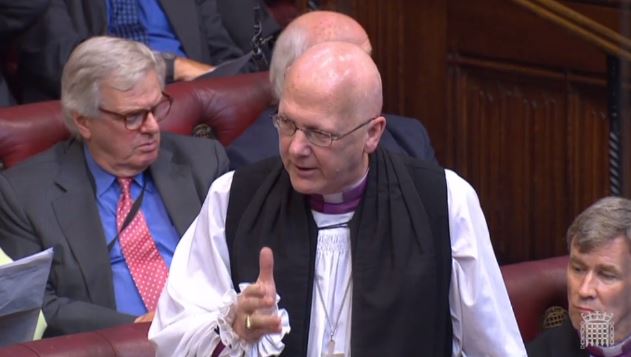
On 3rd May 2016 Lord Marks of Henley-on-Thames asked Her Majesty’s Government, “in the light of the latest figures on deaths in custody and prison violence, what plans they have to improve prison safety in the short term.” The Bishop of Peterborough, Rt Revd Donald Allister, asked a follow up question:
The Lord Bishop of Peterborough: My Lords, given the shocking 27% rise in suicides in prisons in the last year, what can the Minister tell us about the provision of psychiatric and psychotherapeutic care for vulnerable prisoners? Continue reading “Bishop of Peterborough asks Government about plans to reduce prison suicides”
On 25th April 2016 the Bishop of St Albans, Rt Revd Alan Smith, received a written answer to a question on support for those at risk of suicide in prison:
The Lord Bishop of St Albans: To ask Her Majesty’s Government what assessment they have made of the recent increases in the number of non-natural deaths in prisons; and what plans they have to improve mental health support for those in prison who are at risk of suicide. [HL7466] Continue reading “Bishop of St Albans asks Government about support for prisoners at risk of suicide”
On 3rd March 2016 Lord Marks of Henley-on-Thames asked Her Majesty’s Government “what steps they are taking to tackle the incidence of deaths, serious assaults and incidents of self-harm in prison.” The Bishop of St Albans, Rt Revd Alan Smith, asked a follow up question:
The Lord Bishop of St Albans: My Lords, in the light of the welcome announcement last autumn that a number of the old, unsuitable prisons were going to be replaced with purpose-built ones, will the Minister assure the House that the specifications for those new-builds will take very careful account of mental health issues, consulting with the charities that are dealing with this particular area and producing excellent educational, medical and spiritual facilities, so that we can minimise the level of mental health problems and maximise rehabilitation? Continue reading “Bishop of St Albans asks Government to ensure new prison designs take account of mental health needs”
On the 19th January 2016 the Bishop of Peterborough, the Rt Revd Donald Allister, took part in a short debate tabled by Lord Hanningfield, “To ask Her Majesty’s Government what steps they are taking to help improve education standards in United Kingdom prisons.” Bishop Donald spoke about his recent visits to several prisons and the challenges presented by studying for qualifications within a prison. The Bishop also urged the Government to include restorative justice as part of its education provision within the prison estate.
The Lord Bishop of Peterborough: My Lords, I, too, am grateful for this debate. I also note with great pleasure a number of changes made to policy and practice in this area by Mr Gove since he became Secretary of State. I gladly thank him and the Government, particularly for allowing prisoners greater and easier access to books. But if educational standards in prisons are to be improved, as they desperately need to be, we still need much more joined-up thinking. I will give two examples. Continue reading “Bishop of Peterborough speaks about the importance of education on the prison estate”
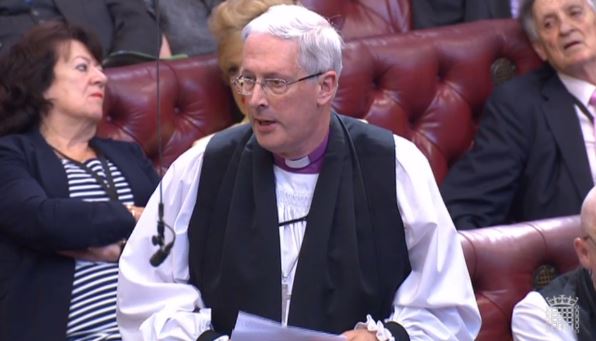
On the 19th January 2016 the Bishop of Derby, the Rt Revd Alistair Redfern took part in a short debate tabled by Lord Hanningfield “To ask Her Majesty’s Government what steps they are taking to help improve education standards in United Kingdom prisons.” The Bishop spoke from his own experience of visiting a number of prisons in his diocese and of the important work of chaplains, musicians and arts projects within prisons.
The Lord Bishop of Derby: My Lords, I, too, thank the noble Lord, Lord Hanningfield, for his introduction to the debate, especially for linking education with vocation for people in prison. As the noble Lord, Lord Addington, said, it is a very complex territory with very deep needs. A lot of research shows that the prison population represents people with multiple needs. Therefore, the task of education and vocation will be challenging. I see the importance of formal education for literacy and numeracy to help people to get jobs. I am all in favour of that, but I want to look behind that at the informal fashioning of vocation and the development of character and confidence, which allows people to enter formal learning. I will draw on my own experience of going into prisons. Continue reading “Bishop of Derby highlights work of prison chaplains and value of educational and arts projects”
You must be logged in to post a comment.