The Bishop of Durham received the following written answer on 7th December 2021:
The Lord Bishop of Durham asked Her Majesty’s Government:
how many missing persons cases of child refugees have been issued in 2021.
what records they keep of the number of child refugees who go missing in the UK.
Baroness Williams of Trafford: Safeguarding procedures are in place to ensure children in temporary accommodation are safe and supported until a permanent place can be found with a local authority.
The Bishop of Gloucester received the following written answer on 3rd December 2021:
The Lord Bishop of Gloucester asked Her Majesty’s Government when they will publish the evaluation of the ‘Action Access’ alternative detention pilot.
Baroness Williams of Trafford (Con): The United Nations High Commissioner for Refugees (UNHCR) have appointed the National Centre for Social Research (NatCen) to independently evaluate this pilot.
NatCen will be publishing the evaluation on their website the aim is for the evaluation to be published by the end of the year.
The Bishop of Durham received the following written answer on 2nd December 2021:
The Lord Bishop of Durham asked Her Majesty’s Government how many child refugees are currently in looked after care in the UK.
Baroness Barran (Con): The department does not collect data on all child refugees that are currently in care, but does collect data on the number of unaccompanied asylum-seeking children (UASC) who are looked after by local authorities in England. Of the 80,850 children looked after up to 31 March 2021, there were 4,070 UASC, down 20% from the previous year which was 5,060.
“a policy that does not go beyond deterrence is not sufficient”
On November 25th 2021 the House of Lords debated a motion from Baroness Hoey, “That this House takes note of the number of migrants arriving in the United Kingdom illegally by boat“.
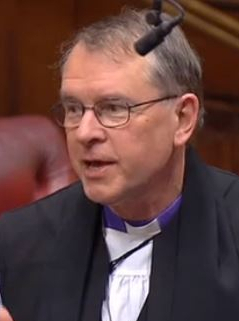
The Lord Bishop of Coventry: My Lords, I too am grateful to the noble Baroness, Lady Hoey, for securing this debate, especially at this time. I was helped this morning by the “Thought for the Day” from my colleague, the right reverend Prelate the Bishop of Leeds, in which he said that this is a time to dig deeper into our emotions and face the grief we feel at the loss of humanity. It is that sense of grief, our common commitment to the preservation and dignity of life, as well as to a passion for justice for those suffering the ills and evils of the world, which unites us. The noble Baroness, Lady Hoey, demonstrated that.
Our shared grief is the proof we do not really need of the humanity and vulnerability that unites us. These common concerns, which underpin both our aim to stop migrants making dangerous journeys and our grief today, are the same concerns and moral instincts that require us to sit back and face the reality that a policy that does not go beyond deterrence is not sufficient.
On 22nd November 2021, the Bishop of Leeds asked a question on the impact of the ongoing conflict in Ethiopia’s Tigray region on peacekeeping in East Africa, and on the refugee population of the area:
The Lord Bishop of Leeds: My Lords, this is a very unstable region of Africa. Ethiopia has proved crucial to stability in UN peacekeeping as well. Can the Minister say, first, how any diminution in the Ethiopian contribution to UN peacekeeping is being mitigated or compensated for elsewhere? Secondly, what is his assessment of the refugee crisis caused despite the welcome restoration of the transitional Government in Sudan?
The Bishop of Southwark received the following written answers on 22nd November 2021:
The Lord Bishop of Southwark asked Her Majesty’s Government:
what assessment they have made of the impact of the reduction in their funding of the UN Relief and Works Agency for Palestine Refugees for 2021 compared to 2020.
what assessment they have made of (1) the financial position of the UN Relief and Works Agency for Palestine Refugees, and (2) the sustainability of the Agency’s provision of services to Palestinian refugees.
The Bishop of Durham received the following written answers on 22nd November 2021:
The Lord Bishop of Durham asked Her Majesty’s Government:
whether family reunion rights will be restricted for all group 2 refugees as a result of the proposed changes to the law in the Nationality and Borders Bill.
assessment they have made of the impact of the proposed changes to family reunion rights in the Nationality and Borders Bill on the number of (1) men, (2) women, and (3) children, who will come to the UK via family reunion; whether they expect the number of such people to be lower than in previous years; and if so, by how many.
The Bishop of Worcester received the following written answers on 11th October 2021:
The Lord Bishop of Worcester asked Her Majesty’s Government what assessment they have made of (1) the current levels of internally displaced persons in Afghanistan, and (2) current and future refugee flows from Afghanistan to (a) Pakistan, (b) Tajikistan, (c) Iran, (d) Uzbekistan, and (e) Turkmenistan.
On 7th September 2021, during a debate on the situation in Afghanistan, the Bishop of Durham asked about the provision of commercial air services to evacuate people from the country, and support for local authorities in providing housing to incoming refugees:
The Lord Bishop of Durham: My Lords, sometimes very unexpected conversations occur. On my journey down from the north-east this morning, I found myself spending two hours talking with someone who had done seven tours of service in Afghanistan and nearly 10 years’ service in security. It is painful to talk to someone who is showing you on their phone the photos of them in the cargo plane coming out and hear his story.
The Archbishop of York asked a question on the expedition of new and existing asylum claims for Afghan nationals in the UK on 6th September 2021, during a debate on the progress of bilateral return agreements with EU states for the return of asylum seekers arriving in the United Kingdom:
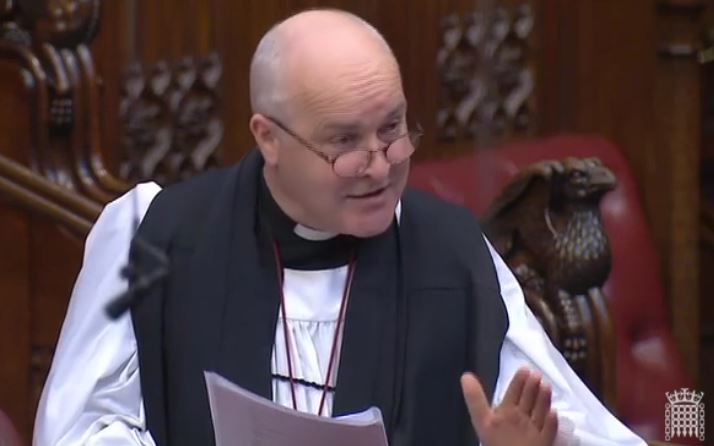
The Lord Archbishop of York: My Lords, care and justice for asylum seekers is obviously a matter very close to the heart of the Church, Jesus himself being a refugee. Last week, the Church of England published a toolkit for the many churches that have asked us what they can do to support Afghan refugees. The Minister will know that the Church and other faith communities are among the main support works for asylum seekers. There are more than 3,000 Afghan nationals with existing asylum claims waiting for a decision, some of whom have been waiting a long time. What steps are the Government taking to expedite procedures for dealing with existing or new asylum claims by Afghan nationals, given the very changed situation and the particular stress and trauma felt by these people?



 The Church of England in Parliament
You must be logged in to post a comment.