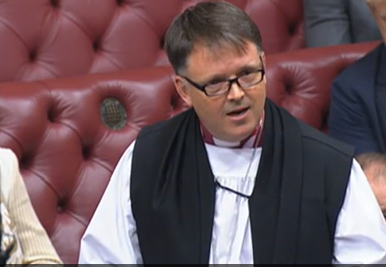
The Bishop of Norwich made a speech during a debate on regeneration of industrial areas on 7th March 2024, calling for greater investment in and engagement with communities to help drive local regeneration:
The Lord Bishop of Norwich: My Lords, the place that shaped me most as a priest in the Church of England was the parish of Holy Trinity North Ormesby in Middlesbrough at the turn of the millennium, so it was a simple delight and joy to hear the noble Baroness, Lady Chapman, speak about so many places that I know, from South Bank to Maske.
North Ormesby is set among derelict land, chemical plants and the distant smoke, sound and smell of the coke and steel furnaces. It is a place that taught me so much about resilience and survival, as well as about the strength of community, even when the stuffing had been knocked out of it. The people there taught me about acceptance and that each day was filled with little blessings. But I also learned about poverty and the impact of damp houses, as well as about health inequalities that meant that, if you lived six miles away, on average you lived another decade.
In all the indices, that community still comes out as being among the poorest, most ill, most unemployed and most unskilled, as well as having the lowest educational attainment and the worst air quality of wards in this nation. But the people I lived alongside in that community have warm and large hearts, despite the challenging context. The church was at the centre of its long-term regeneration, successfully building the Trinity Centre—a place for support, learning, faith and fun, it said. It was funded by the single regeneration budget and the neighbourhood renewal fund, but also, crucially, by many small grant-making trusts—and a local couple who one day knocked on the vicarage door with £1,000 of their savings because they believed in what we were doing. We gave confidence to the local authority and a housing association to invest in that community when others simply walked away.
Continue reading “Bishop of Norwich takes part in debate on industrial regeneration in urban areas”


 The Lord Bishop of St Albans [V]: My Lords, I am also delighted that the Government have set up the towns fund, which will make a significant contribution to many poorer communities. Nevertheless, it still remains that the Public Accounts Committee has expressed concerns about why some towns were chosen and some were not. In future, will Her Majesty’s Government undertake to publish the objective criteria and evidence that will be used for selection so that everyone can be assured that there is no political influence in making these selections and choices?
  The Lord Bishop of Leeds: My Lords, there are some wonderful examples of how old mills being rejuvenated and given new life, such as Salts Mill in Saltaire and Manningham Mills, although there is a vast amount of empty space there. If they were icons of the old northern powerhouse, they are now becoming icons of dereliction. Does the Minister agree that if nothing is going to happen, then it would be better to knock them down? I do not favour that, but there needs to be a strategy that allows these wonderful buildings to be brought back into life, to be given a sort of resurrection.
 On 25th September 2019 the House of Lords took note of the Government’s Spending Round 2019. The Bishop of Durham, Rt Revd Paul Butler, contributed to the debate:
 On 17th May 2018 the House of Lords approved a motion to create a Committee to meet for a year, to consider the regeneration of seaside towns and communities. The Bishop of Lincoln, Rt Revd Christopher Lowson, was appointed as one of the Members of the Committee:
 The Church of England in Parliament
You must be logged in to post a comment.