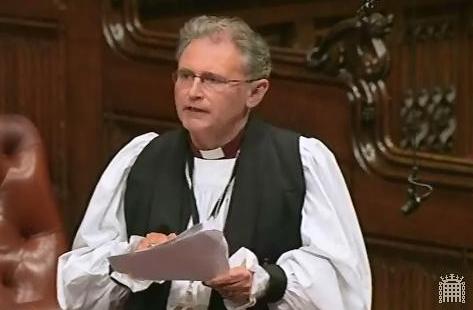
Archbishop of Canterbury responds to Government statement on Syrian refugees

On the 7th September 2015 the Archbishop of Canterbury, the Most Revd Justin Welby, responded to the Prime Minister’s statement about Syrian refugees and counter-terrorism, which had been repeated in the House of Lords by Baroness Stowell.
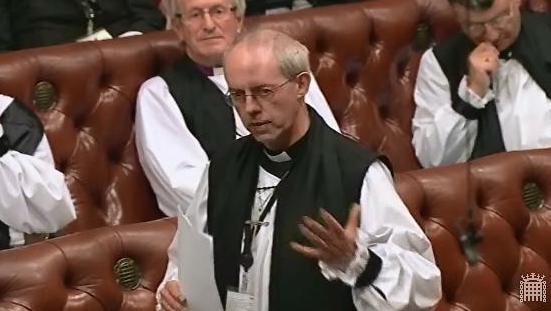
Archbishop of CanterburyThe Archbishop of Canterbury: I warmly welcome this start in the response of domestic hospitality, which comes in addition to the very considerable work that we have done overseas through the overseas aid budget and the work of the Royal Navy. It is on that basis that, challenged by this, the churches, starting this morning, are working urgently to add to what they have already been doing locally, and to work together to achieve and support a coherent, compassionate and credible public policy.

Continue reading “Archbishop of Canterbury responds to Government statement on Syrian refugees”
Bishop of Peterborough speaks on our duty to help the persecuted and dispossessed


“Welcoming the persecuted and the dispossessed is a duty for civilised nations—I would argue that it is a Christian duty—and in the long term it is good for the host nation, as well as for those fleeing for their lives” – Bishop of Peterborough, 22/7/15

14.02 PeterboroughOn the 22nd July 2015 the Bishop of Peterborough, the Rt Revd Donald Allister, spoke in a debate on the relocation of  Mediterranean migrants within the EU. The Bishop spoke of our duty as a nation to help the persecuted and dispossessed, alongside addressing the root causes through aid, diplomacy and other appropriate means.
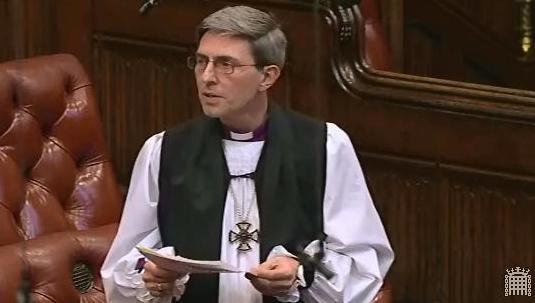
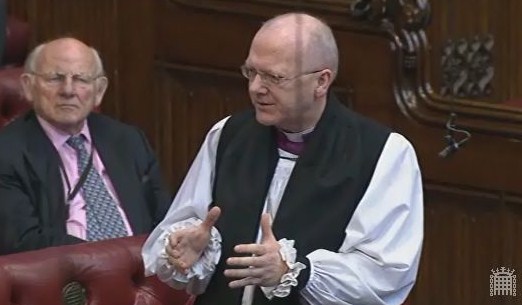
 

The Lord Bishop of Peterborough: My Lords, like other speakers, I am grateful for this debate and particularly grateful to the noble Baroness, Lady Prashar, and her colleagues for this excellent, moving and powerful report.

Of course, there are no easy answers to this dilemma, and I do not pretend that there are. I fully accept that any further help that we offer these poor disrupted people should be on a voluntary basis.Generosity and hospitality are important but cannot be mandated. On the other hand, as relatively wealthy members of the family of nations and of the European Union, we have a duty to help the persecuted and dispossessed, and to offer support to poorer European partners who find themselves under severe pressure. I stress that this is not easy. Continue reading “Bishop of Peterborough speaks on our duty to help the persecuted and dispossessed”

Bishop of Southwark calls on Government to invest in peacekeeping and post-conflict role of armed forces

On Wednesday 17th June 2015 the House of Lords debated a motion in the name of Lord Sterling of Plaistow “to ask Her Majesty’s Government whether they consider that the current defence budget is sufficient to enable the Armed Forces to meet the needs of the United Kingdom’s long-term foreign policy.” The Bishop of Southwark, Rt Revd Christopher Chessun, spoke in the debate, highlighting the need to resource conflict resolution and post-conflict stabilisation in Syria and other parts of the region.

Bp Southwark May 2015The Lord Bishop of Southwark: My Lords, I too welcome this debate and thank the noble Lord, Lord Sterling, for securing it. With the strategic defence and security review we have an opportunity for a wider debate on the politics of defence that might help to reshape our understanding of the purpose and task of our Armed Forces. The fundamentals that have underpinned UK foreign policy and defence spending in the past will need to be adapted to the changed circumstances we face, especially in the Middle East and our European neighbourhood. Continue reading “Bishop of Southwark calls on Government to invest in peacekeeping and post-conflict role of armed forces”

Bishop of Winchester asks Government about support for religious and ethnic minorities in Iraq and Syria

On 19th March 2015  Lord Avebury asked Her Majesty’s Government “what is the strategy of the United States-led coalition for clearing the Daesh out of the territories which they currently occupy in Syria and Iraq.” The Bishop of Winchester, Rt Rev Tim Dakin, asked a supplementary quesion:

Bishop of WinchesterThe Lord Bishop of Winchester: My Lords, even if the current operations to clear Daesh prove successful, the ancient religious and ethnic minority communities in Iraq have an uncertain future. Does the Minister agree with the statement recently submitted by the Holy See to the United Nations Human Rights Council? It said that a future without these communities in Iraq and the Middle East risks,

“new forms of violence, exclusion, and the absence of peace and development”.

Therefore, what steps are being taken to secure the future of those communities, and in particular, their human right to religious freedom? Continue reading “Bishop of Winchester asks Government about support for religious and ethnic minorities in Iraq and Syria”

Bishop of St Albans asks Government about help for Syrian and Iraqi refugees

On 17th March 2015 the Bishop of St Albans, Rt Revd Alan Smith, received three written answers to questions of Government about assistance to civilians displaced by conflict in Syria and Iraq:
Syria
Bishop of St Albans
The Lord Bishop of St Albans: To ask Her Majesty’s Government what financial and other support has been given, or will be given, to the governments of Lebanon and Jordan to ensure they can keep their borders open for Syrian refugees fleeing the conflict in that country.

Continue reading “Bishop of St Albans asks Government about help for Syrian and Iraqi refugees”

Bishop of St Albans – food security and Syria (Written Answers)

On Monday 16th March 2015, the Bishop of St Albans, Rt Revd Alan Smith, received answers to two written questions on (i) food security, and (ii) the future of displaced Syrians.

Bishop of St AlbansFood Security

The Lord Bishop of St Albans: To ask Her Majesty’s Government what assessment they have made of the recent research from the National Farmers’ Union on the decline in food production in the United Kingdom and its impact on food security.

Lord de Mauley (Parliamentary Under-Secretary for Environment, Food and Rural Affairs):This Government is committed to helping UK food producers thrive and expand. We are working with the National Farmers’ Union (NFU) and others to support a competitive UK farming industry, including through our £160 million investment in applied research under the agri-tech strategy, as well as the new Rural Development Programme for England, which includes £141 million dedicated to improving agricultural productivity.

Continue reading “Bishop of St Albans – food security and Syria (Written Answers)”

Bishop of St Albans asks Government about resettlement of Syrian refugees

On 10th March 2015 the Bishop of St Albans, Rt Rev Alan Smith, received a written answer to the following question of Government:

Bishop of St AlbansLord Bishop of St Albans: To ask Her Majesty’s Government whether they have any plans to review their resettlement policy for Syrian refugees in the light of the number who are continuing to seek refuge.

Lord Bates: The Government is deeply concerned about the crisis in Syria, the suffering and hardship it is causing for millions of displaced Syrians in the region, and the strain it is placing on their host countries. Given the scale of the crisis, we believe the most effective way to ensure the UK’s help has the greatest impact for displaced people and their host countries is through substantial humanitarian aid and actively seeking an end to the conflict so that refugees can return to their homes and livelihoods safely. Continue reading “Bishop of St Albans asks Government about resettlement of Syrian refugees”

Archbishop of Canterbury calls for voice of refugees to be heard in Syrian peace negotiations

On 26th February 2015, Lord Hylton asked Her Majesty’s Government what measures they and the host states are planning to prevent Syrian refugees becoming permanent residents in those states. The Archbishop of Canterbury, the Most Revd and Rt Hon Justin Welby, asked a supplementary question: 
Archbishop of CanterburyThe Archbishop of Canterbury: My Lords, given that, as the Minister will be aware, peace agreements in this area have been done to the people, from Sykes-Picot nearly 100 years ago onwards, what contacts are the Government making with those who are in the camps and need to have a voice in the peace settlement, and in particular with women’s groups?

Baroness Northover: The most reverend Primate is right to highlight this. There is constant contact with those in the camps, to try to engage them in moving things forward. With regard to support for women and girls, we are acutely aware of how vulnerable they are, and we have a number of programmes to help support them. As he will probably know, we are very concerned about early marriage and so on, and those who are particularly vulnerable to that. We are trying to ensure that we link up to support those girls so that that does not happen, and seeking out leaders to help protect girls and women more widely.

(via Parliament.uk)

Bishop of Coventry – Syria (Written Answer)

On 1st December 2014, the Bishop of Coventry, the Rt Revd Christopher Cocksworth, received an answer to a written question on freedom of religion or belief in Syria.

13.10 Bishop of CoventryThe Lord Bishop of Coventry: To ask Her Majesty’s Government whether the Foreign Secretary, in his meeting with Hadi al-Bahra on 10 November, discussed the Syrian Opposition’s commitment to guarantee freedom of religion or belief for all religious minorities in Syria.[HL3101]

The Minister of State, Foreign and Commonwealth Office (Baroness Anelay of St Johns): These issues were not raised on this occasion. We have in the past pressed the National Coalition to be inclusive, respecting all sections of Syrian society including ethnic and religious minorities. The National Coalition has made strenuous efforts to broaden its membership base which includes Kurds, Christians and other religious and ethnic groups demonstrating that it has a democratic and pluralistic vision for Syria.

(via Parliament.uk)

Bishop of Coventry receives answers on Government response to situation in Syria

On 29th October 2014, the Bishop of Coventry, the Rt Revd Christoper Cocksworth, received answers to two written questions from the Minister of State at the Foreign and Commonwealth Office, on the subject of religious and other groups in Syria.

13.10 Bishop of CoventryThe Lord Bishop of Coventry: To ask Her Majesty’s Government what steps they are taking to work with Syria’s religious communities, including the smallest minority communities and their political and civic representatives, to help them reach agreement on what measures are needed to ensure religious freedom and security for all communities in that country.[HL2204]

The Minister of State, Foreign and Commonwealth Office (Baroness Anelay of St Johns): We are supporting non-governmental efforts to promote dialogue between different ethnic and sectarian groups in Syria, with a view to a future political settlement. We are also funding training for Syrian activists to document abuses to a criminal law standard with the aim that this documentation could be used in a future process of accountability.

In the long run the only way to secure the position of Syria’s minority communities is to find an inclusive political solution to the crisis. The UK is determined to support the moderate opposition, who are working for an inclusive political settlement, and are committed to protect all of Syria’s communities and resist, extremists and authoritarian regimes. Continue reading “Bishop of Coventry receives answers on Government response to situation in Syria”