Bishop of London highlights the need for relief for civilians in the Syrian conflict

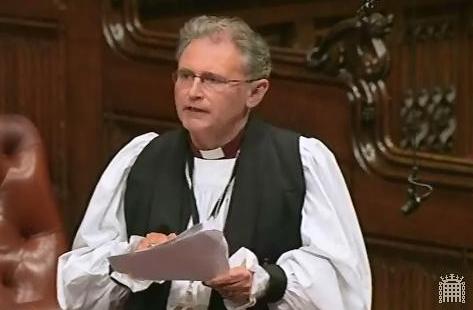
On 19th November 2013, Crossbench Peer Baroness Boothroyd asked Her Majesty’s Government what representations they have received relating to the creation of a humanitarian aid corridor in Syria. The Bishop of London, the Rt Revd and the Rt Hon. Richard Chartres, asked a supplementary question.

LondonThe Lord Bishop of London: My Lords, I think that everybody recognises the complexity of the situation, but just over a month ago, the UN Security Council itself called unanimously for humanitarian pauses. What contribution have Her Majesty’s Government been able to make diplomatically pursuing the possibility of more humanitarian pauses to bring relief to some of the civilians caught up in the fight?

Baroness Northover: Again, that is a case in point. The right reverend Prelate makes a good point in referring to those humanitarian pauses which were politically agreed but not delivered. That is the challenge. This is a very complex situation with many groups fighting each other, and enormous efforts are being put in—not least by UN special envoy Brahimi at the moment—to try to push forward some kind of agreement, but it is immensely difficult.

(via Parliament.uk)

Bishop of Coventry leads debate on humanitarian crisis in Syria

“Even with a political solution, the scars of this conflict will take many generations to heal. It will require the continued generosity of the international community in a sustained and strategic humanitarian commitment. I hope that Her Majesty’s Government will continue to take a courageous lead and make this not the last business of a long day but the priority of every morning until the holy land of Syria is healed.”

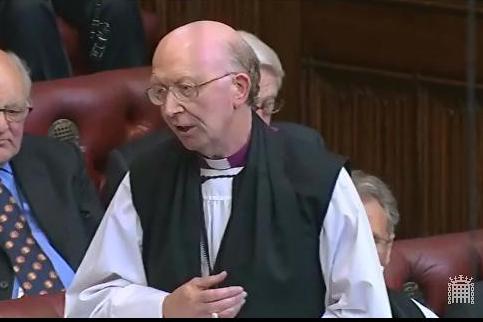
On 30th October 2013, the Bishop of Coventry, the Rt Revd Christopher Cocksworth, led a short debate in the House of Lords, to ask Her Majesty’s Government what steps they are taking to address the humanitarian crisis caused by the ongoing conflict in Syria. In his opening speech, the Bishop commended the Government for its response to the humanitarian crisis in Syria, but called for all pledged humanitarian assistance to be supplied as quickly as possible. He called on the Goverment to look into the resettling of Syrian refugees and noted the negative impact that the humanitarian crisis was having on the broader region. 

13.10 Bishop of CoventryThe Lord Bishop of Coventry: My Lords, despite the admirable diplomatic activity of recent weeks, the humanitarian costs of the ongoing conflict in Syria show no sign of abatement. As violence expands exponentially and cruelty abounds, no one can fail to be moved by the scale of the crisis, which is nothing short of a catastrophe.

This debate seeks neither to underestimate the efforts of Her Majesty’s Government to rise to the challenge of humanitarian support, nor to question their resolve to work towards a political resolution of the civil war. Rather, I hope that it will give an opportunity for your Lordships’ House to focus its expert attention on the humanitarian costs of the conflict and the humanitarian imperative of bringing the conflict to an end, and, in so doing, of checking that every stone is being turned in the cause of compassion and the pursuit of peace. Continue reading “Bishop of Coventry leads debate on humanitarian crisis in Syria”

Bishop of Leicester asks question on peaceful settlement of Syrian conflict

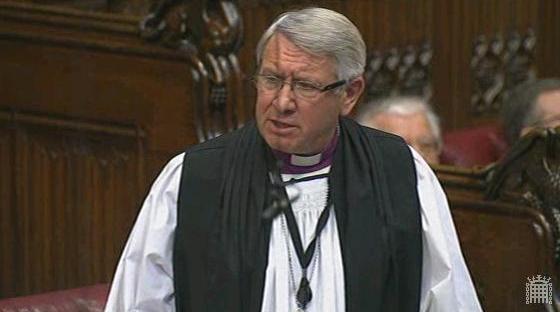
On 15th October 2013, Lord Truscott asked Her Majesty’s Government whether they consider that the recent Russian-led Syrian peace initiative provides a model for defusing other international crises, for example relating to Iran. The Bishop of Leicester, the Rt Revd Tim Stevens, asked a supplementary question:

LeicesterThe Lord Bishop of Leicester: My Lords, does the Minister agree that this shift in fortunes in Syria is very largely due to the relationship of trust that the United States Secretary of State and the Russian Foreign Minister have developed in recent months, and that similar levels of trust will be vital to resolving other pressing international crises, not least with Iran?

Lord Wallace of Saltaire: My Lords, I agree. I should also say that the British Foreign Secretary has worked extremely hard over the past nine months and more to come to terms with the Russians and to develop a relationship with the Russian Foreign Minister. The European Union high representative, the noble Baroness, Lady Ashton, has also done a great deal of work with the Russians on Syria and as part of the E3+3 on Iran.

(via Parliament.uk)

Bishop of Coventry asks Government for update on its support for humanitarian assistance in Syria

On 14th October 2013, the Bishop of Coventry received answers to two written questions on humanitarian assistance in Syria. 

13.10 Bishop of CoventryThe Lord Bishop of Coventry: To ask Her Majesty’s Government what steps they intend to take following the G20 Summit in St Petersburg to ensure unimpeded access for humanitarian workers inside Syria, including safe routes for aid convoys and the lifting of any bureaucratic hurdles imposed by the Assad regime.

Baroness Northover: It is vital that aid reaches those who have been affected by the Syria crisis. Since the G20 summit, the UK has successfully pushed the Security Council to capitalise on its strong chemical weapons resolution by applying its weight and authority to securing unfettered and immediate humanitarian access. On 2 October, the UN Security Council unanimously agreed a Presidential Statement setting out measures to facilitate access for humanitarian relief to all parts of Syria. The Minister of State for International Development, the right honourable Alan Duncan MP, met Baroness Amos of the United Nations Office for the Co-ordination of Humanitarian Affairs on 9 October to discuss these urgent matters.

** Continue reading “Bishop of Coventry asks Government for update on its support for humanitarian assistance in Syria”

Bishop of Oxford asks Government for update on peace negotiations in Syria

On the 8th October 2013, Lord Dykes asked Her Majesty’s Government what assessment they have made of the prospects for a United Nations-led settlement in Syria supported by the European Union, the United States, Russia and China.

Bishop of OxfordThe Lord Bishop of Oxford: It is well known that to have a peace process that works all the relevant parties must be gathered together, not just the moderates. Can the Minister assure us that, at Geneva II, the more extreme nations will be involved, including Iran, Saudi Arabia and so on, as well as the opposition groups, both internal and external? Will they all be there?

The Senior Minister of State, Department for Communities and Local Government & Foreign and Commonwealth Office (Baroness Warsi): The right reverend Prelate may be aware that the Geneva communiqué was for the first time adapted and supported by the UN Security Council as part of this resolution. That effectively means that the opposition and the regime have committed to being part of the Geneva II process. Which other states are part of that process depends very much on what they would be prepared to endorse, and whether they would be prepared to agree to the Geneva communiqué. At this stage, Iran has not done that.

(via Parliament.uk)

Archbishop of Canterbury speaks during debate on use of chemical weapons in Syria

“In civil wars, those who are internal to the civil conflict fight for their lives, necessarily. Those who are external have a responsibility, if they get involved at all, to fight for the outcome. That outcome must be one that improves the chances of long-term peace and reconciliation.”

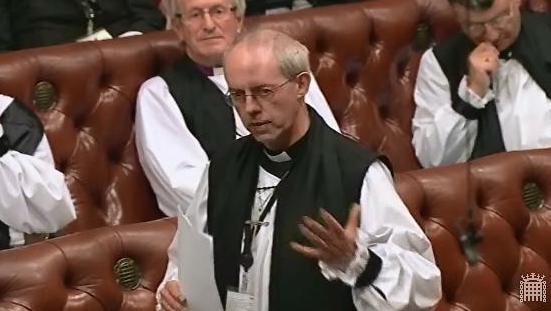
On 29th August 2013, the House of Lords was recalled to take note and debate the use of chemical weapons in Syria. The Archbishop of Canterbury, the Most Revd and Rt Hon. Justin Welby, spoke during the debate. He urged that all intermediate steps before opening fire should be taken and expressed concern that intervention from abroad would declare open season on Christian communities in the country and wider region, which have already been devastated. He argued that such a consequence needed to be balanced against the consequences of inaction and that intervention would have  to be effective in preventing any further use or promotion of chemical weapons and make it more possible for Syria and the Middle East to be places without millions of refugees.
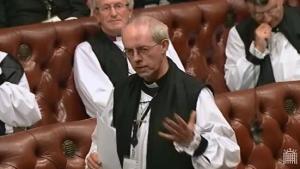
Archbishop of CanterburyThe Archbishop of Canterbury: My Lords, I welcome very much the opportunity to speak later in this debate because of the extraordinary quality of many of the contributions that have been made and how much one can learn by listening to them. Like many noble Lords I have some experience in the region, partly from this role that I have and from recent visits and contact with many faith leaders of all three Abrahamic faiths, and through 10 years of, from time to time, working on reconciliation projects.

I do not intend to repeat the powerful points that have been made on international law, which is itself based on the Christian theory of just war. That has been said very eloquently. However, I want to pick up a couple of points. First, it has been said, quite rightly, that there is as much risk in inaction as there is in action. In a conflict in another part of the world—a civil conflict in which I was mediating some years ago—a general said to me, “We have to learn that there are intermediate steps between being in barracks and opening fire”. The reality is that, until we are sure that all those intermediate steps have been pursued, just war theory says that the step of opening fire is one that must only be taken when there is no possible alternative whatever under any circumstances. As the noble Lord, Lord Alli, just said very clearly and very eloquently, the consequences are totally out of our hands once it has started. Continue reading “Archbishop of Canterbury speaks during debate on use of chemical weapons in Syria”

Bishop of Wakefield – Lebanon and Syria (Written Answers)

On 24th July 2013, the Bishop of Wakefield, the Rt Revd Stephen Platten, received written answers to questions on Lebanon and Syria.

Bishop of Wakefield PlattenThe Lord Bishop of Wakefield: To ask Her Majesty’s Government what steps they are taking to build the resilience of the Lebanese army to respond to the security situation on its border with Syria.

The Senior Minister of State, Department for Communities and Local Government & Foreign and Commonwealth Office (Baroness Warsi): The UK is providing an additional £10 million of assistance to support the Lebanese Armed Forces (LAF) in their mission to secure Lebanon’s border with Syria. The package of non-lethal assistance includes mobility, communications, protection and observation equipment and associated training. The package was discussed by the then Chief of Defence Staff, General Sir David Richards, with the LAF commander during his visit to Lebanon on 4-5 July.

(via Parliament.uk)

** Continue reading “Bishop of Wakefield – Lebanon and Syria (Written Answers)”