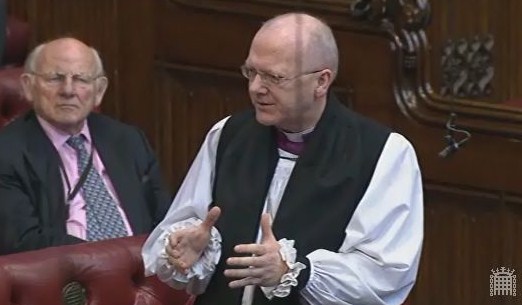
Bishop of Carlisle highlights concerns about victims of violence detained at Yarl’s Wood Immigration Removal Centre

On 24th February 2015, Baroness Bakewell asked Her Majesty’s Government “what requirements were set in the contract for Yarl’s Wood Immigration Removal Centre recently reawarded to Serco regarding the dignity and privacy of women detained there”.

The Bishop of Carlisle, the Rt Revd James Newcome, asked a supplementary question:

14.06.09 Bishop of CarlisleThe Lord Bishop of Carlisle: My Lords, in view of the concerns expressed only last Friday by the Joint Committee on Human Rights about women and girls who claim to have been victims of violence and are detained at Yarl’s Wood under the fast-track process, can the Minister tell us whether the Government have any plans for a screening process for people in that position?

Continue reading “Bishop of Carlisle highlights concerns about victims of violence detained at Yarl’s Wood Immigration Removal Centre”

St Albans- Forced Marriage (Written Answer)

On 11th February 2015, the Bishop of St Albans, the Rt Revd Alan Smith, received an answer to a written question on the Government’s collection of data on forced marriage.

Bishop of St AlbansThe Lord Bishop of St Albans: To ask Her Majesty’s Government To ask Her Majesty’s Government what plans they have to gather data on the number of girls under the legal age of marriage who had married abroad and have been brought back to the United Kingdom, as part of the work of the Forced Marriage Unit.

Baroness Anelay of St John’s – Minister of State (Foreign and Commonwealth Office): The Forced Marriage Unit (FMU) provides a range of support and assistance in cases where British nationals are at risk of forced marriage abroad. In 2013, the FMU gave advice or support related to a possible forced marriage in 1302 cases. Where the age was known, 15% of cases involved victims below 16 years and 25% involved victims aged 16-17. Where a victim is repatriated back to the UK, this is individually recorded on case notes.

(Via Parliament.uk)

Bishop of St Albans – Home Office Written Answer (Vulnerable Women)

On 2nd February 2015, the Bishop of St Albans received an answer to a written question on legislation relating to the criminalisation of the purchase of sex.

Bishop of St AlbansThe Lord Bishop of St Albans: To ask Her Majesty’s Government, further to the Written Answer by Lord Bates on 17 December 2014 (HL3283), whether they will now state what consideration they have given to introducing or amending legislation to criminalise the purchase of sex in order to protect vulnerable women.

Lord Bates: With regard to prostitution, the Government focus is on harm minimisation and I refer to my answer of 17 December 2014 to question HL3283 on this matter.

(via Parliament.uk)

Bishop of St Albans asks Government about action on tackling FGM

On 6th January 2015 the Bishop of St Albans, Rt Rev Alan Smith, received written answers to five questions of Government on female genital mutilation (or FGM):

Female Genital Mutilation

Question

Asked by The Lord Bishop of St Albans

Bishop of St Albans

To ask Her Majesty’s Government how they are resourcing the provision of training and education in communities in the United Kingdom in which female genital mutilation is practised.[HL3454] Continue reading “Bishop of St Albans asks Government about action on tackling FGM”

Bishop of St Albans asks Government about data on violence against women

On 17th December 2014 the Bishop of St Albans, Rt Rev Alan Smith, received a written answer to a question on violence against women:

Bishop of St AlbansThe Lord Bishop of St Albans: To ask Her Majesty’s Government what plans they have to improve the standardisation of comprehensive and analysable data on violence against women.[HL3284] Continue reading “Bishop of St Albans asks Government about data on violence against women”

Bishop of St Albans calls for stronger enforcement and culture change to tackle lack of FGM prosecutions

“…as well as hoping to get prosecutions, we need to work really hard on changing culture. Law is a blunt instrument. We have loads of laws on drugs and substance abuse and we try to enforce them, but, in that and other areas, we need to keep trying to get behind the issue which is causing the problem in the first place.”

Bishop of St AlbansOn 11th December 2014, Labour Peer Baroness Rendell of Babergh led a debate in the House of Lords to ask Her Majesty’s Government what steps they are taking to encourage prosecutions of offenders under the Female Genital Mutilation Act 2003. The Bishop of St Albans, the Rt Revd Alan Smith, spoke in the debate. He welcomed the Government’s Action Plan on FGM and the cross-party consensus on dealing with the issue. He noted that efforts had been made to strengthen the law on FGM through the Serious Crime Bill, but cautioned that existing legislation needed to be better enforced, if prosecution rates were to rise. He also called for a renewed effort to understand and challenge the cultural underpinnings of the practice, in order to see lasting change.
Continue reading “Bishop of St Albans calls for stronger enforcement and culture change to tackle lack of FGM prosecutions”

Bishop of St Albans – Forced Marriage (Written Answer)

On 10th December 2014, the Bishop of St Albans, the Rt Revd Alan Smith, received an answer to a written question on the subject of forced marriage.

Bishop of St AlbansThe Lord Bishop of St Albans: To ask Her Majesty’s Government whether they will clarify the role of teachers in monitoring girls at risk of being forced into under-age marriage. [HL3494]

The Parliamentary Under-Secretary of State for Schools (Lord Nash): All school staff have a responsibility to identify children who may be in need of extra help or who are suffering, or are likely to suffer, significant harm. All staff then have a responsibility to take appropriate action, working with other services as required. Those responsibilities, which apply to the risk of forced marriage as to any other form of abuse, are set out in ‘Keeping Children Safe in Education’ statutory guidance for schools and their staff which the Government published in April 2014. [1] Continue reading “Bishop of St Albans – Forced Marriage (Written Answer)”

Bishop of St Albans receives written answer on international violence against women convention

On 8th December 2014, the Bishop of St Albans, the Rt Revd Alan Smith, received an answer to a written question on the Convention on Preventing and Combating Violence against Women and Domestic Violence

Bishop of St AlbansThe Lord Bishop of St Albans: To ask Her Majesty’s Government by what date they expect that departments and the devolved administrations will have completed their consideration of extra-territorial jurisdiction in respect of offences established in accordance with the Istanbul Convention.[HL3233]

The Minister of State, Ministry of Justice (Lord Faulks): This government takes its international obligations very seriously. That is why we signed the Istanbul Convention on 8 June 2012, to show our strong commitment to tackling violence against women and girls.

The UK has some of the most robust laws in the world against violence towards women and girls. We have criminalised forced marriage but primary legislation will also be needed to comply with the extra-territorial jurisdiction provisions in Article 44 of the Convention before it can be ratified.

Justice Ministers are currently considering the extent to which we need to amend the criminal law of England and Wales for compliance with Article 44 prior to ratification of the Convention.

Any changes necessary to the criminal law in Scotland and Northern Ireland prior to ratification are matters for the devolved administrations. We will consult Ministers in the devolved administrations about whether legislative changes in England and Wales should extend to Scotland and Northern Ireland.

(via Parliament.uk)

Bishop of St Albans presses Government to ratify Istanbul Convention

On 18th November 2014, the Bishop of St Albans, the Rt Revd Alan Smith, received an answer from Home Office Minister Lord Bates on the subject of the Istanbul Convention on Preventing and Combating Violence against Women and Domestic Violence.

Bishop of St AlbansThe Lord Bishop of St Albans: To ask Her Majesty’s Government whether they have any plans to ratify the Istanbul Convention now that the Anti-Social Behaviour, Crime and Policing Bill 2014 has received Royal Assent. [HL2559]

The Parliamentary Under-Secretary of State, Home Office (Lord Bates): The Coalition Government signed the Istanbul Convention on 8 June 2012 signalling its strong commitment on tackling violence against women and girls. The UK already has some of the most robust protections in the world against violence towards women and we already comply with the majority of the articles to the convention. Continue reading “Bishop of St Albans presses Government to ratify Istanbul Convention”

Bishop of Leicester calls for closer co-ordination between faith groups and Government to tackle domestic abuse

On 6th November 2014, the Bishop of Leicester, the Rt Revd Tim Stevens, took part in a debate in the House of Lords on women facing homelessness, domestic violence and social exclusion, led by Labour Peer Baroness King of Bow. The Bishop focused his remarks on tackling domestic violence, highlighting the need for closer co-ordination between faith groups and local and national government, increasing the availability and quality of training for key institutions such as the police, and asked the Minister to update the House on progress made on the Government’s violence against women strategy and its obligations under international treaties.

14.04.01 Bishop of LeicesterThe Lord Bishop of Leicester: My Lords, as this debate progresses the seriousness and critical nature of this subject is dawning on all of us. I share with other noble Lords a gratitude to the noble Baroness, Lady King, for bringing it to our attention with such eloquence and passion. We all look forward to the maiden speeches of the noble Baroness, Lady Rebuck, and the noble Lord, Lord Farmer, this morning.

Although there are profound links between the three subjects before us, I intend to concentrate on the issue of women facing domestic violence. I do so with considerable caution, even trepidation, because of the horrific stories that have already been brought to our attention, but also as a man who represents a hierarchical position in a patriarchal ecclesiastical institution. Nevertheless, I dare to speak, for three reasons. First, because of the extremely disturbing statistics which others have referred to: an estimated 7% of all women experience domestic violence, according to the 2011-12 figures, equivalent to some 1.2 million victims. There were 88,000 domestic violence cases referred to the Crown Prosecution Service that year, of which more than 64% reached a decision to charge, leading to more than 52,000 convictions. Even more disturbing are the 2013 figures, which indicate that on average 155 women and 103 children were turned away from refuges every day, at the most dangerous and vulnerable moment for them. They were then, of course, faced with returning to an abusive partner. Continue reading “Bishop of Leicester calls for closer co-ordination between faith groups and Government to tackle domestic abuse”