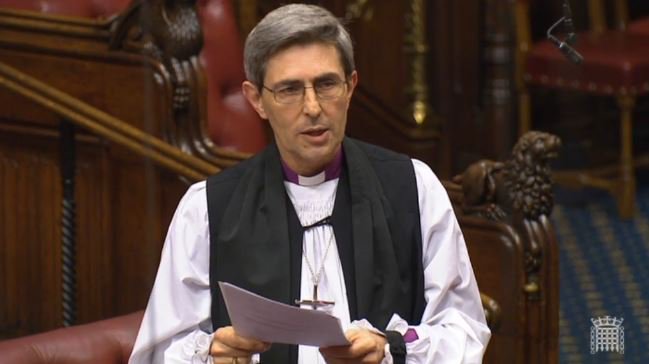
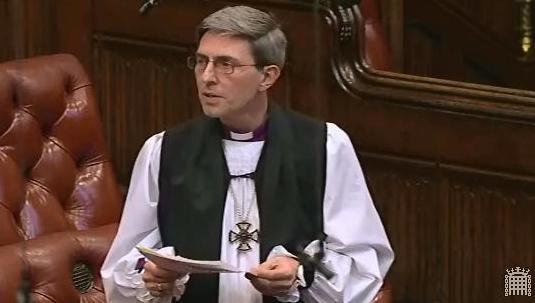
On 18th November 2016 the House of Lords considered the International Development (Official Development Assistance Target) (Amendment) Bill [HL] at its Second Reading. This is a Private Member’s Bill tabled by Labour Peer Lord Lipsey. The Bishop of Winchester, Rt Revd Tim Dakin, spoke in the debate. Continue reading “Bishop of Winchester welcomes Bill on aid target reporting”
Tag: Winchester
Bishop of Winchester on lifting people out of poverty through fairer trade agreements
On 17th November 2016 the House of Lords debated a motion from Liberal Democrat Peer Lord Chidgey, “to ask Her Majesty’s Government what is their assessment of the impact of Economic Partnership Agreements negotiated between the European Commission and economic regions of Africa on the agricultural economies of the African countries concerned.” The Bishop of Winchester, Rt Revd Tim Dakin, spoke in the debate:
The Lord Bishop of Winchester: My Lords, I too thank the noble Lord, Lord Chidgey, for securing this debate. With Malawi on the brink of a major humanitarian crisis, there is no better time to highlight the challenges facing Africa today. I declare an interest as the chair of a small charity supporting education and development in Africa.
The welfare of the east African nations is of particular importance to me. I was born in Tanzania and spent some of my teenage years in Kenya. In the 1990s, I was the principal of a small college in Nairobi—indeed, we still keep a home situated on an old coffee farm near Thika. Through this previous experience and from regular visits, I have observed the finely balanced life which Kenyan agricultural workers live. Smallholdings are a significant element in the agricultural sector of Kenya. Many city dwellers also have a smallholding upcountry. A severe drought might mean the end of their children’s education. It may also result in families being unable to afford even the most basic medicines or in workers having to resort to desperate means of generating income to support their families.
Bishop of Winchester highlights positives for UK of international students
On 17th November 2016 the House of Lords debated a motion from Conservative Peer Lord Lucas, “that this House takes note of the application of immigration policy to overseas students at United Kingdom universities and colleges.” The Bishop of Winchester, Rt Revd Tim Dakin, spoke in the debate:
The Lord Bishop of Winchester: My Lords, I too thank the noble Lord, Lord Lucas, for securing the time to have this important debate. I begin by declaring several interests: as a governor of Winchester University and as visitor to the Oxford colleges of New College, Magdalene, Corpus Christi, Trinity and St John’s.
Universities have always been centres of wisdom and learning: places filled with global-minded people, where political, cultural and geographical boundaries are transcended for the common good. The value of studying abroad is unquestionable. How would scholarship look today if St Augustine had been unable to complete his studies due to visa complications? Would we have heard of Thomas Aquinas if he had been turned back at the French border? Finally, would,
“the world is everything that is the case”,
still be the case if Ludwig Wittgenstein had been asked to produce a study permit on arriving in Britain?
Continue reading “Bishop of Winchester highlights positives for UK of international students”
Bishop of Winchester asks Government about partnership with faith groups in social care delivery
On 15th November 2016, Baroness Pitkeathley asked Her Majesty’s Government “what is their response to the warning by the Care Quality Commission in their State of Care report, published in October, that adult social care is approaching “tipping point”. The Bishop of Winchester, Rt Revd Tim Dakin, asked a follow up question:.
The Lord Bishop of Winchester My Lords, given the well-established engagement of faith groups in the area of social care, such as the Good Neighbours support service in Hampshire, what progress have Her Majesty’s Government made in reducing barriers to engagement by faith and belief groups, as recommended by the Local Government Association in its 2012 report, Faith and Belief in Partnership? Continue reading “Bishop of Winchester asks Government about partnership with faith groups in social care delivery”
Bishop of Winchester calls for universities to confront and combat anti-Semitism
On 27th October 2016 the House of Lords held a short debate on a question from Baroness Deech, “to ask Her Majesty’s Government what steps they propose to take to combat anti-Semitism, in particular in universities.” The Bishop of Winchester, Rt Revd Tim Dakin, spoke in the debate:
The Lord Bishop of Winchester: My Lords, I also thank the noble Baroness, Lady Deech, for initiating this debate.
Despite there being Jewish societies in over 60 universities, a study in 2011 found that half of all Jewish students in the UK attend only eight universities. Safety in numbers seems to be key, as Nottingham, Leeds, Birmingham and Manchester all boast Jewish societies with over 1,000 members. None the less, we know that Jewish staff and students experience anti-Semitism in a significant number of higher education institutions today. As the recent Universities UK task force report on hate crime makes clear, anti-Semitism is a practice for which there is no place in universities, nor in the Church or society at large. Continue reading “Bishop of Winchester calls for universities to confront and combat anti-Semitism”

Bishop of Winchester asks Government about support for religious and ethnic minorities in Iraq and Syria
On 19th March 2015 Lord Avebury asked Her Majesty’s Government “what is the strategy of the United States-led coalition for clearing the Daesh out of the territories which they currently occupy in Syria and Iraq.” The Bishop of Winchester, Rt Rev Tim Dakin, asked a supplementary quesion:
The Lord Bishop of Winchester: My Lords, even if the current operations to clear Daesh prove successful, the ancient religious and ethnic minority communities in Iraq have an uncertain future. Does the Minister agree with the statement recently submitted by the Holy See to the United Nations Human Rights Council? It said that a future without these communities in Iraq and the Middle East risks,
“new forms of violence, exclusion, and the absence of peace and development”.
Therefore, what steps are being taken to secure the future of those communities, and in particular, their human right to religious freedom? Continue reading “Bishop of Winchester asks Government about support for religious and ethnic minorities in Iraq and Syria”
Higher Education: a public good for the common good – speech by Bishop of Winchester
“There is need for public investment in universities, otherwise what is currently a public good will again become a private good, affordable to a few.” – Bishop of Winchester, 9/4/14
On 9th April 2014 the House of Lords debated a Government motion to take note of Higher Education in the UK. The Bishop of Winchester, lead bishop for HE, spoke about the work of the Church of England in the field through its Cathedrals Group of universities, as well as the ethos and purpose of Higher Education. Continue reading “Higher Education: a public good for the common good – speech by Bishop of Winchester”
Bishop of Winchester on teacher training, education and social mobility
“I question whether the Government’s policies for improving the quality of teaching have been fully effective and will enable social mobility. I am particularly concerned about the School Direct programme. In fact, I suggest there is an urgent case for rethinking arrangements around initial teacher training before a crisis develops.” – Bishop of Winchester
The Bishop of Winchester gave a speech in a House of Lords debate on 13th March 2014, tabled by the Education Minister Lord Nash.
The debate title was: ‘that this House takes note of the role of primary and secondary education in improving social mobility.’
The Lord Bishop of Winchester:
My Lords, I, too, am grateful to the noble Lord, Lord Nash, for the opportunity of this debate. I shall focus on the impact made by initial teacher training on social mobility. Continue reading “Bishop of Winchester on teacher training, education and social mobility”
Vote – Marriage (Same Sex Couples) Bill
On 8th and 10th July 2013, a number of bishops took part in divisions on the Government’s Marriage (Same Sex Couples) Bill, during its Report Stage.

8th July 2013
Lord Mackay of Clashfern moved amendment 1, which proposed to seek to refer to same sex marriage as ‘marriage (same sex couples)’, and opposite sex marriage as ‘marriage (opposite sex couples)’.
The Bishop of Chester, the Rt Revd Peter Forster, voted ‘content’. The Bishop of Leicester, the Rt Revd Tim Stevens, voted ‘not content’.
There were: Contents: 119 | Not Contents: 314 | Result: Government Win
(via Parliament.uk)
Vote – Marriage (Same Sex Couples) Bill
On 4th June 2013, nine bishops took part in a division during the Second Reading debate of the Government’s Marriage (Same Sex Couples) Bill.

Crossbench Peer Lord Dear moved, as an amendment to the motion that the bill be now read a second time, to leave out from “that” to the end and insert “this House declines to give the bill a second reading”.
Nine bishops voted “content” with Lord Dear’s amendment. They were: the Archbishop of Canterbury, and the Bishops of Birmingham, Bristol, Chester, Coventry, Exeter, Hereford, London and Winchester. A further five bishops attended but abstained from the vote. No bishops voted “not content.”
There were: Contents: 148 | Not Contents: 390 | Result: Government Win
(via Parliament.uk)

You must be logged in to post a comment.