
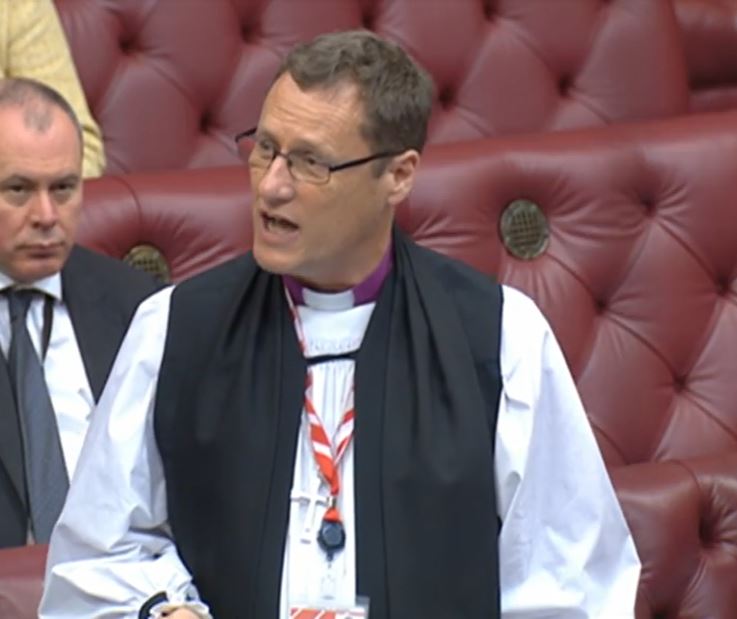
The Bishop of Leicester spoke in a debate on combatting genocide and atrocity crimes on 4th June 2026, calling for greater investment in overseas development aid to combat conflict and related conditions:
The Lord Bishop of Leicester: Like other noble Lords, I am in awe of the noble Lord, Lord Alton, for his patience and persistence in keeping the question of atrocity prevention before this Chamber. I thank him and indeed all those who have spoken. It is not my intention to repeat any of what has already been said: rather, I shall go deeper into the area of the relationship between conflict prevention and overseas aid.
The wholesale dismantling of the United States Agency for International Development has given us for the first time something close to a controlled experiment in what happens when a major donor abruptly walks away from fragile states. A study published last month in Science examined 870 subnational regions across most of the African continent in the 10 months before and after USAID came to an abrupt stop. Using a difference-in-differences design, it compared places that had been heavily reliant on USAID with otherwise comparable places that had not.
Before January 2025, the trends in violent conflict in the two groups moved in step. After January 2025, they diverged sharply. In the most exposed regions, the probability of a violent conflict event rose by roughly 6.5%. In some subnational analyses, conflict events and combat deaths rose by about 10%. This translates, on the authors’ own conservative estimates, into roughly 1,000 additional deaths from armed violence in a single calendar year, and that is before we count the indirect mortality from collapsed clinics, interrupted food programmes and displacements, all of which are estimated to lead to more than 14 million additional deaths by 2030, including 4.5 million children under the age of five.
Another study conducted by Jimmy Graham, a genocide and atrocity prevention research fellow at the United States Holocaust Memorial Museum, finds the same headline result, but he also notes that civilian unrest increased first, followed by armed violence, which suggests that the increase in conflict was not just a coincidence but rather a response to institutional weakening. Graham also argues that the withdrawal of aid acts as a signal of short-term state weakness. Rebels, militias and other armed actors infer, with good reason, that the state has just been deprived of a major source of administrative capacity, basic service delivery and economic stability, all of which gives them a window of opportunity.
That evidence should concern us greatly, because we too are embarking on significant further cuts to our aid budget. By next year, UK aid spending will fall to 0.3% of GNI, reducing proportionate aid spending to levels not seen since the late 1990s, and the total value of FCDO programmes will fall by 31% compared with 2025-26. The Government will tell the House that the share of bilateral aid going to fragile and conflict-affected states is rising, and that is correct, but it is rising against a sharply shrinking total, and the rise is achieved largely by protecting four countries—Ukraine, Sudan, Palestine and Lebanon—while the other 34 fragile states share a much smaller pot. Bond’s analysis finds that bilateral aid to Africa will have fallen by 56%, or £874 million, by 2028-29 compared with 2024-25, and the UK Integrated Security Fund, the principal instrument for stabilisation and peacebuilding, has already been cut by one-third in a single year.
Yet, at precisely the same moment, Ministers rightly tell us that the world is becoming more dangerous. As we have already heard, we face instability in Sudan, catastrophe in Gaza, conflict in the Democratic Republic of Congo, worsening food security across the Horn of Africa, and growing geopolitical competition in fragile states across the Balkans, the Sahel and the Indo-Pacific. If the world is indeed becoming more dangerous, this is surely the wrong moment to dismantle one of the principal instruments through which Britain has historically reduced instability peacefully.
So I ask the Minister: will the Government set out a credible path back to 0.7%? The 2016 Act remains on the statute book. The commitment remains in the Prime Minister’s own words, but a commitment with no timetable lacks resolution. What steps are the Government taking to ensure that, where bilateral programmes are being wound down, they are wound down in a sequenced way: strengthening local institutions, transferring capacity to domestic authorities and civil society, and giving partners reasonable notice, so that the reduction in UK presence does not itself become a driver of instability? Atrocity prevention requires more than public statements and diplomacy after violence has begun. It requires sustained investment in the conditions that make atrocities less likely in the first place.


You must be logged in to post a comment.