
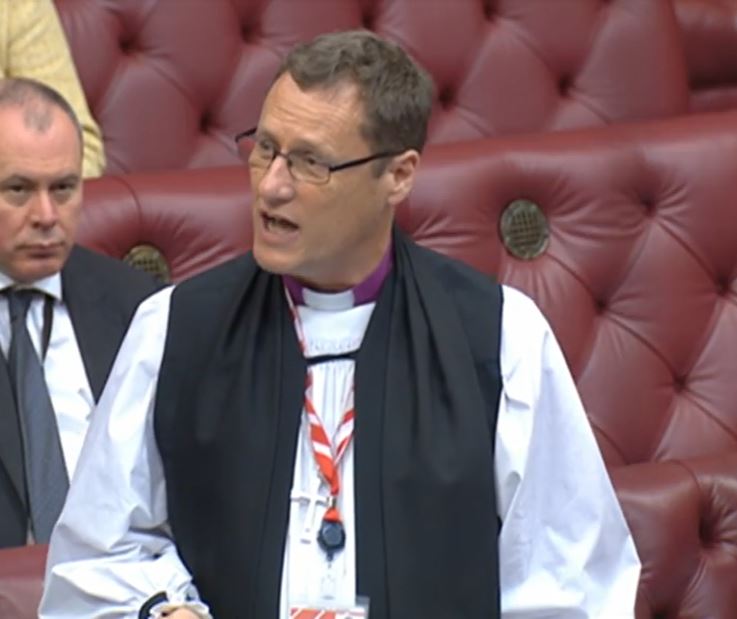
The Bishop of Leicester spoke in a debate on threats to democratic institutions in the UK on 25th June 2026, stressing the importance of local communities and pluralism in combatting extremist rhetoric:
The Lord Bishop of Leicester: My Lords, I too am hugely grateful to the noble Lord, Lord Wallace, for securing this debate, and it is a pleasure to follow the noble Baroness, Lady Falkner. Our belief systems may differ, but we share much in common still.
I speak as chair of a new Church of England working group on promoting unity in our nation, a role that has made me think hard about the three threats before us today and what they mean for our common life, indeed for the Church and for other faith groups. I believe that the three threats that the noble Lord has highlighted—our susceptibility to disinformation, foreign interference and falling trust in our democratic institutions—share a primary underlying cause: the slow loss of the institutions in which people once learned to trust one another and act together.
In decades past, people found recognition and a sense of agency and belonging in the institutions closest to them: the parish and the chapel, the union, the club—the bodies that stood between the individual and the distant powers of state and market. In the past 50 years, both the membership of such bodies and their numbers have fallen dramatically. Without them, we have fewer spaces that bring people together across difference in search of a common aim, fewer ways to learn and practise the habits of democracy and fewer chances to trace the arc from discussion to decision to impact—the very things that give people a sense of participation and, with it, trust in our institutions.
Trust, though, has not disappeared; it has migrated, to online influencers, with whom people form parasocial relationships, and to new in-groups built on shared identity, often mobilised against a particular other. That is where foreign interference and disinformation thrive, because online we make ourselves far more open to manipulation by distant actors. As Frances Haugen, the Facebook whistleblower, put it, anger and hatred are the easiest way to grow the online platform.
In line with that, a recent BBC “Panorama” investigation traced a network of “patriotic” British anti-immigration accounts—pages with names like “Great British People”—that claim to be based in Yorkshire but actually operate from south Asia and the Gulf. Many of these had posted on entirely different subjects before pivoting to anti-immigration content because it drew more engagement and so more advertising revenue. People with no stake in our common life are profiting from deepening its fractures. Such content can give people a sense of common cause, but it is an ersatz belonging, one that depends entirely on the construction of a shared enemy.
I will go further still. It is not merely that populist movements benefit from the decline of our civic infrastructure; they have an interest in dismantling it. A thick, local, plural civil society does three things that this kind of politics cannot abide. First, a plural civil society meets the very hungers for recognition and purpose on which the populist movement feeds. Secondly, a plural civil society mixes the very people a populist movement would prefer to keep sorted into “us” and “them”. Thirdly, particularly where faith-based institutions are concerned, civil society offers a cultivated conscience, a reason to say no to manipulation or controlling behaviour, and to insist on the dignity of those whom a populist movement may wish to exclude. A people bound together by real and overlapping loyalties is far more resistant to fearmongering and far harder to divide, and so these loyalties must be loosened accordingly.
We see where this road leads. In Germany, the churches have declared ethnic nationalism incompatible with the Christian faith and the main far-right party, the AfD, unelectable for Christians. The response from the party, which claims to value Christianity, has been a move to cut the churches’ public funding. I am fearful of people who wish to wear the costume of Christianity with little care for its creeds and doctrines—those who parade the cross of Christ in anything but the name of love, and who speak of Christian values but are careless of the places in which they are learned and practised. Someone not given to overstatement recently spoke to me of what he called the existential threat—for us as a Church, but indeed for us as a democracy.
I am sorry to say that I am not persuaded that the measures taken so far—through the Online Safety Act, the Representation of the People Bill, the Pride in Place programme, and so on—come anywhere near meeting the scale of the threat that we face. I therefore make this plea to the Government: treat these threats, and the causes behind them, with the seriousness they demand. Rebuild the places where, across our differences, we still learn to trust one another. For a people who have somewhere to belong are far harder to set against each other, and that is the surest defence that we have.


You must be logged in to post a comment.