
On 20th November 2018 Government Minister Lord Callanan led a debate in the House of Lords on the motion “That this House takes note of the statement by the Prime Minister repeated by the Lord Privy Seal on 15 November relating to the European Union exit negotiations.” The Bishop of Leeds, Rt Revd Nick Baines, spoke in the debate:

The Lord Bishop of Leeds: My Lords, only four months remain before we walk arm-in-arm to the sunlit uplands where the easiest deal in history will have been made and everybody will be happy—except we know that this is not the case.
Other noble Lords will concentrate on the details of the deal—a word I loathe because it reduces an existential question simply to a matter of trade and transaction—and the position in which it leaves us. I want to pick up on one line of the Prime Minister’s Statement to the House last week, which I questioned in the short debate on Thursday:
“If we get behind a deal, we can bring our country back together and seize the opportunities that lie ahead”.—[Official Report, Commons, 15/11/18; col. 1982.]
I asked if the promise to bring our country back together was credible and achievable and, if so, how it was to be done. The answer was simply a repeat of mantras about the deal. Continue reading “Bishop of Leeds calls for honesty in discourse and about deep challenges UK faces with Brexit”
 On 20th November 2018 the Bishop of Durham, Rt Revd Paul Butler, received answers to three written question about the impact of the two-child limit for Universal Credit claims on children’s wellbeing and financial resilience:
 On 19th November 2018, Lord Clement-Jones tabled a Motion ‘That this House takes note of the Report from the Select Committee on Artificial Intelligence AI in the UK: ready, willing and able? (HL Paper 100).’ The Bishop of Oxford, the Rt Revd Steven Croft, served on the committee that produced the report and he spoke in the debate:
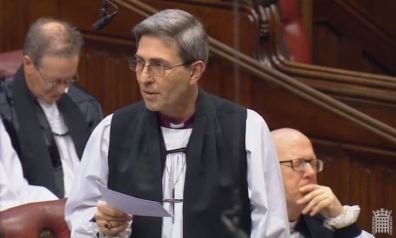 On the 19th November 2018, Lord Stevenson of Balmacara tabled an Oral Question ‘To ask Her Majesty’s Government when the review of the Teaching Excellence Framework is due to report and whether this review will include recommendations for judgements to be made on the change in the percentage of first class and upper second class degrees awarded by higher education institutions’. The Bishop of Winchester, the Rt Revd Tim Dakin, asked a supplementary question:
  This week in Parliament bishops spoke on the Budget, Brexit and the Prince of Wales’s 70th birthday. They also asked questions on violent crime, the death penalty and vaping. They also marked UK Parliament week and the centenary of women’s suffrage with a parliamentary event celebrating the role of women in the church and public life.
 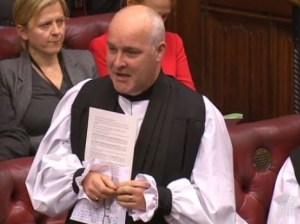 The Lord Bishop of Chelmsford: My Lords, for many on these Benches there are measures to welcome in this Budget: for instance, the decision to increase the work allowances within universal credit for families with children and people with disabilities, as other noble Lords have mentioned. This goes a substantial way towards reversing the cuts announced in 2015. Likewise, the announcement of measures to aid the transition to universal credit, worth £1 billion over five years, is also welcome, as is the additional and non-repayable run-on support for new claimants to help people manage during the five-week waiting period before their first payment. However, I am disappointed that the run-on support does not cover the child elements of universal credit.

You must be logged in to post a comment.