Digital Economy Bill: Bishop of Chester asks how Government is keeping pace with technological advancement

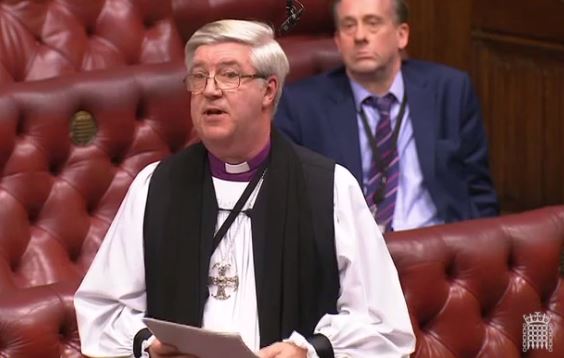
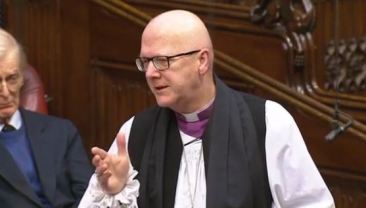
On 8th February 2017 the Bishop of Chester, Rt Revd Peter Forster, spoke during a debate on an amendment by Lord Lucas to the Government’s Digital Economy Bill. The amendment was that Ofcom be granted powers to ‘carry out and publish evaluations of algorithms’. 
14.03 Bishop of ChesterThe Lord Bishop of Chester: My Lords, this is an important amendment because it touches upon the bigger issue of the impact of artificial intelligence on all sorts of aspects of our lives. There is a law called Moore’s law, which says that every two years the power of computers doubles. That has been true over the past 20 or 30 years and we should assume that that power will continue to develop. Artificial intelligence in all its impacting forms will be more and more prevalent in our society and more and more potent in the hands of terrorists in the years to come.
Continue reading “Digital Economy Bill: Bishop of Chester asks how Government is keeping pace with technological advancement”
Bishop of St Albans asks Government about workplace access to mental health services

St Albans 2On the 8th February 2017,  Lord Harrison asked Her Majesty’s Government “what measures they are taking to improve productivity in the United Kingdom economy.” The Bishop of St Albans, the Rt Revd Alan Smith, asked a follow-up question.

The Lord Bishop of St Albans: My Lords, one factor that influences productivity is issues of health, particularly mental health. Something like nearly three out of 10 employees are reporting some sort of mental health problem each year, which analysts believe is costing employers something like £30 billion a year. Will the Minister tell the House what the Government are doing to support employers in encouraging high levels of well-being and what is being done to lessen the stigma of mental ill health—in particular, encouraging employees to access mental health services that are already available to them? Continue reading “Bishop of St Albans asks Government about workplace access to mental health services”

Church Commissioners’ answers: pay, employment, security

On the 3rd, 6th, 7th and 8th February 2017 the Second Church Estates Commisisoner, Rt Hon Dame Caroline Spelman MP, answered a number of written questions from Labour MP Jon Trickett, about pay, employment and office facilities for the Church Commissioners and National Church Institutions: Continue reading “Church Commissioners’ answers: pay, employment, security”

Votes: Health Service Medical Supplies (Costs) Bill

On 8th February 2017 two votes took place in the Lords on amendments to the Government’s Health Services Medical Supplies (Costs) Bill. The Bishops of Chester and St Albans took part in the first vote and the Bishops of Carlisle, Chester and St Albans in the second. Continue reading “Votes: Health Service Medical Supplies (Costs) Bill”

Bishop of Chester asks Government about social effects of fall in house prices

ChesterOn 7th February 2017, Lord Bourne gave a statement to the House on the publication of the Government’s new White Paper on housing. The Bishop of Chester, Rt Revd Peter Forster, asked a question about falling house prices.
The Lord Bishop of Chester My Lords, I want to ask about the politics of all this. I speak as a fool in relation to that, but let us take the hypothesis that this policy is a great success, that we have lots more houses and that the price of houses starts to fall. Indeed, let us imagine that land prices start to fall in the way that the noble Lord, Lord Campbell-Savours, rightly pointed out. All the people who have bought houses in the past 20 years will find that those houses are worth less than they used to be. It seems to me that this is tinkering with a major problem. Do the Government seriously wish to get the average value of a house back down to 3.5 times average earnings? If so, what are the consequences going to be? Continue reading “Bishop of Chester asks Government about social effects of fall in house prices”

Bishop of St Albans welcomes Government White Paper on housing; asks about rural homes

stalbans190117On 7th February 2017, Lord Bourne of Aberystwyth made a statement to the House of Lords on the publication of the Government’s new White Paper on housing. The Bishop of St Albans, Rt Revd Alan Smith, responded, welcoming the report and asking about the Government’s plans to develop rural housing.
The Lord Bishop of St Albans My Lords, on these Benches we are acutely aware of the huge crisis in housing. We hear stories about this from all around the country and we share some of the concerns that have been raised from the Benches opposite. There are a number of things which we welcome hugely. Examples are the new powers for local authorities to prevent land banking, measures to encourage local authorities to work together over larger areas, and new requirements for local authorities to undertake a more thorough assessment of housing needs. Continue reading “Bishop of St Albans welcomes Government White Paper on housing; asks about rural homes”

Bishop of St Albans asks Government about nursing and caring staffing

stalbans190117On the 6th February 2017, Baroness McIntosh of Pickering asked the Government “what estimate they have made of the number of residential care home beds that were available in (1) 2005, and (2) 2015.” The Bishop of St Albans, the Rt Revd Alan Smith, asked a follow-up question. Continue reading “Bishop of St Albans asks Government about nursing and caring staffing”

Week in Westminster, 30th January – 3rd February 2017

Welcome to the Church of England’s weekly round-up of activity in Parliament.

Westminster-abbeyThis week in the House of Lords bishops spoke on the Technical and Further Education Bill and Baroness Jones’ House of Lords Reform Bill. They also spoke in a debate on disability rights post-Brexit and asked questions about educational leadership, eviction of tenants on universal credit and food standards post-Brexit.  Continue reading “Week in Westminster, 30th January – 3rd February 2017”

Bishop of Norwich says Lords reform should enhance civil society voice, not that of established political parties

On 3rd February 2017 Peers debated the House of Lords Reform Bill, a private member’s bill from Green Party Peer Baroness Jones of Moulsecoomb. The Bishop of Norwich, Rt Revd Graham James, spoke in the debate. He set out why the central objectives of the Bill – to elect members of the Lords and create a new category of non-voting Peer – were flawed. 

norwich121016bThe Lord Bishop of Norwich: My Lords, I wondered whether to speak in this debate, but since the Bill makes specific reference to the Lords Spiritual, it seemed important to give a view from these Benches. I am grateful to the noble Baroness, Lady Jones, for recognising the continuing place for Bishops, even if an altered capacity—I will comment on Clause 12 in a little more detail later on.

We on these Benches are on record as being in favour of reform of your Lordships’ House provided it enhances our existing role and function. There are two aspects of the Bill on which I wish to focus and which have already been commented on. The first is the principle of elections as against appointment; the second is the concept of non-voting Members of your Lordships’ House. Continue reading “Bishop of Norwich says Lords reform should enhance civil society voice, not that of established political parties”

Bishop of St Albans says UK must be a world leader in disability rights, post-Brexit

On 2nd February 2017 Baroness Scott of Needham Market led a debate in the House of Lords “to ask Her Majesty’s Government what assessment they have made of the impact on disabled people of the United Kingdom’s withdrawal from the European Union.” The Bishop of St Albans, Rt Revd Alan Smith, spoke in the debate:

stalbans190117The Lord Bishop of St Albans: I too am grateful to the noble Baroness, Lady Scott, for giving us the opportunity to reflect on this important subject. For many years, the European Union has been an important driver of disability rights in the UK, helping to improve disability access and strengthen non-discrimination laws right across Europe. It was the European Union that ensured non-discrimination laws were extended to smaller businesses, and the European Court of Justice which extended rights to carers and those in relationships with a disabled person, to name just two examples. With the proposed European Accessibility Act still some time away from implementation, I hope the Minister can understand the fear expressed by many in this House and outside it that a post-Brexit UK may start to fall behind its European counterparts when it comes to disability rights. Continue reading “Bishop of St Albans says UK must be a world leader in disability rights, post-Brexit”