
On 19th October 2016 the House of Lords considered the Government’s Investigatory Powers Bill at its Report Stage. The Bishop of Chester, Rt Revd Peter Forster, spoke during debate on a Liberal Democrat amendment. Introducing the amendment Lord Paddick said “it seeks to remove internet connection records from the type of communications data that can be acquired in bulk.”
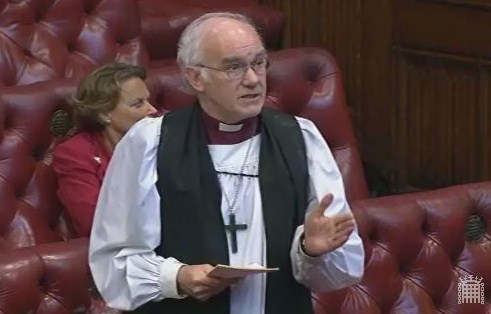 The Lord Bishop of Chester: My Lords, I am sure we do not want to prolong this debate. As I said on Monday, I was a member of the pre-legislative scrutiny group. You might wonder why a Bishop was invited to be part of that exercise, but I think it was because of this point—the ethics of interference with privacy. I am sorry that the discussion so far has almost become too polarised, because the noble Lord, Lord Paddick, is making a serious point, which I demonstrate by quoting David Anderson in his evidence to the Joint Committee on Human Rights. Continue reading “Investigatory Powers Bill – Bishop of Chester speaks on amendment on bulk retention of internet connection records”
 On 18th October 2016, Lord Collins of Highbury asked the government what assessment they have made of the potential effect on peace and stability in Europe and around the world of the United Kingdom leaving the European Union. The Bishop of Leeds, Rt Revd Nick Baines, spoke in the debate about the importance of continued interdependence for peace and stability.
 On 18th October 2016, the House of Lords considered the Government’s Children and Social Work Bill at its Report Stage. The Bishop of Chester spoke in support of an amendment proposed by the Earl of Listowel aiming to improve support for care leavers.
 On 18th October 2016, Lord Hunt of Kings Heath asked the Government whether NHS England is informing patients that lifesaving drugs will be denied them if funding has to be made available for pre-exposure prophylaxis (PrEP) for HIV prevention. The Bishop of Chester, Rt Revd Peter Forster, asked a follow up question.
  On 17th October 2016, the House of Lords considered the Government’s Investigatory Powers Bill at Report Stage. The Bishop of Chester, Rt Revd Peter Forster, took part in the debate on an amendment from the Liberal Democrat Peer Lord Paddick on the retention of internet connection records. Introducing the amendment, Lord Paddick said: “the effect of Amendment 118A, tabled in my name and that of my noble friend Lady Hamwee, would be to remove internet connection records from any notice requiring the retention of communications data by telecommunications operators.”
 On the 13th October 2016 Lord Bird led a debate in the House of Lords: “That this House takes note of the cultural, civic and educational significance of libraries, bookshops and booksellers in the United Kingdom.” The Bishop of St Albans the Rt Revd Alan Smith, spoke about the impact closure could have on rural communities and the importance of imaginative partnerships which are developing between libraries and churches.
 On 13th October 2016 Baroness Andrews led a debate in the House of Lords “that this House takes note of the Government’s proposals for the extension of grammar schools and selection in education”. The Bishop of Norwich, the Rt Revd Graham James spoke in the debate:
 The Church of England in Parliament
You must be logged in to post a comment.