Bishop of Chelmsford supports Bill to raise age of criminal responsibility

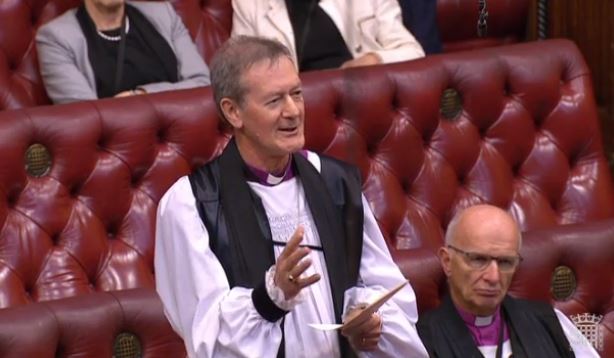
On 29th January 2016 the House of Lords debated at Second Reading the Age of Criminal Responsibility Bill – a Private Member’s Bill introduced by Liberal Democrat Peer Lord Dholakia. The Bishop of Chelmsford, Rt Revd Stephen Cottrell, spoke in the debate, supporting the objective of the Bill to raise the age of criminal responsibility from 10 to 12 years. The Bill was given a Second Reading and proceeded to its next parliamentary stage.

Chelmsford 251115The Lord Bishop of Chelmsford: My Lords, in rising to support the noble Lord, Lord Dholakia—and, indeed, pledging the support of the church to this campaign—I need to declare an interest: I was a child once and got into some scrapes. Now I am a parent and in the work I do hardly a week goes by when I am not in schools. Indeed, last year I had the sad but very moving honour of opening a garden of remembrance in the diocese where I serve in east London for young people who were the victims of, indeed had been killed by, knife crime. So I do not underestimate the seriousness of the crimes that we are talking about, nor the fact that children and young people do commit them. Continue reading “Bishop of Chelmsford supports Bill to raise age of criminal responsibility”
Lords approves Diocesan Stipends Funds (Amendment) Measure

On January 28th 2016 the House of Lords debated and passed the Church of England Diocesan Stipends Funds (Amendment) Measure. The Bishop of Durham, Rt Revd Paul Butler, led the short debate and a transcript is below: 


Moved by The Lord Bishop of Durham

That this House do direct that, in accordance with the Church of England Assembly (Powers) Act 1919, the Diocesan Stipends Funds (Amendment) Measure be presented to Her Majesty for the Royal Assent.

Bp Durham June 2015 bThe Lord Bishop of Durham: My Lords, this is a very short and technical draft measure. It amends the Diocesan Stipends Funds Measure 1953 to ensure that diocesan boards of finance have the same powers to make decisions about the balance of investments in the diocesan stipends fund that they have in relation to their other charitable property. Continue reading “Lords approves Diocesan Stipends Funds (Amendment) Measure”

Lords approves CofE Safeguarding and Clergy Discipline Measure – Bishop of Durham leads debate

On 28th January 2016 the Bishop of Durham, Rt Revd Paul Butler, moved a motion that the House of Lords approve the Church of England’s Safeguarding and Clergy Discipline Measure. Peers gave approval to the Measure, following a short debate – the full transcript of which is below.


Moved by The Lord Bishop of Durham

That this House do direct that, in accordance with the Church of England Assembly (Powers) Act 1919, the Safeguarding and Clergy Discipline Measure be presented to Her Majesty for the Royal Assent.

Bp Durham June 2015 bThe Lord Bishop of Durham: My Lords, the Safeguarding and Clergy Discipline Measure is set in the context of our commitment, as the Church of England, to keep becoming a safer church. The Measure itself is only one part of all the work that we are undertaking. The Measure is before your Lordships because the church believes it needs to improve its statutory arrangements: first, to prevent the abuse of children and adults at risk within the church community; and, secondly, to deal effectively with those in authority within the church who seek to harm children and vulnerable adults. Continue reading “Lords approves CofE Safeguarding and Clergy Discipline Measure – Bishop of Durham leads debate”

Bishop of Derby speaks on role of education and lifelong learning

On 28th January 2016 the House of Lords debated a motion from Baroness Sharp of Guildford “that this House takes note of the role of adult education and lifelong learning and the need to develop the skills needed to strengthen the United Kingdom economy.” The Bishop of Dery, Rt Revd Alastair Redfern, spoke in the debate.

Derby 191115cThe Lord Bishop of Derby: My Lords, I, too, thank the noble Baroness, Lady Sharp, for introducing the debate and from these Benches I want to pay tribute to the noble Baroness, Lady Williams. From our perspective she has continually shown a very special and thoughtful faith—faith in people, faith in politics and faith in goodness. That is the kind of model that we all need to aspire to, and the noble Baroness has certainly been a great inspiration to me and to many of my colleagues.

I want to look at skills and the strengthening of the UK economy. We have heard from the noble Baroness, Lady Sharp, and others about the skills shortage, which is much in evidence. There is a clear mismatch between the needs of business and learning provision. We have heard about the dramatic decline in the number of places for part-time study, and I think that a strong case can be made for earn-as-you-learn opportunities for people at every stage, especially as employment is now such a variable journey for so many people. Continue reading “Bishop of Derby speaks on role of education and lifelong learning”

Bishop of Derby speaks in debate on local democracy

On 28th January 2016 the House of Lords debated a motion from Lord Shipley “that this House takes note of local democracy in the United Kingdom.” The Bishop of Derby, Rt Revd Alastair Redfern, spoke in the debate.

Derby 191115cLord Bishop of Derby: My Lords, it is a great privilege on behalf of the House to welcome the noble Baroness, Lady Scott, and to thank her for an expert and excellent speech—a great harbinger of what she will bring to the House.

 I feel connected with all the maiden speeches today. I was once Bishop of Spalding and worked with great joy in the area of South Holland, where the noble Lord, Lord Porter, was leader of the district council, and I had the privilege of serving with the noble Lord, Lord Stunell, on a Select Committee, so it is good to welcome both of them too. Continue reading “Bishop of Derby speaks in debate on local democracy”

Bishop of Durham praises local partnerships in the north east

On 28th January 2016 the House of Lords debated a motion from Lord Shipley “that this House takes note of local democracy in the United Kingdom.” The Bishop of Durham, Rt Revd Paul Butler, spoke in the debate about the local authorities in the Durham diocese and partnership work with voluntary and civil society organisations.

14.06.10 Bishop of Durham 5The Lord Bishop of Durham: My Lords, I congratulate the noble Lord, Lord Stunell, on his excellent maiden speech and I look forward to listening to other maiden speeches later. What right does a bishop have to say anything about local democracy? Let me give some quick history. I was a curate in Wandsworth in the 1980s when the borough became either a cause celebre or something else, depending on how you thought about it. I then moved to the London Borough of Newham and experienced a democratically elected autocracy that avoided dictatorship because of the extremely fine leadership of Stephen Timms, who now, of course, serves as an MP in the other place. I then moved to the London Borough of Waltham Forest and worked both as team rector and as area dean on issues of social cohesion, through creating an interfaith project and through working on children’s and young people’s issues and on housing and homelessness. Continue reading “Bishop of Durham praises local partnerships in the north east”

Bishop of St Albans asks Government to engage with energy companies on prepaid meters

On 28th January 2016 Baroness Donaghy asked Her Majesty’s Government “what is their estimate of the number of households currently in fuel poverty; and what action they intend to take to reduce that number over the next five years.” The Bishop of St Albans, Rt Revd Alan Smith, asked a follow up question.

Bishop of St AlbansThe Lord Bishop of St Albans: My Lords, one concern is prepaid meters, which are an expensive way of paying for fuel. Will the Minister update the House on what progress is being made to promote the five principles agreed between Consumer Focus and the largest energy groups some years ago—I think it was back in 2011? Furthermore, will Her Majesty’s Government ask the large energy companies to reconsider income-differentiated tariffs again? Continue reading “Bishop of St Albans asks Government to engage with energy companies on prepaid meters”

Welfare Reform Bill: Bishop of Durham speaks in favour of measures to aid supported housing

On the 27th January 2016 the Bishop of Durham, the Rt Revd Paul Butler, spoke during the second day of the Report  Stage of the Government’s Welfare Reform and Work Bill. The Bishop spoke in support of an amendment in the name of Lord Best, to exclude supported housing from the proposed social housing rent reduction.

Bp Durham June 2015 b

Continue reading “Welfare Reform Bill: Bishop of Durham speaks in favour of measures to aid supported housing”

Welfare Reform Bill: Divisions, Report Stage day 2

On the 27th January 2016 bishops took part in one vote during the Report Stage day 2 debate on the Government’s Welfare Reform and Work Bill. The amendment was to negate planned reductions in payments for those receiving Employment Support Allowance in the work related activity group.

Lords No Division Lobby

House of Lords Division Lobby

Continue reading “Welfare Reform Bill: Divisions, Report Stage day 2”

Welfare Reform Bill: Bishop of Durham supports 2 child limit exemptions

On 27th January 2016 the Bishop of Portsmouth, the Rt Revd Christopher Foster, proposed an amendment at Report Stage to the Government’s Welfare Reform and Work Bill. The amendment, supported by Labour, Liberal Democrat and Crossbench Peers, set out exemptions from the two-child limit for new claimants of tax credit and universal credit for kinship carers, bereaved parents, those fleeing domestic violence and disabled children. The Bishop of Durham supported the amendment and his speech is below. During his response to the amendment the Minister Lord Freud offered a number of concessions, most notably on kinship carers, and as a result the amendment was not put to a vote.

Bp Durham June 2015 bThe Lord Bishop of Durham: My Lords, I would like to tell two stories that illustrate why I believe two of these exemptions are important. A good friend of mine and his wife were unable to have children, and they put themselves forward as adoptive parents. They went through the rigorous process—this was a few years ago—and with great pride entered a room with several of us who had our own children and presented a piece of paper that said, “I have been authorised to become a parent in a way that none of you ever have”. Continue reading “Welfare Reform Bill: Bishop of Durham supports 2 child limit exemptions”