
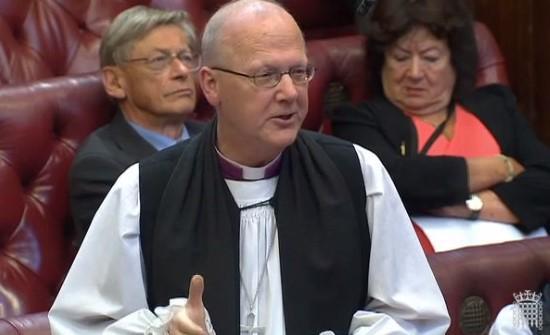
On 8th December 2015 the House of Lords considered the Government’s Scotland Bill at Committee stage. The Bishop of Chester, Rt Revd Peter Forster, spoke during debate on amendments to the Bill from Lord Norton of Louth and Lord Forsyth of Drumlean.
The amendment from Lord Norton proposed the removal from the Bill of two new clauses to be added to the 1998 Scotland Act, namely:
(1) The Scottish Parliament and the Scottish Government are a permanent part of the United Kingdom’s constitutional arrangements.
(2) The purpose of this section is, with due regard to the other provisions of this Act, to signify the commitment of the Parliament and Government of the United Kingdom.
Lord Forsyth’s amendment sought to change the wording of (1) so that it instead read
(1) The Scottish Parliament and the Scottish Government are recognised as a permanent part of the United Kingdom’s constitutional arrangements.
The Bishop argued against both amendments on the grounds that they conflicted with settled political reality and would send unwelcome signals. The amendments were withdrawn after debate.
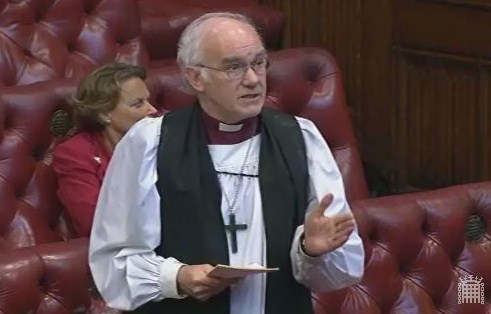
The Lord Bishop of Chester: My Lords, it is always dodgy for bishops to speak about Scottish matters. The kirk has sometimes considered the possibility of introducing bishops but the one condition it has always applied is that they must not be like English bishops—they must be quite different.
I have some credentials inasmuch as I have had a close association with Scotland for 40 years, since I went to Edinburgh as a student. I have had a house in Scotland for 30 years, I have two Scottish degrees and one Scottish wife, who has kept my feet on the ground over the years. I shall also retire to Scotland shortly, and very much look forward to doing so. Continue reading “Bishop of Chester supports measure in Scotland Bill stating permanence of Scottish Parliament and Government”
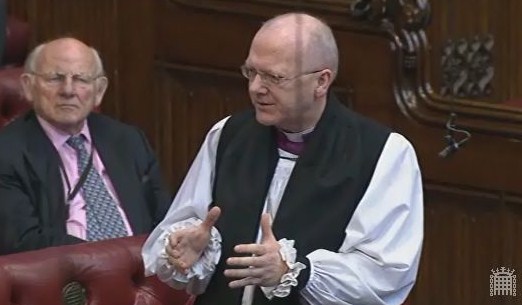

 The Lord Bishop of Portsmouth: My Lords, I tabled Amendment 21 to highlight the impact of this measure on different faith communities who share our concerns with this part of the Bill in particular. Noble Lords who attended the special briefing we organised two weeks ago will have heard Chaya Spitz, chief executive of the Interlink Foundation, speak passionately about the implications for the Orthodox Jewish community that she represents and is a member of. For her community, larger families are the norm and the central pivot around which everything else revolves. There is a positive, faith-based imperative to have children, to create the next generation in service of God. There is also a commonly held conscientious objection to the use of artificial contraception, except in prescribed circumstances, and to abortion, except in rare circumstances. By limiting financial support to the first two children, this policy is making a judgment that touches on deeply personal and strongly held religious and cultural beliefs about the family, and that threatens the viability of whole faith communities.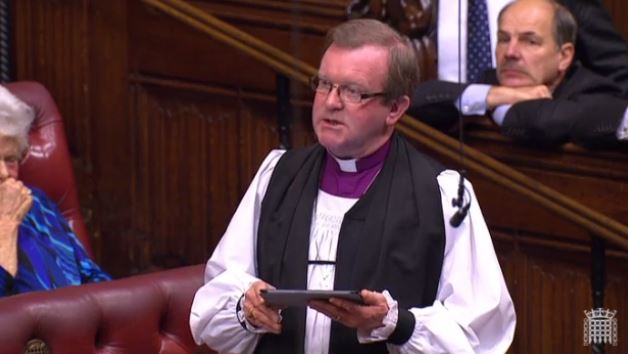
 The Lord Bishop of Portsmouth: My Lords, I highlight two particularly vulnerable groups in my Amendments 5, 6, 13 and 14, groups that I believe should be exempted from this measure. These are bereaved parents and victims of domestic abuse. In focusing so heavily on promoting personal responsibility, there is always a danger with welfare reforms that we neglect our collective responsibility to look after those who fall on difficult times, people we will probably never meet but whom we support through our taxes in their time of need so that we, too, will be supported when we need help.
 The Lord Bishop of Portsmouth: My Lords, my concerns about this measure, along with those of other faith groups and organisations, are set out in the briefing note that my colleague the right reverend Prelate the Bishop of Durham circulated to all Members of the House prior to the Second Reading debate. In that note we expressed our belief that children are a blessing and that anything that sends an implicit or explicit message that a child is unwanted or burdensome should be strongly resisted.
 The Church of England in Parliament
You must be logged in to post a comment.