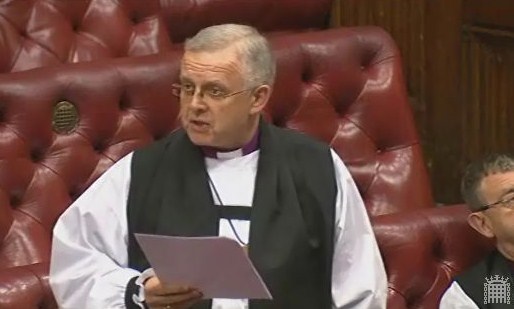
The Bishop of Wakefield speaks in debate on situation in Syria and the Middle East

The Bishop of Wakefield spoke during the debate on Syria and the Middle East, highlighting the increasing complexity of the conflict in Syria, the difficulties facing outside countries such as the UK in responding appropriately and effectively, the huge displacement of the Syrian population, and the need to invest significant resources in the region to facilitate a peaceful solution to the conflict. He asked the Government to support efforts to bring about reconciliation between two key actors in the conflict – Iran and Saudi Arabia, and called for support of civil society within the refugee populations, particularly in Lebanon and Jordan.

The Lord Bishop of Wakefield: My Lords, I thank the Minister for her characteristically clear introduction to this debate and for setting the context so succinctly.
In December 2002, I was called to 10 Downing Street for a clandestine meeting with the Prime Minister’s appointments secretary to talk about the possibility of my going to the See of Wakefield. When I arrived, I was terrified that my cover might be blown, since television cameras surrounded us and, indeed, I followed Andrew Marr through the security gate. The cameras were, of course, not for us but for President Assad, who was paying an official visit to the then Prime Minister, Tony Blair. Indeed, there was even talk at the time of persuading the Queen to confer a knighthood on the Syrian leader. Continue reading “The Bishop of Wakefield speaks in debate on situation in Syria and the Middle East”

Bishop of St Albans raises concerns about the impact of closing rural schools

Lord Storey asked Her Majesty’s Government what support is given to young people living in rural areas to enable them to travel to school or college.

The Bishop of St Albans asked a supplementary question:

The Lord Bishop of St Albans: My Lords, the Church of England is deeply involved with hundreds of tiny rural schools in sparsely populated areas and is acutely aware of some of the financial difficulties that they face. When such a school has to close, what advice do Her Majesty’s Government give on the educational, financial and environmental issues—to do with sustainability—of transporting these pupils, sometimes very long distances, to the next nearest school?

Baroness Northover: I will write to the right reverend Prelate with details about what happens when these schools are closed. There is a special premium for rural schools of the type that he describes, which have fewer pupils than you might find elsewhere, but I will write with further details.

(via parliament.uk)

Votes – Pensions Bill

House of Lords Division Lobby

On 24th and 26th February 2014, a number of Bishops took part in votes on amendments to the Government’s Pensions Bill, during its Report Stage.

Continue reading “Votes – Pensions Bill”

The Bishop of Peterborough makes his maiden speech in the House of Lords

The Bishop of Peterborough delivered his maiden speech to the House of Lords on 25th February 2014, during the debate tabled by Lord Low of Dalston: ‘To ask Her Majesty’s Government what is their response to Tackling the Advice Deficit, the report of the Low Commission on the future of advice and legal support on social welfare law in England and Wales’.

The Lord Bishop of Peterborough: My Lords, as I make this m14.02 Peterboroughaiden speech I am delighted to have the opportunity to thank the many Members and staff of your Lordships’ House who have made me so very welcome here. I am also most grateful to the noble Lord, Lord Low, for initiating this debate, and for producing with his colleagues this excellent, wide-ranging and challenging report.

I suppose it to be inevitable that cuts in government spending, however necessary they may be, will always hit the poorest most. It is therefore all the more important to give attention to ways of helping the most vulnerable to claim and receive the support to which they are entitled and the professional advice they may need. This report does that: I welcome it most warmly and hope that Her Majesty’s Government can do so too. Continue reading “The Bishop of Peterborough makes his maiden speech in the House of Lords”

Bishop of Wakefield raises concerns about impact of lack of free parking on local businesses

Baroness Williams of Trafford asked Her Majesty’s Government what assessment they have made of town-centre parking policies and their impact on local businesses.

The Bishop of Wakefield asked a supplementary question:

The Lord Bishop of Wakefield: My Lords, I want to focus particularly on the impact on small towns, which may not necessarily have trains and buses bringing people into them. Where there are not just large-scale out-of-town developments but also small-scale shopping centres, where it is easy to park for nothing, the impact on the high street is significant. In Mirfield, in the diocese from which I come, free parking has had a very good impact. In Berwick-upon-Tweed, another town I know very well, there is no free parking and that is seriously affecting local businesses. Can we be assured that Her Majesty’s Government will encourage local authorities to look at ways of finding more parking spaces in small towns?

Baroness Stowell of Beeston: The right reverend Prelate is right to raise the issue of more free parking. In a recent report published by Deloitte, more free parking was the single biggest issue raised by people who responded. In examining some options, we are trying to ensure that local people have a greater say in the parking arrangements of their local areas—and, clearly, access to free parking should be one of those things.

(via parliament.uk)

Floods – Church Commissioners’ Written Answer

On 25th February 2014, Second Church Estates Commissioner, Rt Hon Sir Tony Baldry MP, answered a written question from Anne McIntosh on floods.

Tony Baldry MPMiss McIntosh: To ask the right hon. Member for Banbury, representing the Church Commissioners, what work the Church Commissioners are undertaking to support flooded communities and farmers.

Sir Tony Baldry: Following my comments to the House on 13 February 2014, Official Report, column 1010, the Church Urban Fund have launched a ‘Flood Appeal Fund’. This follows highly successful funds set up in 2000 and the year 2007 where the Church Urban Fund and the Church of England co-ordinated the collection of money to help support flood victims and businesses. Continue reading “Floods – Church Commissioners’ Written Answer”

Bishop of Wakefield speaks about bereavement payments during Pensions Bill debate

The Lord Bishop of Wakefield: My Lords, having been one of the signatories, along with 26 other Anglican bishops, to the letter that went to the Daily Mirror last week, I am loath to speak too much about amendments to government legislation. However, on this particular occasion, because bereavement support is such a notable part of our business and ministry, I am very bothered about the direction in which the legislation is going. Continue reading “Bishop of Wakefield speaks about bereavement payments during Pensions Bill debate”

Bishop of Wakefield calls for close links with civil society to end violence against women

The Lord Bishop of Wakefield: My Lords, I, too, congratulate the noble Baroness, Lady Prosser, on securing this debate. I reassure noble Lords that I am not speaking simply to bring a modicum of gender balance to the Chamber.

Many years ago now, when we were living in the East Midlands, my wife was a volunteer at a women’s refuge. She was scrupulous in maintaining confidentiality about those who used the refuge. None the less, on occasion, she would return home shocked and distressed at the violence that women had experienced, even here in our own country. It was a phenomenon that did not relate to just one stratum of society. Continue reading “Bishop of Wakefield calls for close links with civil society to end violence against women”

Bishop of Wakefield responds to Government statement on the situation in Ukraine

The Lord Bishop of Wakefield: My Lords, perhaps I may focus my question on Ukraine. It seems to me that there are some senses—not exactly repetitions—in which we are seeing replayed some of the things that were not resolved in the early 1990s with the collapse of the Soviet Union. I remember that at that time I was working at Lambeth as the archbishop’s foreign secretary, as it were, and on one occasion the telephone was brought to me in the bath. There was a call from the gatekeeper telling me that Mr Gorbachev was in captivity in the Crimea and he thought that I ought to know so that I could do something about it. Some very good and quite low-key, and low-cost, initiatives were taken by Her Majesty’s Government at that time to support the development of democracy in the various republics that resulted from the collapse of the Soviet Union, including Ukraine. Can we be reassured that, once things become a little more stable, those sorts of initiatives might be looked at again? I am suggesting not carbon copies but that sort of thing.

My other point is that only the churches never recognised the division of Europe. The Conference of European Churches always worked across Europe. There are very serious divisions in the churches in the Ukraine, often reflecting some of the fragmentations that exist in the country as a whole. Again, that is another area where Her Majesty’s Government might work with others to see how one moves towards a more democratic situation.

Lord Wallace of Saltaire: My Lords, I continue to learn how close church links can be across national boundaries. I was in Armenia some months ago and was met by a very chatty archbishop, who seemed to know almost every bishop I had ever met in this country. However, we all know that the Orthodox Church in and across the former Soviet Union is a very complex and divided entity, and not all its branches are committed to anything that we would recognise as a liberal approach to organised religion. Sadly, the different branches of the church in Ukraine represent that rather well.

(via parliament.uk)

Bishop of St Albans presses Government on taking action against payday loan advertising (Written Questions)

The Lord Bishop of St Albans: To ask Her Majesty’s Government, in the light of the Ofcom’s publication Trends in Advertising Activity—Payday Loans, published in December 2013, what assessment they have made of the impact on children between four and 15 years old of the number of payday loan advertisements to which they are exposed.

The Lord Bishop of St Albans: To ask Her Majesty’s Government, in the light of Ofcom’s publication Trends in Advertising Activity—Payday Loans published in December 2013, what assessment they have made of the increase in the number of payday loan advertisements watched by children aged four to 15 years old over the past four years; and whether they have any plans to address the situation.

The Lord Bishop of St Albans: To ask Her Majesty’s Government, in the light of Ofcom’s publication Trends in Advertising Activity—Payday Loans published in December 2013, what assessment they have made of the frequency and impact of payday loan advertising viewed by children on non-children’s television channels.

The Lord Bishop of St Albans: To ask Her Majesty’s Government, in the light of Ofcom’s publication Trends in Advertising Activity—Payday Loans published in December 2013, whether they plan to commission research into the impact of payday loan advertisements on young peoples’ attitudes to the responsible use of money.

The Commercial Secretary to the Treasury (Lord Deighton): Payday loan adverts are subject to the Advertising Standards Authority’s strict content rules. The ASA will not hesitate to ban irresponsible adverts, and has a strong track record of doing so.

The Broadcast Committee of Advertising Practice (BCAP), the body that writes the Broadcast Advertising Code, is considering Ofcom’s research and the extent to which payday loan advertising features on children’s TV, and whether there are any implications for the ASA’s regulation of this sector.

Separately, the Financial Conduct Authority is consulting on new rules for consumer credit adverts, including proposals to introduce mandatory risk warnings and signposting to debt advice. It has powers to ban misleading adverts which breach its rules.