
On 12th December 2014 the House of Lords debated the Cohabitation Rights Bill, a private member’s bill introduced by Lord Marks of Henley-on-Thames. The Bishop of Sheffield, Rt Rev Steven Croft spoke in the debate, celebrating the commitment made by couples entering marriage or civil partnership and advising caution over conferring similar rights to cohabiting couples in the way the Bill proposes. His speech is reproduced in full below. Continue reading “Marriage and Cohabitation Rights – Bishop of Sheffield speaks on Bill”
Category: Bills
Legislation before Parliament
Bishop of Derby calls for strong National Referral Mechanism to support efforts to tackle modern slavery
On 10th December 2014, the Bishop of Derby, the Rt Revd Alastair Redfern, took part in the Committee Stage of the Government’s Modern Slavery Bill. The Bishop spoke in support of an amendment to put a new National Referral Mechanism on a statutory footing, and also raised questions about how the Government’s approach towards tackling slavery could be better integrated with safeguarding awareness. The Bishop had previously spoken in the Bill’s Committee Stage, and his remarks can be read here.
 The Lord Bishop of Derby: My Lords, I will contribute briefly to the debate. I hope the Government will take the time to take seriously the NRM review. Jeremy Oppenheim has made some crucial insights, particularly about the 45 days being used as a period for deciding about judicial processes, not a period for nourishment and proper support. Therefore, we need to think very carefully about how we pitch the 45 days or whatever period it is, alongside a commitment to support victims on a longer timescale. He also made an important point about the concept of safeguarding, just referred to by the noble Lord, Lord Warner. I have spoken about this before in the House. It would be very helpful for everybody if we could connect what we are doing about slavery with the culture of safeguarding awareness. I very much support the suggestion from the noble Lord, Lord Warner, about what we call this mechanism. Continue reading “Bishop of Derby calls for strong National Referral Mechanism to support efforts to tackle modern slavery”
Criminal Justice and Courts Bill – Divisions

On 9th December 2014, four bishops took part in divisions on the Government’s Criminal Justice and Courts Bill, during ‘ping-pong’ between the House of Lords and the House of Commons. The amendments dealt with secure colleges and judicial review. Bishops previously voted in favour of amendments on judicial review, and details can be found here.
Continue reading “Criminal Justice and Courts Bill – Divisions”
Bishop of Sheffield welcomes support for families in Childcare Payments Bill
On 9th December 2014, the Bishop of Sheffield, the Rt Revd Steven Croft, took part in the Second Reading debate of the Government’s Childcare Payments Bill. The Bishop welcomed the provisions in the Bill to support low and middle-income families, but pressed the Government to ensure the Bill provided equity of delivery for families in receipt of Universal Credit, and also called on the Government to provide greater support for families with disabled children.
The Lord Bishop of Sheffield: My Lords, from these Benches I warmly welcome the Bill, which will provide much needed assistance towards childcare costs for many middle-income and low-income families. I also welcome the careful expansion of the availability of childcare. However, there are two areas which I shall mention briefly where further attention may be needed. Continue reading “Bishop of Sheffield welcomes support for families in Childcare Payments Bill”
Bishop of Peterborough highlights collaboration between churches and local enterprise in Small Business, Enterprise and Employment Bill debate
On 2nd December 2014, the Bishop of Peterborough, the Rt Revd Donald Allister, spoke during the Second Reading debate of the Government’s Small Business, Enterprise and Employment Bill. In his remarks, the bishop highlighted a number of examples of churches and cathedrals working local businesses for the common good of the community. He strongly welcomed the Bill, particularly noting the inclusion of measures to introduce a Register of Persons with Significant Control. However, he also highlighted a number of ways in which the Register could be strengthened, and called on the Government to review the proposed legislation.
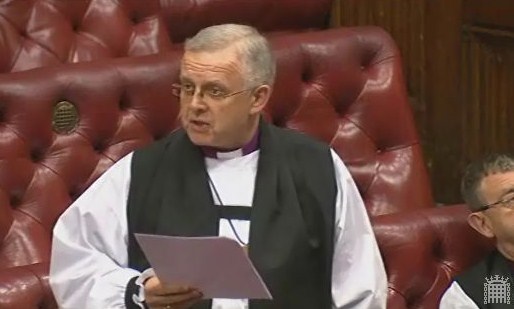 The Lord Bishop of Peterborough: My Lords, like others I welcome the noble Baroness, Lady Harding, and look forward to hearing her maiden speech when I sit down.
I warmly welcome the Bill. Small businesses and local enterprise are part of the life-blood of communities and play a major part in enhancing the life opportunities of many people. Granted, there are areas where the Bill could go further, but every initiative to support small businesses is to be welcomed. Continue reading “Bishop of Peterborough highlights collaboration between churches and local enterprise in Small Business, Enterprise and Employment Bill debate”
Bishop of Derby speaks during Modern Slavery Bill debate
On 1st December 2014, the Bishop of Derby, the Rt Revd Alastair Redfern, took part in the first day of Committee Stage for the Modern Slavery Bill. A former member of the Joint Select Committee that undertook the pre-legislative scrutiny of the bill, the Bishop spoke in favour of three amendments to the bill – one relating to ensuring that the legislation is ‘victim focused’, the second – recommended by the Joint Select Committee and co-sponsored by the Bishop – to create a specific offence for child exploitation, where a child has been exploited but not moved or trafficked, and the third to make criminalise all paying for sexual services. Following assurances from the Government of further discussions, the first two amendments were withdrawn. The third amendment was withdrawn following the recognition the the Bill was not an appropriate place for changes to be made to the law on prostitution.
Continue reading “Bishop of Derby speaks during Modern Slavery Bill debate”
Bishop of Birmingham leads call for improved regulation of payday loan advertising
 On 26th November 2014, the Bishop of Birmingham, the Rt Revd David Urquhart, led the debate on two amendments to the Government’s Consumer Rights Bill, during its Report Stage. The amendments,which the bishop spoke to on behalf of the Bishop of Truro, the Rt Revd Tim Thornton, sought to improve the regulation of payday loan adverstising in two ways – first, through preventing payday lenders from targeting children with advertising on television and second, through the regulation of unsolicited telephone
 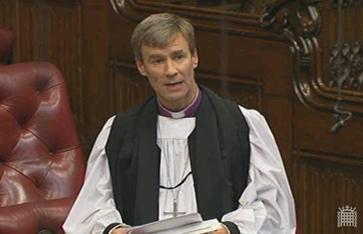 calls from payday lenders. Amendment 47, related to pre-watershed advertising, was pressed to a vote by members of the House of Lords. No bishop took part in the division, and the vote was not successful. The Government did, however, state that the regulator, the Broadcast Committee of Advertising Practice (BCAP) had agreed to broaden the remit of its review into the content of payday loan advertising to consider scheduling rules. Continue reading “Bishop of Birmingham leads call for improved regulation of payday loan advertising”
Consumer Rights Bill – Vote
On 24th November 2014, three bishops took part in a division of the House of Lords, during Report Stage of the Government’s Consumer Rights Bill.
Amendment 31
Labour Peer Baroness Hayter of Kentish Town moved amendment 31, which sought to remove the requirement for trading standards officers to give 48 hours notice before inspecting businesses, as the Bill currently requires.
The Bishop of Chester, the Rt Revd Peter Forster, the Bishop of Derby, the Rt Revd Alastair Redfern and the Bishop of St Albans, the Rt Revd Alan Smtih, voted ‘content’. No bishop voted ‘not content’.
There were Contents: 194 | Not Contents: 220 | Result: Government Win
(via Parliament.uk)
Consumer Rights Bill – Divisions
On 19th November 2014, four bishops took part in two divisions of the House of Lords, during the Report Stage of the Government’s Consumer Rights Bill.
Amendment 1
Shadow Business Spokesperson, Labour peer Lord Stevenson of Balmacara, moved amendment 1, to insert the new clause Consumer credit: bill of sale. The amendment sought to develop a new regulatory framework related to bills of sale as a form of consumer credit.
The Bishop of Chester, the Rt Revd Peter Forster, the Bishop of Norwich, the Rt Revd Graham James, the Bishop of Peterborough, the Rt Revd Donald Allister, and the Bishop of Worcester, the Rt Revd John Inge, all voted ‘not content’ with the amendment. No bishop voted ‘content’.
There were Contents: 176 | Not Contents: 244 | Result: Government Win
(via Parliament.uk)
Bishop of Derby takes part in debate on Modern Slavery Bill
I wonder whether there is some way of privileging people once they have been recognised as having been exploited or enslaved, to give them a different way of accessing benefits and support because they have been enslaved and treated as commodities. That would make an enormous difference.
On 17th November 2014, the Bishop of Derby, the Rt Revd Alastair Redfern, took part in the Second Reading debate of the Government’s Modern Slavery Bill. The Bishop, who was a member of the Joint Select Committee on the Draft Modern Slavery Bill, welcomed the progress that had been made in bringing the Bill to its current form. He noted that concerns about the commodification of humans through slavery required further thinking on supply chain accounting and other aspects of the legislation, and also raised questions about how best the vicitms of trafficking and slavery could be supported by the state.
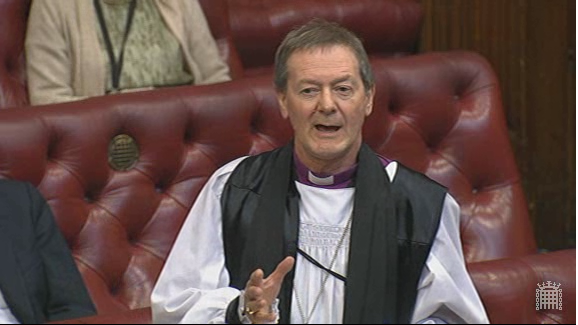 The Lord Bishop of Derby: My Lords, I was privileged to be on the Joint Select Committee and I congratulate the noble Lord, Lord Bates, on his very positive introduction. I also express my appreciation to the Government for listening and being willing to negotiate and explore options as this legislation unfolds.
I remind your Lordships that this is not just a huge and wicked crime. It is, as the noble and learned Baroness, Lady Butler-Sloss, says, increasing as we talk, massively. It treats human beings as commodities to be traded. The challenge of this legislation is to stop this practice. I am delighted that the Government are committed to producing a slavery strategy to complement the Bill and I hope that many of our concerns can be refined through that strategy. I would like to raise three of four things that might benefit from further scrutiny and wider debate in our process. Continue reading “Bishop of Derby takes part in debate on Modern Slavery Bill”
 The Church of England in Parliament
You must be logged in to post a comment.