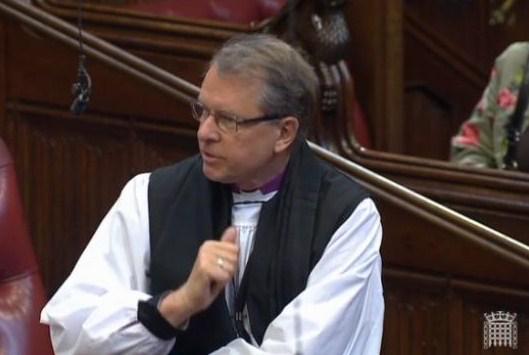
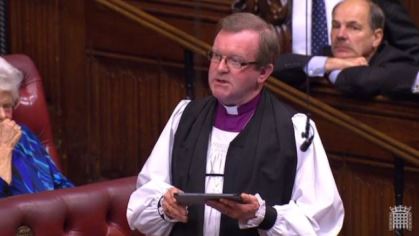
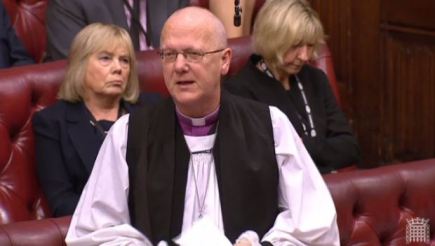
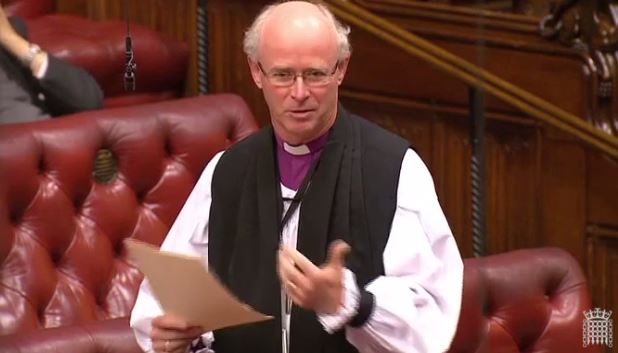
On 16th December 2015 votes were held on amendments to the Government’s Education and Adoption Bill at its Report stage in the House of Lords. Several bishops took part in the votes: Continue reading “Divisions – Education and Adoption Bill”
Category: Bills
Legislation before Parliament
Education and Adoption Bill – Bishop of Ely welcomes Government assurances on church school ethos and academy conversion
On 16th December 2015 the House of Lords considered the Government’s Education and Adoption Bill at Report Stage. Ther Bishop of Ely, Rt Revd Stephen Conway, spoke during debate on amendments to clause 7 of the Bill on the Secretary of State’s duty to make Academy orders where a school is judged to be failing. The Bishop supported the Government’s position.
The Lord Bishop of Ely: My Lords, I am very keen to support the idea of effective communication with our parents, not least about the ethos and character of schools, given that they have a deep effect. We see in the good key stage 2 results this last year the impact of character and ethos on effective academic results. Our parents are really keen to ensure that in any change of school, its ethos and character are maintained and that that is effectively communicated to them by any academy proprietor.
I had submitted my own amendment, which I have now withdrawn because I am content, following conversation with the Minister, that he agrees that ethos and character can be maintained and should be safeguarded effectively. I understand that parents around the country want, of course, to have even more say in what happens, but consider that church schools, in particular, have something significant to offer in relation not only to academic performance and ethos but future guarantees of religious literacy in the way in which our country is served. Continue reading “Education and Adoption Bill – Bishop of Ely welcomes Government assurances on church school ethos and academy conversion”
Welfare Reform Bill: Bishop of Durham supports amendments on reporting on apprenticeships
On 14th December 2015 the House of Lords considered the Government’s Welfare Reform and Work Bill in its third day of Committee.
The Bishop of Durham, Rt Revd Paul Butler, spoke in support of amendments that would require the government to provide a more thorough reporting on the take-up of apprenticeships. The amendments were withdrawn after debate.
The Lord Bishop of Durham: My Lords, in the north-east I get to see apprentices in the car industry, the subsea industry, traditional industries such as stonemasonry, farming, and all kinds of sectors in schools. It is brilliant to be able to see them face to face, to meet them and talk to them. There are brilliant apprenticeships and we need to grow them. Therefore, the 3 million target is fantastic, but I have to say that where the Bill refers to,
“information about the progress made in the reporting period towards the apprenticeships target”,
which is simply the figure of 3 million, that does not give the information about the types of apprenticeship that there are. Continue reading “Welfare Reform Bill: Bishop of Durham supports amendments on reporting on apprenticeships”
Welfare Reform Bill: Bishop of St Albans supports amendments on reporting of disability employment gap
On 14th December 2015 the House of Lords considered the Government’s Welfare Reform and Work Bill in its third day of Committee.
The Bishop of St Albans, Rt Revd Alan Smith spoke in support of two amendments that would require the government to report annually on progress towards halving the disability employment gap. The amendments were withdrawn after the debate.
The Lord Bishop of St Albans: My Lords, I rise briefly to support Amendment 65 in the name of the noble Baroness, Lady Manzoor, and Amendment 67 in the name of the noble Baroness, Lady Campbell of Surbiton, which would legislate for a disability employment gap reporting obligation. Continue reading “Welfare Reform Bill: Bishop of St Albans supports amendments on reporting of disability employment gap”
Divisions – European Union Referendum Bill
On 14th December 2015 the House of Lords considered the House of Commons’ reasons for rejecting Lords amendments to the Government’s European Union Referendum Bill on extending the vote to 16 and 17 year olds. Peers voted on a new amendment from the Opposition, which sought to reinstate the lower voting age in the European referendum. The Bishop of Chester, Rt Revd Peter Forster, took part. Continue reading “Divisions – European Union Referendum Bill”
Online Safety Bill – Bishop of Bristol supports aims and amendments
On 11th December 2015 the House of Lords considered in Committee the Online Safety Bill which had been tabled by Baroness Howe. The Bishop of Bristol, Rt Revd Mike Hill supported the Bill and spoke favourably to an amendment, later withdrawn, by Lord Morrow on filtering of adult content and age verification policies.
The Lord Bishop of Bristol: My Lords, I do not want to add too much to the way that the noble Lord, Lord Morrow, has framed his amendment today, but his point is worthy of serious scrutiny, simply because children living in households that are not serviced by the big four ISPs surely require the same level of protection as those in homes whose services are provided by the big four ISPs. Everyone in your Lordships’ House agrees that every child matters; I think that it is not at all controversial to say that.
It is a little confusing that the Prime Minister should seem so robust in his statement in the other place on 28 October, suggesting that the Government wanted to introduce legislation, yet the Minister—unless I misunderstand her—seems very happy to continue with a kind of voluntary regulation. I am not quite sure how that squares up. The point—and the noble Lord, Lord Morrow, makes it well—is that whatever we come up with cannot apply only to some children; surely it must apply to them all. Continue reading “Online Safety Bill – Bishop of Bristol supports aims and amendments”
Welfare Reform Bill – Bishop of Durham supports amendments about parents of young children
On 9th December 2015 the House of Lords considered the Government’s Welfare Reform and Work Bill in its second day of Committee.
The Bishop of Durham, Rt Revd Paul Butler, spoke in support of a group of amendments to clause 15 of the Bill, concerned with work-related requirements and Universal credit. The amendments, which were withdrawn after the debate, sought to make the work-related requirements in legislation take into account particular circumstances of parents with young children or those with disabilities.
The Lord Bishop of Durham: My Lords, I encourage the Minister to at least agree to go away and think very seriously about these amendments. The paramountcy of the welfare of the child, I am sure, we are all entirely agreed about. We know that the first two years of life are absolutely crucial to long-term life chances. The next two years matter as much again. So how we behave towards children in the first four or five years of life, before they go to school, is the most significant factor in their long-term life chances.
Welfare Reform Bill – Bishop of Durham supports amendments on children’s life chances
On 9th December 2015 the House of Lords considered the Government’s Welfare Reform and Work Bill in its second day of Committee.
The Bishop of Durham, Rt Revd Paul Butler, spoke in support of a group of amendments to clauses 4 and 5 of the Bill, concerned with Government reporting on the life chances of children. The amendments sought to require the Government to lay before Parliament a report setting out the measures it proposes to take to improve children’s life chances, and to rename the proposed Social Mobility Commission the ‘Life Chances Commission’. The amendments were withdrawn after the debate.
The Lord Bishop of Durham: My Lords, I rise to speak first to Amendment 31. Given the serious enthusiasm that the Government have for introducing “life chances” as a title and theme, it would make complete sense for the Government to want to report on improvement in children’s life chances in the future. So I commend this as being entirely in line with the purpose of the whole Bill—it would make sense to report. Continue reading “Welfare Reform Bill – Bishop of Durham supports amendments on children’s life chances”
Welfare Reform Bill – Bishop of Durham supports amendments on child poverty
On 9th December 2015 the House of Lords considered the Government’s Welfare Reform and Work Bill in its second day of Committee.
The Bishop of Durham, Rt Revd Paul Butler, spoke in support of a group of amendments to clause 4 of the Bill, concerned with Government reporting on the life chances of children. The amendments sought to require the Government to report on the situation of children in low-income households, not only workless households and educational attainment. The amendments were withdrawn after the debate.
The Lord Bishop of Durham: My Lords, I will speak in support of Amendments 24, 25 and 26. I know that everyone in this House, and indeed in the other place, is committed to protecting those children in our society who are vulnerable to suffering the worst effects of poverty. Indeed, I know that there is a broad recognition across the House that some form of statutory reporting on the issues of child poverty and children’s life chances is an important tool in driving initiatives that will combat that poverty. The questions about what should be included in Clause 4 are questions of best practice, rather than questions of best intention. Continue reading “Welfare Reform Bill – Bishop of Durham supports amendments on child poverty”
Bishop of Chester supports measure in Scotland Bill stating permanence of Scottish Parliament and Government
On 8th December 2015 the House of Lords considered the Government’s Scotland Bill at Committee stage. The Bishop of Chester, Rt Revd Peter Forster, spoke during debate on amendments to the Bill from Lord Norton of Louth and Lord Forsyth of Drumlean.
The amendment from Lord Norton proposed the removal from the Bill of two new clauses to be added to the 1998 Scotland Act, namely:
(1) The Scottish Parliament and the Scottish Government are a permanent part of the United Kingdom’s constitutional arrangements.
(2) The purpose of this section is, with due regard to the other provisions of this Act, to signify the commitment of the Parliament and Government of the United Kingdom.
Lord Forsyth’s amendment sought to change the wording of (1) so that it instead read
(1) The Scottish Parliament and the Scottish Government are recognised as a permanent part of the United Kingdom’s constitutional arrangements.
The Bishop argued against both amendments on the grounds that they conflicted with settled political reality and would send unwelcome signals. The amendments were withdrawn after debate.
The Lord Bishop of Chester: My Lords, it is always dodgy for bishops to speak about Scottish matters. The kirk has sometimes considered the possibility of introducing bishops but the one condition it has always applied is that they must not be like English bishops—they must be quite different.
I have some credentials inasmuch as I have had a close association with Scotland for 40 years, since I went to Edinburgh as a student. I have had a house in Scotland for 30 years, I have two Scottish degrees and one Scottish wife, who has kept my feet on the ground over the years. I shall also retire to Scotland shortly, and very much look forward to doing so. Continue reading “Bishop of Chester supports measure in Scotland Bill stating permanence of Scottish Parliament and Government”

You must be logged in to post a comment.