Bishop of Lichfield highlights educational excellence in Church of England schools

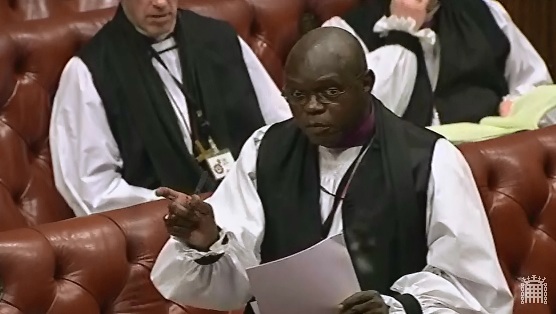
On 30th October 2013, Baroness Massey of Darwen asked Her Majesty’s Government whether free schools and faith schools will be required to deliver a broad and balanced curriculum which addresses the needs of all pupils. The Bishop of Lichfield, the Rt Revd Jonathan Gledhill, asked a supplementary question:

14.03.27 Bishop of LichfieldThe Lord Bishop of Lichfield: Does the Minister agree that the use of the phrase “faith schools” can be profoundly unhelpful in the context of this discussion? Schools of a religious character come in many forms. Is it not true that the nearly 4,700 Church of England schools sit very firmly within the mainstream of English education, and that even C of E free schools and academies are linked to diocesan boards to ensure that the education that they provide is broad and balanced, academically challenging, personally inspiring and serving the needs of the whole local community?

Lord Nash: I agree entirely with the right reverend Prelate. Faith schools are a long-established and highly valued part of our educational establishment, and church schools are, too. Church schools consistently outperform maintained schools; they are very popular and often highly oversubscribed. The applications procedures of many of them do not rely heavily on faith; they have a much wider intake.

(via Parliament.uk)

Bishop of Derby receives answer on accountability in free schools (Written Answer)

On 29th October 2013, the Bishop of Derby, the Rt Revd Alastair Redfern, received an answer to a written question on accountability in free schools. 

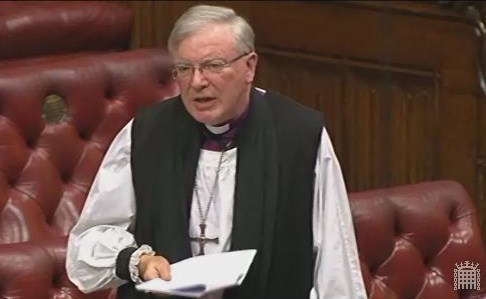
Bishop of DerbyThe Lord Bishop of Derby: To ask Her Majesty’s Government what steps they are taking to ensure that there is a rigorous assessment of the leadership, aims and ethos of free schools.

The Parliamentary Under-Secretary of State for Schools (Lord Nash) (Con): All free school applications undergo a rigorous assessment against a number of criteria. The areas covered include: the education vision and plan for the school, which will cover its proposed aims and ethos; and the capacity and capability of the applicant group, which covers the track record and expertise of the trust members and proposed governing body, as well as their plans for recruiting a high quality principal. We also carry out due diligence checks on the suitability and track record of key members of the proposer group. The assessment criteria for the next round of applications will be published on the Department’s website shortly.

Where an application is approved into the pre-opening phase, those leading the project work closely with a named lead contact and an education adviser from the Department. Where any concerns are reported, including about their leadership, aims or ethos, the matter is escalated and an early decision is taken on what action to take in response, which may include cancellation of the project.

(via Parliament.uk)

Bishop of Ripon and Leeds calls for stronger monitoring of welfare of asylum seekers returned to DRC

On 24th October 2013, the Bishop of Ripon and Leeds, the Rt Revd John Packer asked Her Majesty’s Government on what evidence they consider the Democratic Republic of the Congo to be a safe country to which to return asylum seekers.

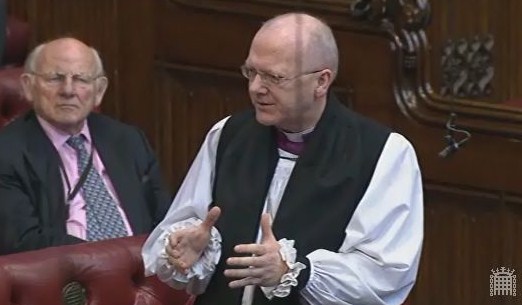
R_LThe Lord Bishop of Ripon and Leeds: Despite my unelected nature, I beg leave to ask the Question standing in my name on the Order Paper.

The Parliamentary Under-Secretary of State, Home Office (Lord Taylor of Holbeach) (Con): My Lords, we observe our obligations under the refugee convention and the European Convention on Human Rights. Every asylum application is considered on its individual merits in the light of country information from a range of sources, including fellow European and asylum-intake countries. Returns are made only if it is safe to do so, and the courts have supported our position.

The Lord Bishop of Ripon and Leeds: I am very grateful to the Minister for that response. Following the Unsafe Return report of November 2011 and continued documented reports of ill treatment of those who return to the Democratic Republic of the Congo in the Unsafe Return 2 report of this month, will the Government use the evidence provided to challenge the DRC authorities and to set up a monitoring mechanism for those returned so that there is a minimal safety measure for them in this very dangerous country?

Lord Taylor of Holbeach: My Lords, the Home Office works very closely with FCO staff here in London and with embassy officials in Kinshasa. The embassy staff participated in the DRC fact-finding mission and stated that they were not aware of substantial evidence of any returnee being ill treated. However, I assure the right reverend Prelate that the Home Offices investigates specific allegations of mistreatment on return.

(via Parliament.uk)

Bishop of Derby receives answer to question on credit union expansion (Written Answer)


On 24th October 2013, the Bishop of Derby, the Rt Revd Alastair Redfern, received an answer to a written question on the development of credit unions.

Bishop of DerbyThe Lord Bishop of Derby: To ask Her Majesty’s Government what steps they are taking to support credit unions as viable alternatives to payday lenders and other providers of high cost credit.

The Parliamentary Under-Secretary of State, Department for Work and Pensions (Lord Freud): While the majority of credit unions are not providing direct competition to payday lenders, credit unions are increasingly helping members who have become trapped with payday loans, offering them a way to consolidate and escape from the high interest rates, spreading out their debts over a longer, more affordable period.

Government has committed investment of up to £38 million in credit unions — to increase access to affordable credit for at least 1 million more people and save consumers up to £1 billion in loan repayments by March 2019.

We are also changing the maximum interest rate credit unions can charge per calendar month from 2% to 3%, coming into force on 1st April 2014.

This will enable credit unions to break even on their smaller, most expensive to issue loans, and to become more stable over the long term. This will give low income consumers greater access to reliable, affordable credit, without having to resort to more expensive means, such as home credit or payday lenders.

(via Parliament.uk)

Bishop of Worcester puts questions to Government on Israeli settlements (Written Answers)

On 24th October 2013, the Bishop of Worcester, the Rt Revd John Inge, received answers to three written questions regarding Israeli settlement-based entities, activities and products.

Worcester

The Lord Bishop of Worcester: To ask Her Majesty’s Government what steps they intend to take to implement the new European Commission guidelines of July 2013 on the funding of Israeli settlement-based entities and activities.

The Senior Minister of State, Department for Communities and Local Government & Foreign and Commonwealth Office (Baroness Warsi) (Con): The EU guidelines on the eligibility of Israeli entities and their activities in the territories occupied by Israel since June 1967 for grants, prizes and financial instruments, were prepared to implement the commitment made by EU Foreign Ministers in December 2012 to make a distinction in relevant EU programmes and agreements between the State of Israel and Israeli settlements in the Occupied Territories. The guidelines themselves apply to EU, rather than individual Member State programmes, and will be implemented by the European Commission. The guidelines are due to be implemented in January 2014.

Continue reading “Bishop of Worcester puts questions to Government on Israeli settlements (Written Answers)”

Bishop of Ripon and Leeds calls for Government to examine reform of winter fuel allowance

On 23rd October 2013, Lord Greaves asked Her Majesty’s Government what proposals they have to reduce the level of economic inequality. The Bishop of Ripon and Leeds, the Rt Revd John Packer, asked a supplementary question:

R_LThe Lord Bishop of Ripon and Leeds: My Lords, bearing in mind the way in which wealthy pensioners, such as many in this House, are protected against the austerity cuts that other welfare recipients face, will the Government consider how to enable us to begin to bear our share of the burden, whether by taxing or means-testing the winter fuel allowance or otherwise?

Lord Newby: My Lords, one of the commission’s recommendations was that intergenerational equity could be improved if pensioners paid a higher share. That has not been the view that the Government have taken. Particularly given the very high levels of pensioner poverty, against which many noble Lords have campaigned over many years, we have taken the view that the real value of pensions should be protected during this period of fiscal consolidation. However, we accept that there may be more to be done. Indeed, for people who receive payments such as the winter fuel allowance, there are now a number of voluntary schemes under which they can make that payment available via charities so that it can be used for people on low incomes.

(via Parliament.uk)

Bishop of Ripon and Leeds calls for co-ordinated international tax transparency efforts

On 22nd October 2013, Lord Chidgey asked Her Majesty’s Government what new millennium development goals they would prefer to see introduced post-2015. The Bishop of Ripon and Leeds, the Rt Revd John Packer, asked a supplementary question:

R_LThe Lord Bishop of Ripon and Leeds: My Lords, will the Minister press for tax justice to be a distinctive international goal in ensuring that major corporations pay appropriate taxes and in channelling taxes to the countries where profits are actually made?

Baroness Northover: The right reverend Prelate is right to highlight that and he will know that the UK Government are emphasising the importance of tax being collected appropriately within the developing countries. This will be transformative. Corporate transparency is one of the aspects required and he will know that my right honourable friend the Secretary of State for BIS, Vince Cable, is working very hard on that. BIS has just consulted and is considering responses, and DfID is trying to ensure that tax regimes in the developing countries are strengthened and built on.

(via Parliament.uk)

Bishop of Ripon and Leeds calls for greater research on impact of under-occupancy charge

On 21st October 2013, Baroness Hollis of Heigham asked Her Majesty’s Government what advice they give to social landlords whose tenants have fallen into arrears as a result of the under-occupancy charge. The Bishop of Ripon and Leeds, the Rt Revd John Packer, asked a supplementary question:

R_LThe Lord Bishop of Ripon and Leeds: My Lords, is the Minister aware of the evidence that people who are leaving accommodation to avoid the under-occupancy charge are being rehoused in private accommodation at greater cost? What steps are being taken to monitor this?

Lord Freud: My Lords, as I have just pointed out, we are undertaking an elaborate set of research programmes to understand this. If a family moves into private accommodation, which is more expensive, it does not necessarily mean that there is a net cost, because it frees up larger accommodation in the social rented sector to which a family can move from the expensive private sector.

(via Parliament.uk)

Second Church Estates Commissioner Answers Written Questions on Credit Unions and Food Banks

On the 21st October 2013, Sir Tony Baldry MP answered written questions about the Church of England’s attitude towards Credit Unions and its involvement in food banks14.01 CCQ Baldry Continue reading “Second Church Estates Commissioner Answers Written Questions on Credit Unions and Food Banks”

Bishop of Derby responds to Government Statement on Al-Madinah Free School

On 17th October 2013, a Government Statement was repeated in the House of Lords by the Parliamentary Under-Secretary State for Schools, Lord Nash, on the Al-Madinah Free School in Derby. The Bishop of Derby, the Rt Revd Alastair Redfern, responded to the statement during the subsequent question and answer session.

DerbyThe Lord Bishop of Derby: My Lords, I declare an interest as the Bishop of Derby and congratulate the Minister and his colleagues on the monitoring and firm action that is being taken. As I understand it, this is a very local initiative. What lessons can be learnt because if we do not have the local authority playing a key role, how are we providing the right kind of framework and guidance for local initiatives so that the right kind of standards, structures and expectations are put in place and met? What are we learning and how are we going to deal with that?

The Parliamentary Under-Secretary of State for Schools (Lord Nash): I am grateful to the right reverend Prelate for his question. This is a local initiative, it is quite a complicated situation and I do not have time to go into all the details now, but I can assure the House that we are all over this and will not allow this situation to continue.

(via Parliament.uk)