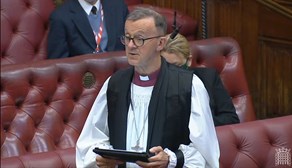
Media Bill: Bishop of Newcastle calls for additional focus on language provision

The Bishop of Newcastle spoke in a debate on the second reading of the Media Bill on 28th February 2024, commending the bill and requesting that additional attention for language provision be included in the legislation:

The Lord Bishop of Newcastle: My Lords, I am glad to be able to speak in this debate, and thank the previous speaker, the noble Lord, Lord Russell, for his comments. It is an honour to follow him.

In conversations I have had in recent weeks, it is clear that there is a strong desire across this House to ensure the Media Bill progresses positively through its legislative processes, in part because this is, as noble Lords have said, a Bill that acknowledges the vastly changed broadcasting landscape over the past 20 years. Given the rapidly developing technological nature of the communications landscape, it is understandable that the Bill aims to give flexibility and adaptability where needed. The point I wish to make is about the absence of clear statutory provision for languages in this Bill, in particular for Gaelic. Other noble Lords have already referred to this in the debate.

Continue reading “Media Bill: Bishop of Newcastle calls for additional focus on language provision”

Media Bill: Bishop of Leeds welcomes legislation and highlights areas of concern around data use and metrics

On 28th February 2024, the House of Lords debated the Media Bill in its second reading. The Bishop of Leeds spoke in the debate, welcoming the bill whilst raising concerns on issues of metrics, language, prominence and genres:

The Lord Bishop of Leeds: My Lords, it is a pleasure but somewhat daunting to follow the noble Lord, Lord Birt. I agree with every word he said. I strongly welcome the Bill. It is timely and necessary. The regulatory framework that governs public service media, not just broadcasting, is in urgent need of updating, given the accelerating changes in technology, media consumption and the wider media ecosystem in the 20 years since the Communications Act 2003. I commend the excellent Library briefing for this debate. It was very helpful.

A number of things that are on my mind have already been mentioned, so I will move swiftly on. As the noble Baroness, Lady Featherstone, and, I think, the noble Lord, Lord Lipsey, have already noted, I understand that the intention to drop Section 40 of the Crime and Courts Act will almost certainly proceed. It was a manifesto commitment by the Government. However, I will not be the only person to want to put on record that arguments by press agencies about freedom of speech can ring somewhat hollow. Leveson worked on this for good reasons. Freedom of speech and press freedom must not be confused with press protectionism. Victims of press misrepresentation and abuse must be forgiven for suspecting that government can easily be captured by business.

Continue reading “Media Bill: Bishop of Leeds welcomes legislation and highlights areas of concern around data use and metrics”

Victims and Prisoners Bill: Bishop of Manchester supports amendment on transparency of public officials

On 26th February 2024, the House of Lords debated amendments to the Victims and Prisoners Bill. The Bishop of Manchester spoke in support of amendment 133 to the bill, which “would require public authorities, public servants and officials to act in the public interest and with transparency, candour and frankness when carrying out their duties in relation to major incidents,” arguing that introducing this statutory duty would allow for greater support for victims and survivors of major incidents and crimes:

The Lord Bishop of Manchester: My Lords, I rise to speak to this amendment to which I have added my name. I declare my interest as co-chair of the national police ethics committee.

Before turning to the amendment, I follow other noble Lords by recording the deep gratitude of both myself and many in the Church for the wisdom and friendship of Lord Cormack. On behalf of both the party he served and the Church he loved, over so many decades, Patrick wonderfully embodied that concept of “critical friend” which is so vital to the functioning of all institutions. We were all better for his wisdom and friendship, and we all learned much from his challenges. He may not have been subject to a duty of candour, but that never stopped him from being very candid in expressing his views. We will miss his contributions, here and elsewhere greatly.

The former Bishop of Liverpool advocated for a duty of candour in his report on the Hillsborough disaster, The Patronising Disposition of Unaccountable Power. That title tells its story. His report was produced over six years ago; a duty of candour was finally contained in the College of Policing’s Code of Practice for Ethical Policing in the last two months, for which I and many others are deeply grateful.

Continue reading “Victims and Prisoners Bill: Bishop of Manchester supports amendment on transparency of public officials”

Bishop of Hereford makes maiden speech on poverty in rural communities

On 22nd February 2024, the Bishop of Hereford made his maiden speech during a debate on poverty reduction, focusing on tackling poverty in rural communities:

The Lord Bishop of Hereford: My Lords, I begin by recording my grateful thanks for the welcome and encouragement I have received since my introduction to your Lordships’ House. I am especially grateful for the forbearance of the staff as they have helped me navigate the labyrinthine corridors of this place, and to my colleagues for their patience in introducing me to the various procedures and protocols that govern our business.

I became the Bishop of Hereford in early 2020, just before the start of the first lockdown. The diocese of Hereford celebrates the 1,350th anniversary of its foundation in 2026—we are a diocese that predates the foundation of England. Indeed, the earliest timbers in the episcopal residence were acorns in the year 910. I have both worthy and ignoble predecessors in this role. I have already done better than four of them, who never actually came to the diocese at all. I hope not to emulate one of my Saxon predecessors, who, angered by the burning of the cathedral by the Welsh in 1055, took up arms with some of the canons and died in battle as a result. I also hope to avoid the fate of the cousin of the bishop who was murdered in the garden in 1256 on the coat-tails of his cousin’s unpopularity.

Hereford is the smallest and most rural diocese in England. We comprise the counties of Herefordshire and the southern half of Shropshire, one parish in Worcestershire and 14 in Wales. Sustaining a diocesan infrastructure with such a small base presents its challenges. For every 800 people who live here, we have one church building, and three-quarters of them are grade 1 listed.

Continue reading “Bishop of Hereford makes maiden speech on poverty in rural communities”

Bishop of Durham gives valedictory speech in debate on poverty reduction, calling for greater efforts to combat child poverty in the UK

The Bishop of Durham gave his valedictory speech in the House of Lords on 22nd February 2024, during a debate on poverty reduction, focusing on continuing high levels of child poverty and calling for poverty in the UK to be confronted as a national emergency:

The Lord Bishop of Durham: I am very grateful to the noble Lord, Lord Bird, for securing this debate on an issue of such importance and for the way that he introduced it. Also, because I have spoken on this issue repeatedly throughout my past 10 years as a Member of this House, it thus seems a fitting debate for my valedictory speech. I am very grateful to the noble Baroness, Lady Armstrong, for speaking straight after me. We have worked together on poverty in the north-east. I also look forward to the right reverend Prelate the Bishop of Hereford’s maiden speech.

During my maiden speech, I spoke of the high levels of poverty in my region of the north-east. Sadly, poverty, particularly child poverty, remains as significant an issue today as it was 10 years ago. Only last week, the North East Child Poverty Commission released its blueprint for tackling child poverty, featuring the latest poverty stats from 2021 to 2022, along with those recorded in 2014-15—the very year I entered this House. They reveal that, in 2021-22, there were around 134,000 children living in poverty in the North East Mayoral Combined Authority—an increase of over 7% since 2014-15.

But poverty is not just about numbers. Behind each statistic are the lives of children and the impact on them is all-encompassing. Poverty means going without the basic essentials. It means not being able to concentrate in school due to an empty stomach and not getting adequate nutrition; a packet of apples costs five times the amount of a packet of biscuits. Poverty means missed opportunities. It denies the chance to develop new skills through extra-curricular activities. Poverty means growing up too soon. It means dealing with stresses and anxieties with which no child should ever be burdened. It impacts the present and its effects last a lifetime.

Continue reading “Bishop of Durham gives valedictory speech in debate on poverty reduction, calling for greater efforts to combat child poverty in the UK”

Animal Welfare (Livestock Exports) Bill: Bishop of St Edmundsbury and Ipswich welcomes legislation

On 21st February 2024, yhe Bishop of St Edmundsbury and Ipswich gave a speech during the second reading of the Animal Welfare (Livestock Exports) Bill, expressing his support for the bill and stressing the importance of maintaining animal welfare standards in the UK:

The Lord Bishop of St Edmundsbury and Ipswich: My Lords, I draw attention to my entry in the register of interests. It is a pleasure to speak in this debate, and I welcome the Government’s commitment to improving the standards of animal welfare in the UK. I add my thanks to the Minister, as he begins his new role, and to those who have campaigned for so long, particularly the noble Baroness, Lady Fookes, whose birthday it is today.

I have spoken to farmers and farm vets in Suffolk, and they are clear that the exporting of animals for slaughter is not an acceptable practice, and I fully support the Bill. They raised with me a couple of related points, both of which have been made already, but I will briefly refer to them. First, we must ensure that holding British farmers to high welfare standards does not result in the undercutting of our farmers by cheaply produced imported meat that does not meet the same standards required of UK farmers. I hope the Government are able to provide farmers with the assurances they need on this matter.

Continue reading “Animal Welfare (Livestock Exports) Bill: Bishop of St Edmundsbury and Ipswich welcomes legislation”

Economic Activity of Public Bodies (Overseas Matters) Bill: Bishop of Southwark expresses concerns over implications of legislation

On 20th February 2024, the Bishop of Southwark made a speech during the second reading of the Economic Activity of Public Bodies (Overseas Matters) Bill, raising the potential issue of religious education foundations being affected inadvertently by the bill, and expressing concern about the far-reaching implications of the bill:

The Lord Bishop of Southwark: My Lords, I expect that the name of Field-Marshal Julius Jakob Freiherr von Haynau does not elicit the sort of interest that once it did in your Lordships’ House. He was, none the less, a staple of O-level history when that subject would have elicited the admiration of the Secretary of State for Levelling Up. Field Marshall von Haynau was an effective but severe Habsburg military commander during the revolutionary years of 1848 and 1849. His imperial standing, however, did not prevent him being chased down Borough High Street in my diocese in 1850—where my diocesan headquarters now is, very near the cathedral—by two draymen from the nearby brewery of Barclay Perkins to remonstrate with him about his military conduct in Italy and Hungary.

I mention this once-famous incident to illustrate that there have always been strong currents of feelings about issues, including those abroad. Some of these fall into what one might call the dissenting tradition. As a Church of England Bishop, I recognise that I am an heir to a different tradition, but surely our history has taught us that consensus has been built up around what is obviously true and lived out with integrity, rather than by suppression.

Continue reading “Economic Activity of Public Bodies (Overseas Matters) Bill: Bishop of Southwark expresses concerns over implications of legislation”

Safety of Rwanda (Immigration and Asylum) Bill: Bishop of Chelmsford moves amendment introducing sunset clause to bill

On 19th February 2024, the Bishop of Chelmsford tabled her her amendment 91 to the Safety of Rwanda (Immigration and Asylum) Bill, which would insert a sunset provision for the Bill to expire two years after commencement unless Parliament decides that it should remain in force and the Government has produced a report containing evidence that the Rwandan government is fulfilling its Treaty obligations:

The Lord Bishop of Chelmsford: My Lords, in moving Amendment 91 I am grateful to my friends the noble Lords, Lord Scriven and Lord Blunkett, for their support. The noble Lord, Lord Scriven, is in his seat and the noble Lord, Lord Blunkett, was in touch with me today to apologise for not being able to be here this evening.

I want to keep my comments as short as possible, given the hour and the fact that some of the issues have already been debated in Committee. However, there is merit in discussing the value of a sunset provision, now that each of the Bill’s clauses has been scrutinised.

The fundamental issue, which I fear has not yet been fully addressed by the Government Benches, is that we are being asked to make a permanent judgment on the safety of Rwanda on the basis of the yet to be implemented arrangements outlined in the treaty. This is, of course, against the opinion of our highest court. Furthermore, it is simply not arguable on any rational basis that Rwanda is safe at present, when, as the Minister himself has conceded, Rwanda is moving towards having the required protections in place.

Continue reading “Safety of Rwanda (Immigration and Asylum) Bill: Bishop of Chelmsford moves amendment introducing sunset clause to bill”

Safety of Rwanda (Immigration and Asylum) Bill: Bishop of Chelmsford speaks in support of amendments protecting unaccompanied children

During a debate on the Safety of Rwanda (Immigration and Asylum) Bill on 19th February 2024, the Bishop of Chelmsford spoke in support of two amendments tabled by Lord Dubs which sought to prevent the erroneous relocation of unaccompanied children to Rwanda:

The Lord Bishop of Chelmsford: My Lords, I too support Amendments 54 and 55, to which I have added my name. I thank the noble Baroness, Lady Lister, and the noble Lord, Lord Dubs, for giving us the opportunity to ensure that the voice of the child is heard in this debate. For we should never forget that both accompanied and unaccompanied children, and those who may well be found to be children, are in the scope of the Bill, which the Government cannot confirm is compatible with convention rights under the ECHR. I spoke earlier in Committee on the universality of human rights, but to remove children from their reach is simply unforgivable. For this reason, I repeat the noble Baroness’s request that a children’s rights impact assessment be published as a matter of urgency.

Continue reading “Safety of Rwanda (Immigration and Asylum) Bill: Bishop of Chelmsford speaks in support of amendments protecting unaccompanied children”

Safety of Rwanda (Immigration and Asylum) Bill: Bishop of Chichester supports amendments on role of the courts in asylum system

On 19th February 2024, the House of Lords debated the Safety of Rwanda (Immigration and Asylum) Bill in committee. The Bishop of Chichester spoke in the debate, in support of two sets of amendments on the jurisdiction of the courts, pointing out the practical issues associated with offshoring of asylum seekers:

  • amendments tabled by Baroness Chakrabarti restoring the jurisdiction of domestic courts “by rendering the future safety of Rwanda (evidenced by UNHCR advice) a rebuttable presumption and restoring the ability for UK courts and tribunals to grant interim relief…”
  • amendments in the name of the Archbishop of Canterbury and Baroness Chakrabarti which would seek to ensure that that proper regard is given to interim measures of the European Court of Human Rights in accordance with international law

The Lord Bishop of Chichester: My Lords, my noble friend the most reverend Primate the Archbishop of Canterbury regrets that he cannot be in his place today to speak to the amendments in this group tabled in the name of the noble Baroness, Lady Chakrabarti, and the noble and learned Baroness, Lady Hale. I wish to associate my remarks with theirs and to emphasise how important the restoration of the jurisdiction of the domestic courts is in considering also UNHRC evidence and the ability to grant interim relief. This is no mere technicality. This jurisdiction might make the difference between sending an asylum seeker to Rwanda while their claim, or an aspect of their claim, is pending or not doing so.

Continue reading “Safety of Rwanda (Immigration and Asylum) Bill: Bishop of Chichester supports amendments on role of the courts in asylum system”