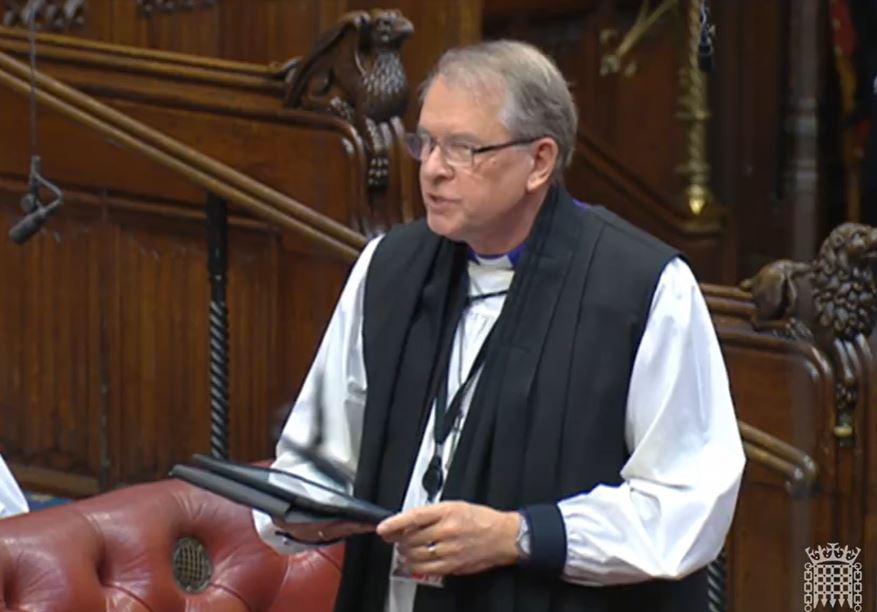
On 5th January 2022, during a debate on the newly introduced Nationality and Borders Bill, the Bishop of Chelmsford made a speech advocating for the value of viewing asylum seekers as potential future citizens, and emphasized the importance of treating them with dignity and respect:
The Lord Bishop of Chelmsford: My Lords, I must begin with an apology. As I am new to your Lordships’ House, there was an error in processing my request to speak, although I am grateful to the Whips for permission to interject at this point. It is a privilege to have been part of the debate and I look forward to following this Bill through and benefiting from the collective wisdom here.
I believe that I am among relatively few in the House who have experience of both sides of the asylum and refugee system, having first come to this country as a refugee from Iran in 1980. The plight of those fleeing violence and persecution and the difficulties in navigating identity and finding a new home are not abstract or intellectual propositions for me but part of who I am, and it is with that perspective that I offer some thoughts now.
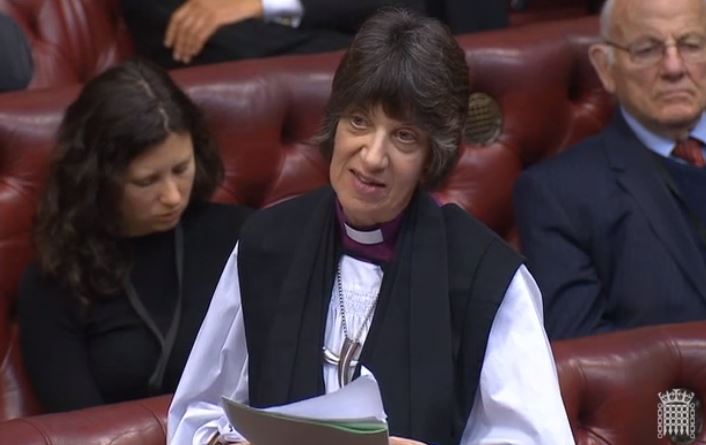
On 5th January 2022, the House of Lords debated the Nationality and Borders Bill in its second reading. The Bishop of London spoke in the debate, welcoming some provisions in the bill whilst expressing concerns that it might have a counterproductive effect on protections against modern slavery:
The Lord Bishop of London: My Lords, it is a pleasure to follow the many noble Lords in this House who bring such expertise to our deliberations and compassion to our scrutiny of this Bill. I wish to focus my remarks particularly on Part 5 of the Bill, on modern-day slavery. It has been said that the Modern Slavery Act was a pioneering piece of legislation.
I would agree with that, but there is so much more work for us to do to confront this blight on our communities. Addressing modern-day slavery is close to the Church of England’s heart. Through the Clewer Initiative and other programmes, we have worked to raise awareness and to support survivors. This is a matter in which civil society, law enforcement and government share a joint responsibility to act.
On 5th January 2022, the Nationality and Borders Bill was introduced to the House of Lords in its second reading. The Bishop of Durham spoke in the debate that followed, raising concerns that bill would fail to adequately protect children and others seeking asylum:
The Lord Bishop of Durham: I declare my interests as a member of the RAMP Project and a trustee of Reset, as laid out in the register. This Bill will raise strong views across the Chamber, as already illustrated by the three Front-Bench introductions, for which I thank all three, because I believe that they have served the House well in all three cases. I hope that we can have a debate that is reasoned and evidence-based, ever mindful of the individual humanity of each asylum seeker and refugee of whom we speak.
This Bill needs to be assessed against the Home Office’s own values of being compassionate, respectful, courageous and collaborative. Other values are important, too: the value of every human being as one made in the image of, and loved by, God, the value that we place on the rights of the child both through the United Nations and the Children Act 1989—and then there are the values relating to the right to family life.
The Bishop of St Albans spoke in a debate on international development on 16th December 2021, highlighting the benefits of supporting this development, especially regarding fair trade, education, democracy and the rule of law:
The Lord Bishop of St Albans: My Lords, I too pay tribute to the noble Lord, Lord McConnell, for obtaining this really important debate and for his passionate and informed introduction, which set the scene so well for us.
The omicron variant is a powerful and topical reminder that there is only one world and only one human race. There are people around who want to make out the case that our concern for international development is an additional cost, something added on the side. Actually, when we truly grasp what it is about, it is a real win-win for us. Apart from it being morally right, it will make economic sense for us as well as helping us address many issues. For example, helping other countries to flourish and thrive will increase their health systems, address things such as the pandemic we currently face and even begin to address some of the issues of economic migrants, so it is vital for us.
The Bishop of Gloucester tabled an amendment to the Police, Crime, Sentencing and Courts Bill on 15th of December 2021, requiring courts to reference the impact of sentencing on primary carers of dependent children:
85: After Clause 132, insert the following new Clause—
“Pre-sentence report requirements
(1) Section 30 of the Sentencing Act 2020 is amended as follows.(2) After subsection (3) insert—“(3A) A court must make inquiries to establish whether the offender is a primary carer for a child.(3B) If the court establishes that the offender is a primary carer for a child, unless there are exceptional circumstances before sentencing the offender the court must obtain a pre-sentence report containing information to enable the court to make an assessment of the impact of a custodial sentence on the child.”(3) After subsection (4) insert—“(5) In this section—(a) “child” means a person under the age of 18; and(b) “primary carer” means a person who has primary or substantial care responsibilities for a child.””Member’s explanatory statement
This Clause amends section 30 of the Sentencing Act 2020 to make clear the requirement for a sentencing judge to have a copy of a pre-sentence report, considering the impact of a custodial sentence on the dependent child, when sentencing a primary carer of a child.
The Lord Bishop of Gloucester: My Lords, in moving Amendment 85 I will speak also to the other amendments in my name in the group. I am very grateful for the support of the noble Lords, Lord Ponsonby and Lord German. I am very grateful for the briefing and expertise provided to me by the organisation Women in Prison and I declare my interest as Anglican Bishop for Her Majesty’s Prisons.
In Committee I highlighted the injustice of punishing a child for their parent’s mistakes and I will not go over that ground again. But I want to frame this discussion by reminding us that when a parent goes to prison it can affect every area of a child’s life, from losing their familiar home and school through to reduced educational achievement and mental and physical well-being. The consequences can last a lifetime.
On 15th December 2021, the House of Lords debated the Police, Crime, Sentencing and Courts Bill in the report stage. The Bishop of Gloucester spoke in support of amendment 82A, which would seek to limit the issuing of short prison sentences of six months or less, with reference to the impact of short sentences on families:
The Lord Bishop of Gloucester: My Lords, I agree with much of what has been said. On Amendment 82A I reiterate what has been said, and I hope will be said later, about primary carers. We know the damage short sentences do to families. We also know that close to half of those leaving custody go on to reoffend within a year of their release, but two-thirds of those sentenced to less than 12 months go on to reoffend.
On 15th December 2021, the House of Lords debated a motion to approve continued COVID-19 Health Protection Restrictions. The Bishop of Leeds spoke in the debate, responding to issues of public health and personal freedom raised by other peers, and contrasting these issues with approaches to other legislation:
The Lord Bishop of Leeds: My Lords, in one sense I hesitate to contribute to this debate, which has been very interesting for lots of reasons. We sit in a Chamber where we contribute to the making of law, which is precisely about the infringement of people’s freedoms—that is what law is—so I struggle with the arguments about freedom. Yesterday or the day before we talked about infringing people’s freedoms regarding the right to protest, for example. I hope to hear the same arguments about the importance of freedom when we get to some of those very restrictive debates.
There are two issues here that we must not confuse. One is the public health issue and the demands of that; I hear everything that has been said about good scientists and bad scientists, and I totally agree that science is not God and scientists are not messiahs—noble Lords would expect me to say that anyway—but our job is to interpret the science with a view to then taking responsible decisions on behalf of other people. Like the noble Lord, Lord Thomas of Gresford, and his immuno- compromised situation, my wife up in Leeds is immuno- compromised because of radical chemotherapy for cancer at the moment. I had to think very carefully about whether I should come down here, and I question how it will be when I go back.
On 13th December 2021, during a debate on the Police, Crime, Sentencing and Courts Bill, the Bishop of Manchester spoke in support of amendments that would provide protection from eviction and homelessness for those from Gyspy, Roma, and Traveller communities:
The Lord Bishop of Manchester: My Lords, I declare my interests, first in my work with the National Police Chiefs’ Council, which has already been referred to today, secondly as chair of the Wythenshawe Community Housing Group, and lastly as deputy chair of the Church Commissioners for England, one of the largest owners of farmland in the country. I think I have almost as wide a range of interests as has this extraordinarily diverse and far-reaching Bill.
I am grateful to those noble Lords from across the House who have proposed and supported the amendments in this group and spoken to them so powerfully in this debate. Like others, I am also grateful to the Minister for generously taking time to engage with us last week.
In my short time so far as a Member of your Lordships’ House, I have become accustomed to Ministers telling us that they have sympathy for our position but that the present Bill is not the way to address the matters that concern us—for example, when we tried to look at safety in high buildings on the then Fire Safety Bill. I do not see why we cannot play the same card. We need a separate Bill, one that deals comprehensively with the needs as well as the obligations of Gypsy, Roma and Traveller people—not simply legislation that offers fresh and very serious penalties for what may be rather minor infractions. The matters addressed in these clauses would surely be better dealt with in that more balanced context. That would allow Her Majesty’s Government to deliver on their manifesto commitment.
On 13th December 2021, the House of Lords debated the Police, Crime, Sentencing and Courts Bill in the second day of the report stage. The Bishop of Leeds spoke in the debate, following an amendment from Baroness Chakrabarti on digital extraction of information from devices by police, highlighting issues regarding lack of understanding of technology and the need to communicate with young people:
The Lord Bishop of Leeds: My Lords, especially following the speech by the noble Lord, Lord Carlile, I am conscious that I have no conception of what the world looks like through the eyes of my grandchildren. When I was their age there were three channels on television, which began at 4.40 in the afternoon with “Jackanory”. The world has changed considerably and, although I have tried to keep up with technology, professionally and personally, I am aware that I cannot see the world into which we are moving. We are not ahead of the game.
“When people are too scared to express their genuinely held and legally protected beliefs, that is very dangerous for democracy.”
On 10th December 2021 in the House of Lords the Archbishop of Canterbury held a debate on freedom of speech. His opening and closing remarks are below, and the full debate including the contributions of Peers and the Opposition and Government response, can be read in Hansard, here.
Moved by The Archbishop of Canterbury: That this House takes note of contemporary challenges to freedom of speech, and the role of public, private and civil society sectors in upholding freedom of speech.
The Archbishop of Canterbury: My Lords, I am most grateful to the Leader of the House, the usual channels, all noble Lords who have taken the trouble to be here today and, especially, the noble Lord, Lord Parkinson, for answering on behalf of the Government in order that we may have this debate. It is a return to an Advent tradition, interrupted in recent years by elections and pandemics. Should your Lordships worry that I am infectious in some way, I have been tested to the limits of testing. I have my granddaughter’s cold, for which I would like to record my grateful thanks.
We on these Benches have our critics—I have a large number—but for all our present failings you would be hard-pressed to find a more disastrous move by the Lords spiritual than when, in 1831, 21 of them lined up behind the Duke of Wellington and opposed the Great Reform Bill. Had they voted the other way, it would have passed. The people, denied their rights, responded with riots, and bishops were particularly targeted, some with violence. In Bristol, the Bishop’s Palace was burned down. A dead cat was thrown at my predecessor Archbishop Howley, narrowly missing him but striking his chaplain in the face. “Be glad it wasn’t a live one,” Howley is reported to have responded.
I start with this dive into the past because it illustrates a present point. The grey area between, on the one hand, peaceful protest and reasoned criticism and, on the other, incitement to hatred or to violence is one that we are still trying to navigate today. The Church of England knows about that. I must start by suggesting that our society should never follow our historical example of coercion, Test Acts and punishment. There is still a prison at Lambeth Palace at the top of the Lollards’ Tower, with room for eight people. It was used for the Lollards—I have a little list.






 The Church of England in Parliament
You must be logged in to post a comment.