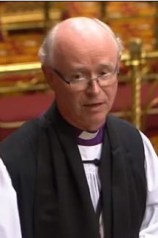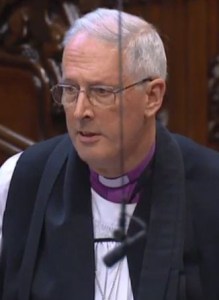
Bishop of Leeds says we must act on the views on young people, if we are to ask for them

On 20th June 2019 Lord Bird led a debate in the House of Lords on the motion “that this House takes note of the case for better protecting and representing the interests of future generations in policy-making.” The Bishop of Leeds, Rt Revd Nick Baines, spoke in the debate, and his speech is below. The speech of the Bishop of Oxford in the same debate can be seen here.

Continue reading “Bishop of Leeds says we must act on the views on young people, if we are to ask for them”

Bishop of Chester on the need to erase antisemitism

On 20th June the House of Lords debated a motion from Baroness Berridge, “that this House takes note of the incidence of anti-Semitism worldwide.” The Bishop of Chester, Rt Revd Peter Forster, spoke in the debate:

Christian complicity arose after the break between the Church and the Synagogue in the late first century of our era, and with the emergence of the view that the Christian Church had replaced the Jews as God’s chosen people. The properly New Testament view that Christians had been graciously grafted into Israel to share its promises and inheritance reasserted itself only in the 20th century, after nearly two millennia. This was partly the result of renewed biblical scholarship and partly due to the efforts of a small but distinguished group of continental Christian theologians led by Dietrich Bonhoeffer and Karl Barth, who saw the evil of Nazism.

Continue reading “Bishop of Chester on the need to erase antisemitism”

Bishop of Chelmsford calls for better regulation to protect online spaces

Chelmsford310119aOn 12th June 2019 the House of Lords debated a report from the Communications Committee, “That this House takes note of the Report from the Communications Committee Regulating in a digital world (2nd Report, HL Paper 299).” The Bishop of Chelmsford, Rt Revd Stephen Cottrell, who served on the Committee, spoke in the debate.

The Government have already committed themselves to making the United Kingdom the safest place in the world to be online. The ideas in this report explain that this does not necessarily require more regulation, but a different approach to regulation. It is not an exaggeration to say that this is one of the big moral challenges of our day. We need to get it right, especially for our children, for there are no longer two worlds, the online and offline, but the one digital environment that we all inhabit and that needs a set of principles to govern not just its oversight but its future development.

Bishop of Coventry on the place of theatre in upcoming Coventry City of Culture celebrations

Coventry171122 bOn 11th June 2019 the Earl of Glasgow led a short debate on the question to Government, “what assessment they have made of the operation of the theatre market in (1) London, and (2) elsewhere in the United Kingdom; and what steps they are taking to ensure that theatre is accessible to as wide an audience as possible.” The Bishop of Coventry, Rt Revd Dr Christopher John Cocksworth, asked a follow-up question:

The Lord Bishop of Coventry: My Lords, even though the Arts Council analysis of theatre in England reveals how the Midlands is underserved in theatre, I speak from a diocese that has international, national, regional and local treasures, and from a city that will be the UK’s City of Culture in 2021.

The million or so people of Coventry and Warwickshire are rich in creativity and are reaching out for the sort of accessibility that is the intention of the noble Earl, Lord Glasgow, whom I thank for securing this important debate and for his wide-ranging introductory speech. I am very glad to speak in this debate, not least because I am the only speaker in costume today—fittingly dressed.

Continue reading “Bishop of Coventry on the place of theatre in upcoming Coventry City of Culture celebrations”

Bishop of Leeds – heritage railways offer skills and volunteer opportunities for young people

On 6th June 2019 the House of Lords debated a Motion from Lord Faulkner of Worcester, “To ask Her Majesty’s Government what is their response to the report of the All-Party Parliamentary Group on Heritage Rail, Engaging the Next Generation: Young People and Heritage Railways.” The Bishop of Leeds, Rt Revd Nick Baines, spoke in the debate:

18.12.05 Leeds Brexit deal debate

The Lord Bishop of Leeds: My Lords, while congratulating the noble Lord, Lord Faulkner, on securing this debate, I must confess to some surprise at standing to speak in it. I have little knowledge or experience of heritage railways, despite having had such a beast going through the village where I was for eight years a vicar in Rothley in Leicestershire and now having several in the diocese of Leeds. I am not proud of my ignorance, but engineering never quite got me; I guess I was more of a media studies man. I fully accept that this probably makes me a rarity among clergy in the Church of England, but I do see the import of this report and fully endorse what this debate seeks to achieve.

Continue reading “Bishop of Leeds – heritage railways offer skills and volunteer opportunities for young people”

Bishop of Salisbury calls for substantial determined and transformative response to climate challenges

On 5th June 2019 Lord Cameron of Dillington led a debate on a motion “to ask Her Majesty’s Government what plans they have to (1) harness the potential of tidal ranges to generate renewable energy, and (2) encourage the private sector to invest in this area.” The Lord Bishop of Salisbury, Rt Revd Nicholas Holtam, spoke in the debate:

Salisbury231018b

The Lord Bishop of Salisbury: My Lords, this debate has already become something of a no-brainer. Quite a lot of what I wanted to say has been said, so there is no point in repeating it, but I want to thank the noble Lord, Lord Cameron, for asking the Question which has generated the debate.

The context is one in which we see a climate emergency, an increasing number of councils across the country responding to it and the other place in Parliament recognising that. Whatever we think of Extinction Rebellion, it has raised the public profile and urgency of the climate change debate and the environmental awareness of what is required of us as legislators. It cannot be business as usual.

Continue reading “Bishop of Salisbury calls for substantial determined and transformative response to climate challenges”

Bishop of Winchester on importance of education, religion and voluntary agencies in UK foreign policy

On 21st May 2019 the House of Lords debated a Motion from Lord Howell of Guildford ,”That this House takes note of the Report from the International Relations Committee UK foreign policy in a shifting world order (5th Report, HL Paper 250).” The Bishop of Winchester, Rt Revd Tim Dakin, spoke in the debate:

Continue reading “Bishop of Winchester on importance of education, religion and voluntary agencies in UK foreign policy”

Bishop of Portsmouth – we must not let Brexit dilute our moral purpose

On 15th May 2019, the House of Lords debated a motion from Lord Horam, “That this House takes note of the Report from the European Union Committee Brexit: Common Security and Defence Policy missions and operations (16th Report, HL Paper 132).” The Bishop of Portsmouth, Rt Revd Christopher Foster, spoke in the debate: 

19.04.02 Portsmouthb

The Lord Bishop of Portsmouth:  My Lords, the noble Lord, Lord Dannatt, has just reminded us that none of us participating in this debate can forget that we will shortly mark the 75th anniversary of what must surely be the most defining day in Europe in living memory: D-day. That has special significance for the city of Portsmouth, and indeed the whole diocese I serve. As a result, we will have the pleasure—I think—of welcoming the President of the United States into our midst as part of the commemorations.

Continue reading “Bishop of Portsmouth – we must not let Brexit dilute our moral purpose”

Bishop of Leeds calls for leadership by example to counter ‘toxic public debate’

On 9th May 2019 the House of Lords debated a motion from Lord Harris of Haringey, “to move that this House regrets the conduct, and toxicity, of debate in public life; of the divisions in society which result from that; and calls on Her Majesty’s Government to take steps to address such divisions.” The Bishop of Leeds spoke in the debate and a transcript is below. The Bishop of Rochester also spoke in the debate and his speech can be read here:

The Lord Bishop of Leeds: My Lords, I am grateful to the noble Lord, Lord Harris, for securing this debate and for the clarity of his and other speeches. I say to the noble Lord, Lord Patten, that if such a cast were assembled, some of the people who need to be there simply would not turn up. If they did, they would see it as their job to disrupt it, so I suspect it will be more complex.

We still admire Benjamin Disraeli for telling Parliament that half the Cabinet were asses and, on being ordered to withdraw the comment, responding, “Mr Speaker, I withdraw. Half the cabinet are not asses”. Political invective is not new and it must have a place in a free society, but words matter. I speak as a former professional linguist. Language is never neutral, and the ad hominem abuse we increasingly witness now simply encourages wider public expression of violent hatred. It is incrementally corrosive.

If the conduct of debate in public life has become toxic, it is only because it has been in the interests of some people to allow it to be so. I have already spoken in this House of the corruption of the public discourse and the consequences of normalising lying and misrepresentation. I add that reducing people to categories might reinforce tribal identity, but it demonises and dehumanises everyone else. As Viktor Klemperer recognised from 1930s Germany, a million repetitions of single words, idioms, and sentence structures or slanders become unconsciously assumed to be normal. Think of Rwanda and “cockroaches”.

Continue reading “Bishop of Leeds calls for leadership by example to counter ‘toxic public debate’”

Bishop of Rochester – national conversation with unifying narrative needed to overcome toxic public debate

On 9th May 2019 the House of Lords debated a motion from Lord Harris of Haringey, “to move that this House regrets the conduct, and toxicity, of debate in public life; of the divisions in society which result from that; and calls on Her Majesty’s Government to take steps to address such divisions.” The Bishop of Rochester spoke in the debate and a transcript is below. The Bishop of Leeds also spoke in the debate and his speech can be read here:

The Lord Bishop of Rochester: My Lords, I join other noble Lords in thanking the noble Lord, Lord Harris, for bringing forward this debate and for his characteristically robust, thoughtful, clear and evidenced introduction. I also thank other noble Lords for their contributions. I look forward to reading in the Official Report what the noble Lord, Lord Parekh, has just said, because there is a lot to reflect on.

Others have spoken from these Benches in recent months on this and related matters, referencing a number of scenarios which have given rise to language and expression that cause hurt and offence and do no credit to our public life. The right reverend Prelate the Bishop of Leeds will, I understand, speak later in this debate about the power and importance of language in our public discourse. My contribution, which I hope will be brief, is to raise a question about one part of the context in which such harmful, toxic, destructive and even violent expression may come to flourish.

The phrase attributed to Aristotle about nature abhorring a vacuum has many applications. I suggest that one of the reasons for this flourishing of destructive and harmful conduct and debate may be that these things are rushing in to fill a vacuum.